
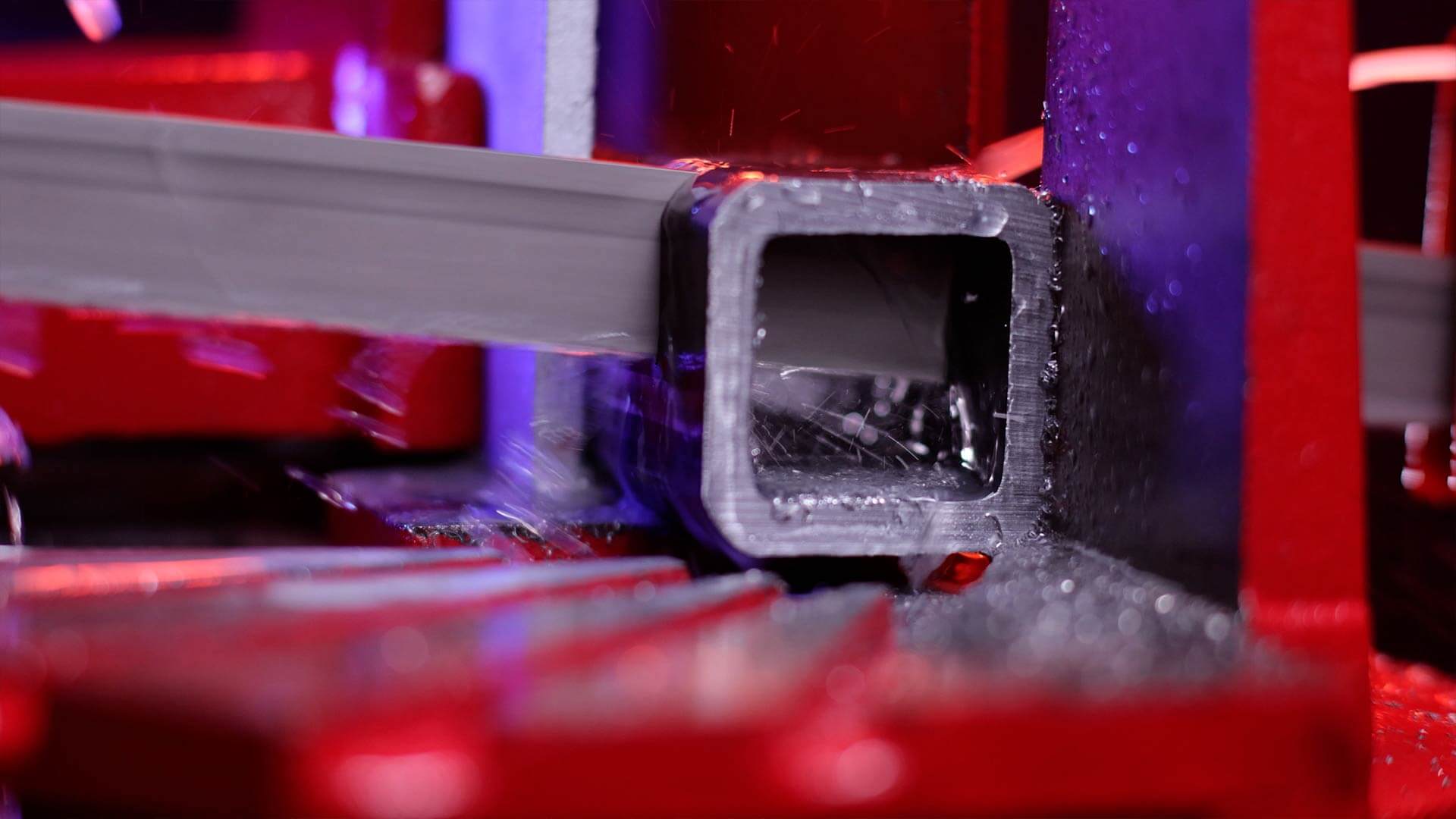
Fabricators that cater to more routine materials and shapes likely have their sawing process down to a science – they know their applications well, have a supply of trusty saw blades, and the saw’s optimal speed and feed rates for the material are second nature. But when tubes, pipes and bundles enter into the equation, a host of new problems can arise.

From thin- to thick-walled tubes and pipes, there can be several issues such as clamping, burrs, limited penetration causing the blade to bounce, premature tooth wear and full-on destruction of blades. When bundling tubes or pipes (or both), slippage may occur due to improper clamping. To reduce the risk of poor cut quality, adding to the scrap pile and missing production deadlines, shops should follow tried-and-true best practices, including using the best saw blade for the job.
The teeth of it
Unfamiliar with thin-walled material? Those who are new to it may encounter headaches whether they’re cutting one tube or pipe at a time or a bundle. The first order of business is getting a good tooth match, which will prevent the teeth from slapping up against or hitting the material and also stop chips from sliding into the gullet where they can cause blade wear and inconsistent cuts. The best-case-scenario is one where the blade is taking a piece of the material. Pro tip: with thin-walled tubes or pipes, saw operators need a minimum of three teeth in the material at all times.
In thinner walled applications, a blade with a finer tooth pitch is typically the best choice. Blades with a heavier tooth back and more tooth set provide better strength and higher shock resistance. This provides longer blade life when the teeth are constantly going in and out of the material, traversing across thick and thin sections.
Also, blades for thinner walled tubes or pipes usually have a wider tooth set for producing a larger kerf. This minimizes stresses in the material that tend to pinch the blades. In many cases, a wider tooth set can eliminate pinching altogether.
Through thick and thin
Another issue is the challenge of cutting larger thin-walled tubes or pipes, such as an 8-in. round, when the material is only 1/8 in. or 1/16 in. gauge. Operators need to double check that their clamping pressure is not set too high. When thin-walled material is clamped incorrectly and the material is compressed, the cut is going to be crooked, even if the material looked fine while being cut.
Thick-walled tubes or pipes are a little easier to deal with because the risk of compressing is reduced. Furthermore, it’s easier to match with the right tooth pitch on thicker walled material, as there are more options than what operators see with thinner walls. It’s recommended to look for a blade designed specifically for interrupted cuts, such as one that offers a heavier tooth back and can take abuse as it goes repeatedly in and out of the material.

Noise is also a consideration, as using the right blade can solve noise issues related to cutting thicker walled material. Fabricating shops cutting these types of materials encounter the familiar “screaming” noises, which is a big complaint among saw operators. Fortunately, Starrett has a solution for this.
For example, with the new Starrett Tennax-Pro bi-metal bandsaw blade line that features a variable tooth set, significant reductions in noise and vibration are achieved, providing smoother, quieter cuts, specifically when cutting tubes, pipes and structural shapes.
The quieter cutting perk is certainly welcome. Also, the Tennax-Pro blade, which is made with high-speed M-42 steel teeth in special geometry and profile, outperforms competitive blades, making up to 25 percent more cuts per blade. And it’s also made for structural cuts, dissipating stress during cutting for improved resistance to wear and tooth breakage. The wide tooth set also minimizes pinching when cutting structural and bundled material.
When cutting bundles, the cross sections obviously increase from one to multiple pieces, so again blade selection and tooth set are very important. For example, if the material is a simple 4-in. square pipe with a 1/4-in.-thick wall, depending on desired results, a 4/6, 5/8 or even 6/10 tooth-pitch blade will work well.
With bundling, based on the size of the bundle, the cross section that needs to be cut changes. For example, using the 4-in. square pipe in a bundle of four pieces side by side and four pieces high, it is now similar to cutting a 16-in. solid, depending on the angle of the head each time it travels through the tops or sides of the pipes. In addition, the 1/4-in.-thick wall has in effect become a 1/2-in.-thick wall. Both 6/10 and 5/8 tooth-pitch blades are now much too fine to cut the material efficiently. So, moving to a 4/6 or even a 3/4 tooth-pitch blade would offer better cutting rates in this scenario.
Bundle blunders
Two of the biggest issues when cutting round tube or pipe bundles are spinning and vibration. A common occurrence is that a few tubes in the middle of the bundle begin vibrating, which causes some deleterious effects to the blade; it will literally chew up the teeth, so precautions must be taken.
Clamping is an issue every time a bundle is cut. Most of the bandsaws designed for bundles have nesting clamps, so the clamping is along the sides, as well as on the top. If the bundle is odd shaped, that’s where nesting clamps really come into play, preventing the bundle from moving. If a bundle moves during the cutting operation, the blade will be destroyed.
One of the best practices in cutting bundles is to establish proper blade speeds, which requires being completely familiar with the material being cut because there is no benefit to making a “best guess.” The disadvantage of cutting tubes or pipes is that chips can’t be read the way they can with a solid. This means making adjustments isn’t as easy and the operator is probably going to get more inconsistent chips (thicker or powdery) as opposed to clean chips (thin and curly), depending on the material. The operator is likely to face reduced blade life instead of achieving smooth cuts and extended blade longevity.
Tubes and pipes are also more difficult because the blade is constantly going in and out of the material, and if the operator’s knowledge of the material is limited, the bad results will show up very fast. If the material is similar to what they are accustomed to cutting, they can at least get started and then make small adjustments. The blade will quickly reveal if they are wrong because they will hear the teeth hitting the material instead of cutting it.
Operators should listen for a slapping or banging type sound. It shouldn’t sound like the machine or the blade is coming apart. It shouldn’t be screaming so loudly that everything is shaking, and the blade is vibrating.
The other problem is that tubes or pipes aren’t always straight. There are times when the material comes off the truck and is hastily thrown into the inventory, which can sometimes damage the product. The most common issue involves crooked pipes. When the machine shuttles and feeds the material automatically into the blade, pipes can jam the machine.
Crooked pipes could also cause length issues – when it’s cut it, it won’t be the right length. The material should be straight up against the fixed vice, which is 90 degrees to the blade, and this ensures a nice straight cut. If the pipe is bent or compressed or wasn’t clamped correctly, the blade is still coming down straight, but the material is coming in crooked, which will result in crooked cuts.
Rust reckoning
Tubes and pipes exposed to the elements (moisture) can oxidize, leading to layer of rust. In general, rust isn’t a huge issue, but when the buildup is excessive, the abrasive nature of the rust, as well as its tendency to cause blade deflection and inconsistent cutting, can lead to a 5 to 10 percent decrease in blade life. To avoid this added wear and tear, reducing the speed and feed rates is highly recommended.
To prevent oxidation while the material is waiting in storage, fabricators apply a layer of oil. While this may be viewed as a good preventative approach, one issue rarely considered is what happens as the material is being cut when the old oil mixes with the machine’s coolant. As the material is being cut, the anti-oxidation oil makes its way into the coolant tank. Eventually, the coolant tank will become partially filled with the oil.
This scenario will kill blade life too, because the oil doesn’t double as a coolant and will compromise the machine’s ability to keep material cool while being cut. While pipes might have been cut with no problem for 6 months or a year, then suddenly there is a problem. Keeping tabs on the coolant change schedule will help prevent this from becoming a recurring issue.


