Until June 2023, James and Patricia Beedle and Josh Austin were working for a mechanical contractor with unstable management. Confident in their skills and that a focus on treating people and customers right would pay off, the three of them and five other employees left to start B&H Industrial (BHI), a 24-hour emergency maintenance, custom fabrication and fully licensed mechanical contracting company that handles everything for everyone – from small shops to giant corporations.
In 2025, BHI merged with the Rigid Industrial Group to become Rigid Fabrication, a supplier of end-to-end fabrication and emergency services to support industrial operations. While this tale has a happy ending, the two years from startup to merger were a wild ride, and it began with acquiring the tools of the trade and pinching pennies.
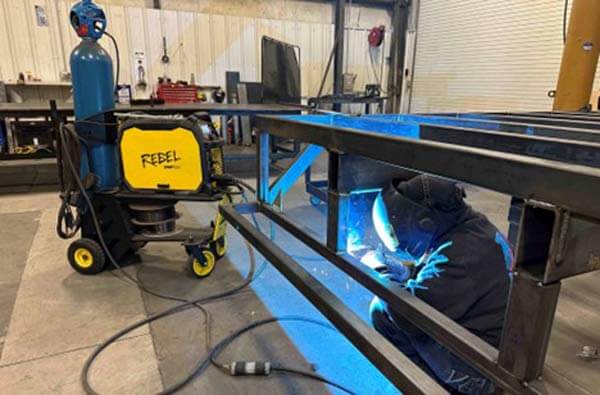
“When we were starting our own shop, we needed quite a few welders to open our doors,” says James, BHI owner. “We needed something we knew we could count on that would give us the most bang for our buck as well as be able to punch above its weight as we took advantage of new opportunities.
“After doing all the research, I decided on a combination of welders that would provide the best value and enable us to successfully bid on a broad variety of work,” he adds.
To start, the company chose two core types of equipment:
- Five multi-process MIG/stick/TIG welders with 285-amp output at 40 percent duty cycle that would deliver process versatility and the power to weld thicker material with larger diameter electrodes.
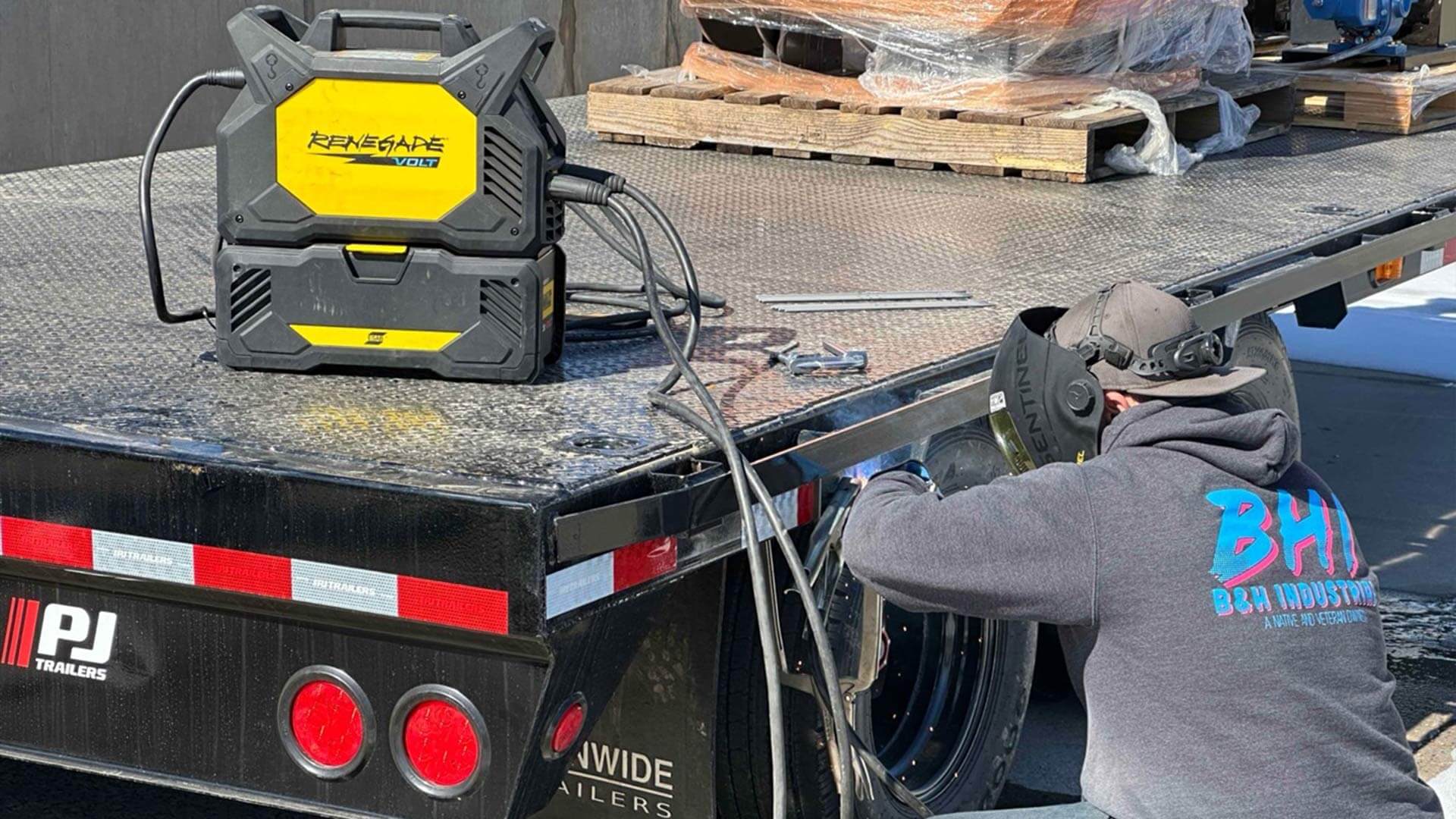
- Two lightweight (22-lb.) 180-amp stick/TIG inverters for field fabrication that would be easy to transport and offer a reliable and easy-to-use design.
BHI’s equipment investment paid off. The tight-knit crew of skilled fabricators and employees soon grew from eight people to 24. The number of customers grew, too, including household names in pet and human food manufacturing, global distribution, fire and rescue equipment, fracking equipment maintenance and basically every type of manufacturing facility out there. The team also began working closely with area trade schools to support welding education.
“We started with seven machines in June of 2023, which have been kicking ass ever since,” James says. “Since then, we’ve grown our fleet. We added true multi-process machines with a CC/CV, AC/DC output for TIG welding aluminum, battery-powered welders for off-the-grid welding, and 70-amp manual plasma cutters for shop and field work.”
“We came from a situation that wasn’t the best, but like a phoenix, we rose from the ashes, and we continue to grow,” says Patricia, BHI’s safety director.
Multi-tasking
Austin, one of the founding members of BHI and current supervisor, says money was tight in the beginning. “We were really starting with nothing.”
With five people performing fabrication work in the shop during start-up, James wanted welding equipment that he could fully leverage across the entire fabrication team.
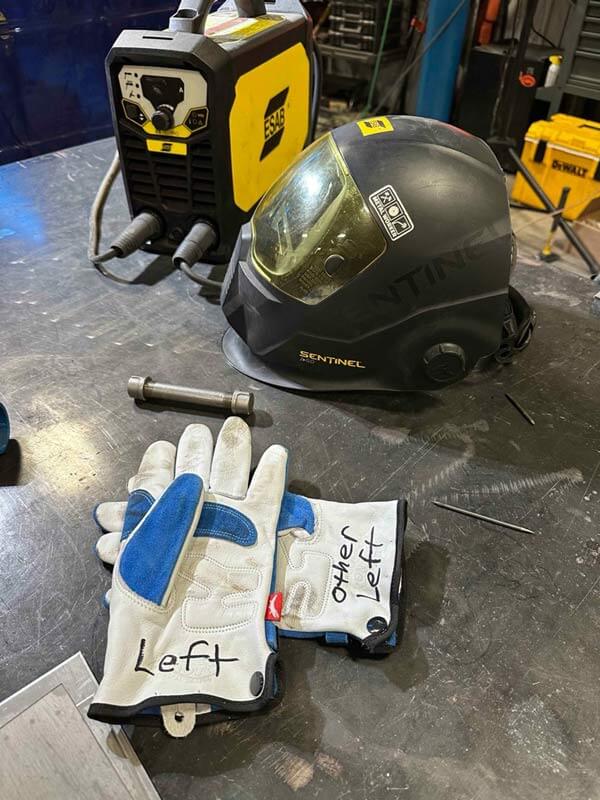
“We needed one welder that could do everything pretty darn well,” James adds. “We went with a multi-process unit so we could stick, MIG and lift-TIG with just one welder. We bought five of those, which were reasonably priced.”
Welding machines in this category have a rated output of 285-amp at 40 percent duty cycle and can run the full range of 0.030-in. to 0.045-in. wires in short arc and spray transfer modes, offering a combination of precision and productivity. The single-phase version BHI uses can connect to 120-V and 230-V power for better location flexibility. Such systems with an optional cart have a current retail value that starts around $4,500.
“We couldn’t get into anything else for the price, let alone buy three different welders for MIG, stick and TIG,” Austin says.
All in one
For field work, BHI started with two stick/TIG inverters with dual-voltage input. As the team’s mechanical contracting client base and fabrication team has grown, the number of welding power sources increased to more than a dozen.
“We may have 120-V power, we may have 230-V power – we don’t know what we’re going to get,” James says. “The dual-voltage machines give us everything we need.”
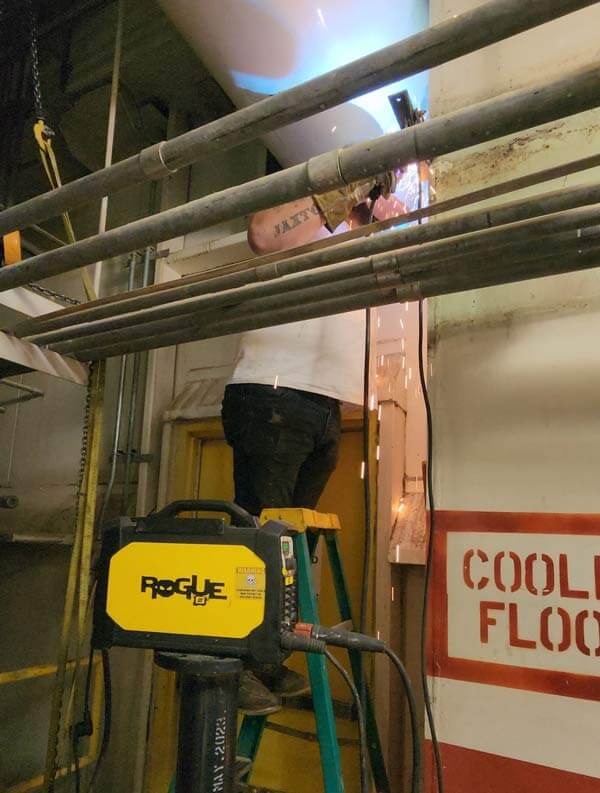
Professional machines in this category can cost less than $1,000. James notes they are simple to use and durable.
“I like to call it an easy-to-use welder,” he says. “You can turn it on, set it to stick or TIG and go. You beat them up in the field, and they’ll still turn on.”
On 230-V input, welders in this category deliver an output of around 200 amps at 25 percent duty cycle for welding with electrodes up to 1/8-in. On 120-V input, the top output is around 90 amps at 25 percent duty cycle, which is good for welding with 1/16-in. and 3/32-in. electrodes. When evaluating these welders, it’s better to opt for one that has settings that optimize performance with all types of electrodes, including 7018s and 6010s. The next generation of welders in this category also has a pulsed stick output, which can reduce heat input to minimize distortion and reduce spatter.
“These inverters are flawless little units,” Austin says. “For field work, we can use them on a conversion rig or TIG rig, which is where you hook your stick electrode holder to a TIG torch with a manual gas control valve and the gas line is connected directly to a small cylinder. That’s convenient out in the field because I can be 30 ft. away from my machine – which is good because we’re in weird positions inside a plant.”
All-process welder
When the opportunity arose to fabricate brush and wildland trucks for a fire equipment company, BHI needed to add aluminum capabilities.
“For MIG welding aluminum, we use spool guns,” James says. “When I was doing research on how I was going to weld aluminum and get the most bang for my buck, I realized I could get five spool guns for the price of one push-pull system.”
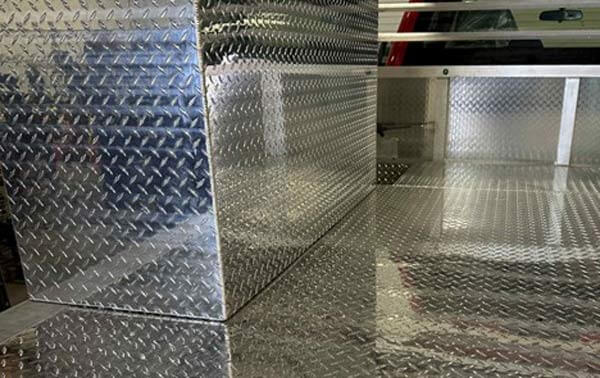
“If you’re getting into fabrication and want one welder that can do everything, a multi-process welder with an AC/DC output is the way to go,” Austin adds. “For business out of your shop, home projects or side gigs, it’s great because you can TIG weld stainless and aluminum, you can MIG weld steel and you can stick weld with it. You throw a little generator in the back of the truck, go out and start working. It’s a killer machine.”
For TIG welding aluminum, the team at BHI says to look for a welder with an AC output and high-frequency (HF) arc start capabilities, both of which are required. Also, be sure the machine has essential controls for AC TIG welding, such as an adjustable AC output frequency (up to 400 Hz), adjustable AC wave balance control (up to 90 percent EN) and amplitude offset to further fine-tune penetration and cleaning action. Finally, a pulsed TIG output (typically adjustable from 0.1 to 500 Hz) helps when welding sheet metal, stainless steel and other applications where operators want more tools to reduce heat input and control the bead profile.
A total life saver
Even though small portable inverters work well, they still require a primary power connection. In some instances, this can mean stringing hundreds of feet of cable to reach an outlet inside a facility or a welding generator located outside the facility.
“We had this huge shutdown going on at a warehouse facility with limited access to power,” Patricia says. “I didn’t want cord strung all over the place because it’s a tripping hazard. The facility is humongous, and even when it was shut down, there were maintenance crews plus all sorts of vendors doing different jobs, which created a lot of foot traffic. Also, the facility requires us to follow Avetta risk management practices, so we wanted to keep our work area clean.”
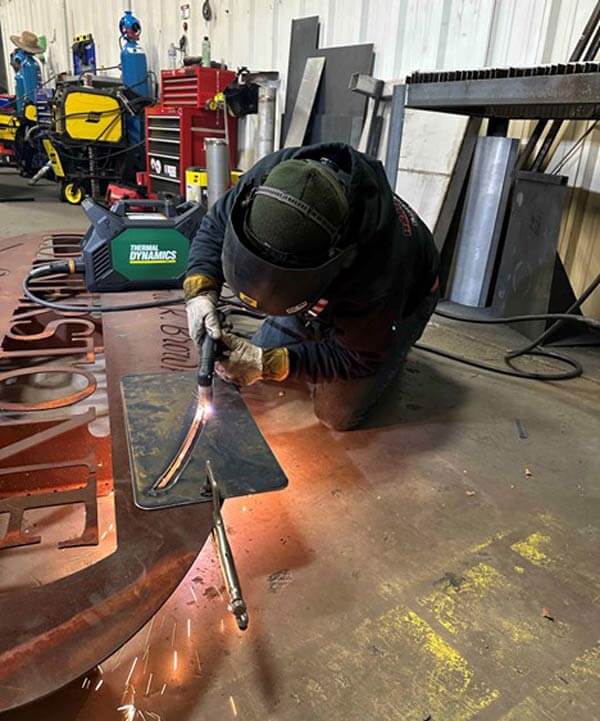
Long extension cords can also lead to voltage drops that trip circuit breakers, which takes time to address. On this 12-hour shutdown with a hard deadline, delays were not an option. To solve the problem, BHI purchased two battery welders, each providing up to 140 amps of welding power running from four 12-Ah DeWalt Flexvolt batteries. The units can also connect to 120-V and 230-V primary power.
“We could use the limited amount of plugs they had for the battery charger,” Patricia says. “We just plugged in, charged the batteries and took the battery welder where we needed it. We went to 19 different locations in the facility and finished with time to spare. It literally shaved time off the job.”
“I thought, ‘this is the only thing I’m going to be able to use because I can run on pure battery,’” Austin adds. “I never strung a single cord.”
Additional jobs using the highly portable battery welder have also demonstrated a competitive advantage for BHI. For inaccessible areas that are hundreds of feet in the air or when power is far away, BHI operators can just carry the welder.
The right tool
In the business of mechanical contracting, operational efficiency is critical, especially when you’re starting a business. Getting the most bang for your buck means choosing the right tool for the job, which is never consistent. As Austin says, “It’s a different adventure every day.”
“The way BHI shapes the world is that we’re a small company that’s involved in your dog food, your hot dogs, your bologna, your corn dogs, your tahini and almost every package that comes to your house as well as all the fire trucks in a seven-state region,” James says.
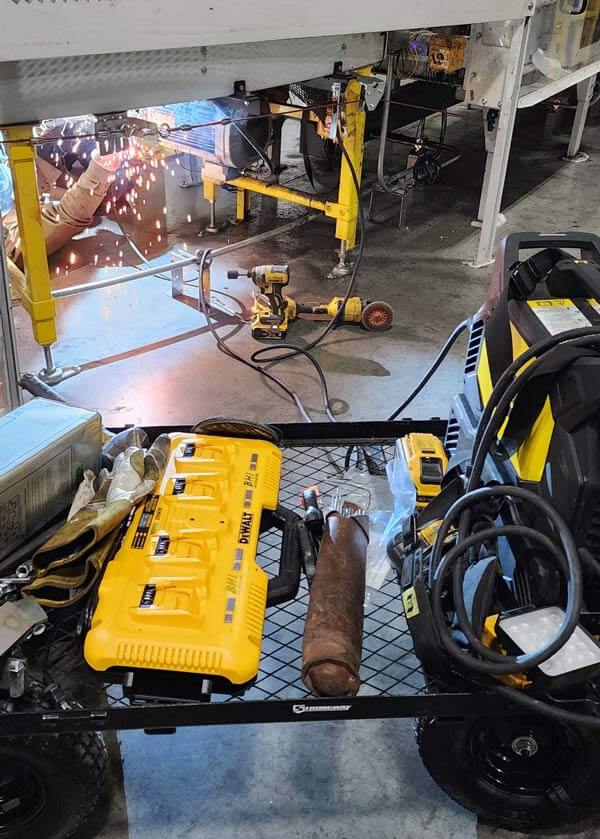
Whether it involves plasma cutting or MIG, TIG or stick welding, in the field or in a warehouse, at a mom-and-pop shop or worldwide distribution facility, for manufacturing food or building fire trucks, BHI chooses its equipment for the long haul.
“If you’re looking to start a fab shop or repair business and you need to save money and get reliable equipment, you need a good welding partner,” James concludes. “You also need good relationships with vendors when starting a business, and our local welding distributor has been key to our expansion. They’ve been very reliable for everything that we need for parts and service.”
Cutting capacity
As a new company, B&H Industrial would, of course, need more than just welding equipment. In fact, the company recently acquired a manual plasma cutter after winning a project that required cutting 500 ft. of stainless steel angle.
“With a 70-amp machine, we smoked through 1/2-in. stainless,” owner James Beedle says. “It’s powerful and cuts really nicely.”
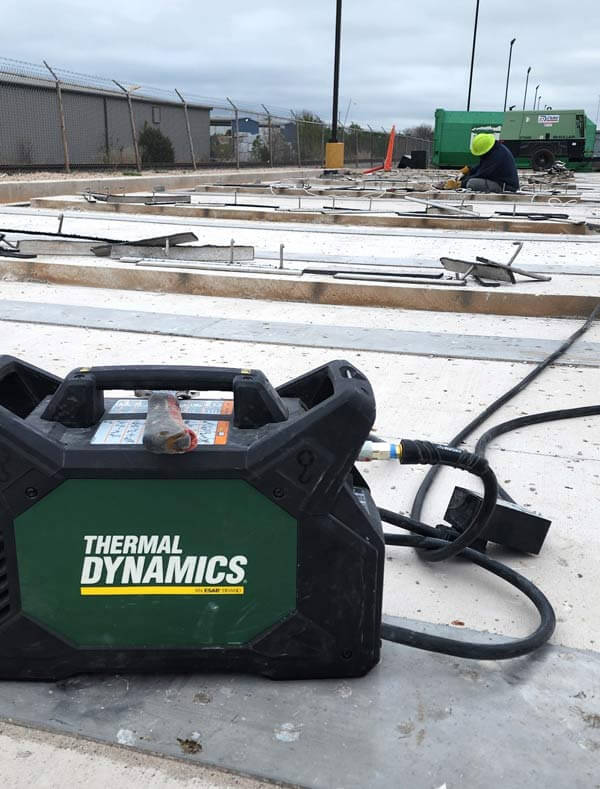
The 70-amp machine has a pierce capacity of 3/4 in. (20 mm), cutting capacity of 1 1/8 in. (30 mm) and maximum severance of 1 1/2 in. (38 mm). It also weighs less than 40 lbs. so it can be easily moved between the shop and the field.