If you could boost welding speed from 15 ipm to 30 ipm or boost arc-on time from 15 percent to 30 percent, why wouldn’t you? Positioned between manual welding and full industrial automation, mechanized tractor systems offer a compelling argument for faster implementation, lower capital expenditure, reduced risk and little to no need to add floorspace, especially because you can bring the tractor to the work instead of the work to a robot, which requires guarding.
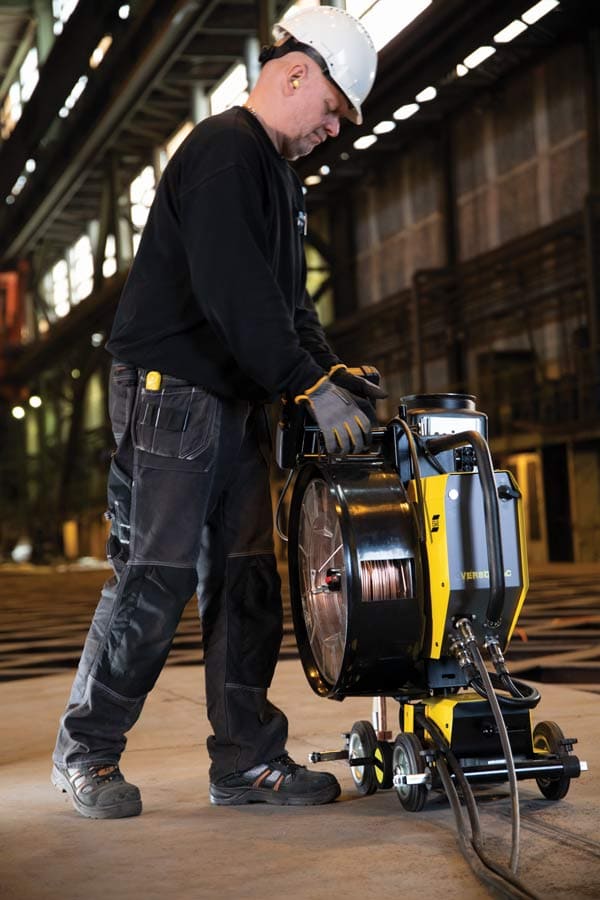
Welding tractors remain an underutilized solution by fabricators and manufacturers, yet they offer practical and immediate productivity gains. In the face of tighter delivery windows, persistent labor shortages, and the need to improve weld quality and control costs, anyone welding long seams – and not so long seams – should consider tractors.
Get the bug
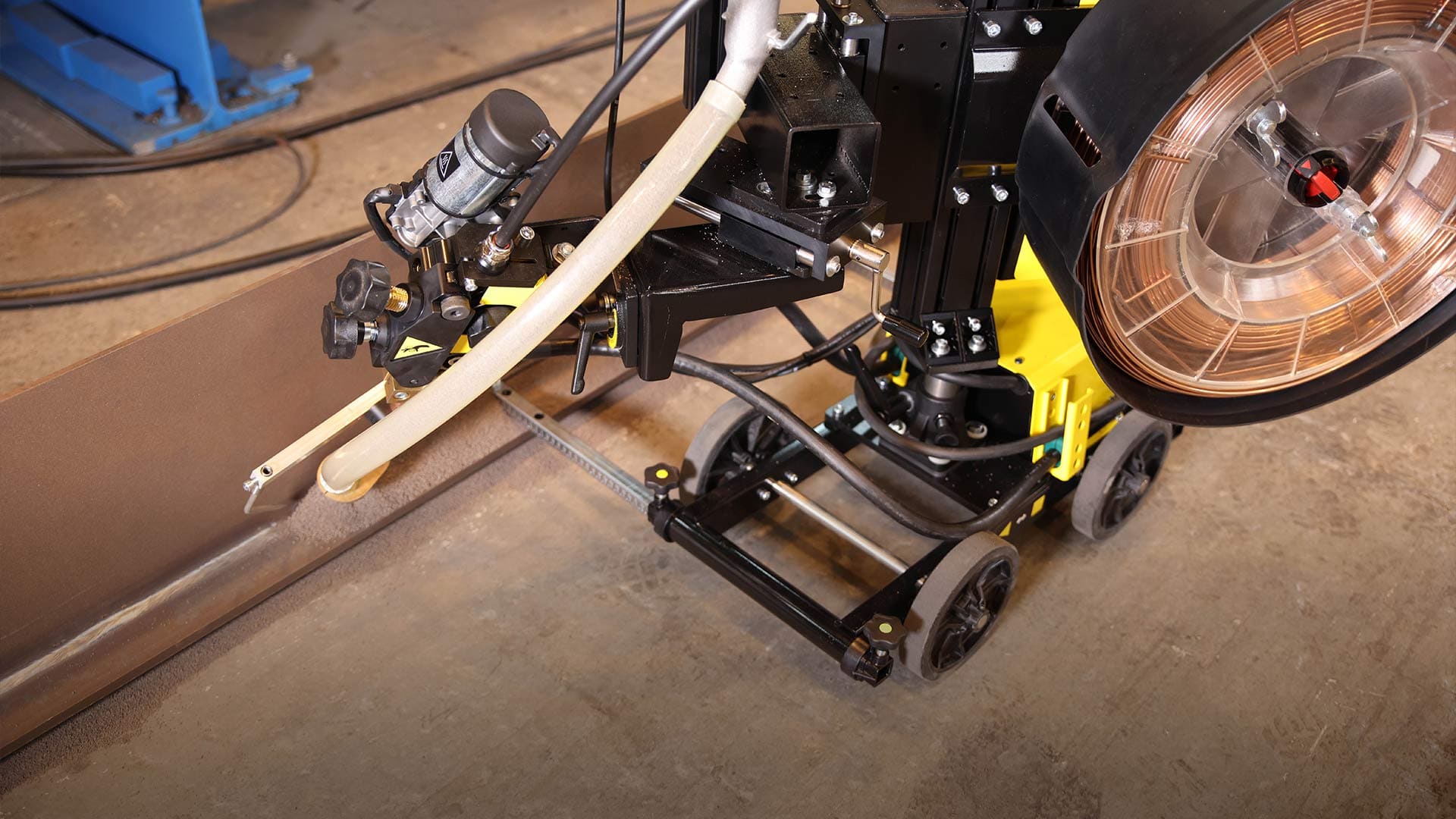
Mechanized welding tractors, sometimes called a welding bugs, guide the welding or cutting torch along the path. They are “pick up and place” welding systems where the operator sets them on a seam, sets the weld parameters, sets the tractor travel speed and starts/stops the arc. There are three basic types of tractors:
- Compact welding carriages that move on four wheels
- Rail/track-mounted carriages (which also include bands for pipe) that use a rack-and-pinion drive mechanism for all-position welding
- Heavy-duty wheeled systems for work in the flat position, typically used for submerged arc welding, MIG welding and carbon arc gouging
Welding tractors are powered either through a 42V connection to the welding power source or standard 18V power tool batteries. Operating time for the carriage battery is between 10 and 20 hours, enabling the tractor to run for an entire shift before needing to be swapped out.
Welding tractors can work with any brand of power source to offer basic functions; operators set weld parameters at the machine and then set travel speed at the tractor. Integrated systems offer more programming capabilities, including being able to set parameters at the tractor.
Newer tractors enable operators to save up to 30 jobs and store variables such as welding speed and length, delays, repetitions, stitch welding, back-step welding, standard weaving patterns, customized weave dwell times, width and a special multi-axis weaving function that combines horizontal and vertical weaving enables weaving at any specified angle.
For more versatility, some tractors feature a magnetic base with enough magnetic force to operate in all welding positions, including vertical up and down, overhead and on inside and outside diameters. New tracking software can adjust the tractor’s trajectory based on torch position, eliminating the need for rails and minimizing setup time.
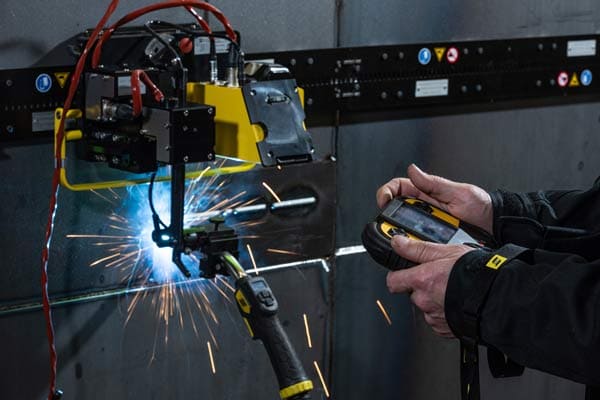
An optional remote control lets operators adjust direction while the tractor is moving, much like a remote-controlled car.
Portable tractors for submerged arc welding are common for heavy plate and beam fabrication, with options available for single-wire, tandem/twin-wire and advanced processes for unsurpassed control over heat input and deposition rates.
Operator buy-in
Where an industrial robot can create fear on the shop floor, mechanized tractors make it easier to gain operator buy-in because they require an operator to run them. For an older operator with aging knees and an aching back, the tractor alleviates time spent in awkward positions over long welds, reducing strain and fatigue.
Additionally, increased distance from the arc helps limit exposure to weld fumes, UV radiation and heat. These improvements not only enhance operator well-being but can attract new workers and support retention in a trade where experienced labor is increasingly difficult to replace.
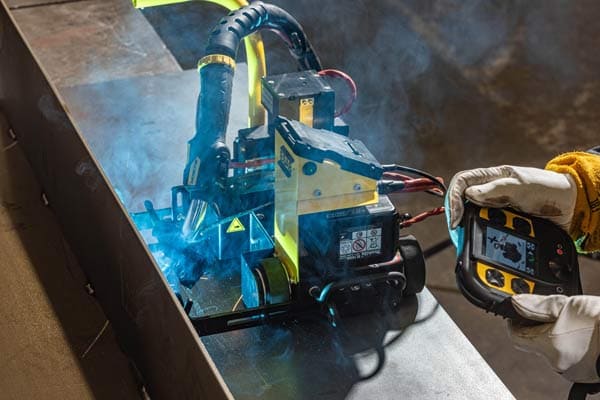
The most successful implementations of mechanization often begin with a single weld seam or a repetitive subassembly. Straight welds, long seams, welds with predictable and repeatable quality, and welds that are frequently viewed as mundane by operators are ideal candidates for mechanization.
Starting with the easiest welds frees the skilled welders to focus on more complex, value-added projects. This targeted approach minimizes risk, simplifies training and creates a clear framework for measuring a return on investment.
Low risk, high gains
The most immediate benefit of mechanized welding tractors is a significant increase in deposition rates and travel speeds. Manual welding operations typically achieve deposition rates in the range of approximately 5.5 lbs. to 7.5 lbs. per hour. By contrast, mechanized systems can more than double that output, reaching well into the double-digit range depending on the application.
For travel speeds, manual MIG welding often progresses at roughly 15 ipm to 20 ipm, whereas mechanized tractors can operate at speeds several times higher. This acceleration not only reduces cycle times but also enables higher heat input processes and larger wire diameters, which can further boost productivity.
Tractors also reduce non-productive time. Continuous welding eliminates frequent starts and stops, which are common sources of defects such as porosity and lack of fusion.
The result is fewer repairs, less rework and more consistent weld quality. Also, tractors can provide all the weld consistency and quality benefits of automation, including parameter changes that can occur during manual welding operations and shift changes, without the complexity of robotic programming.
Building scalability
Mechanized welding tractors are not just a standalone solution; they are often the first step in a broader automation roadmap. By introducing mechanization in a controlled, incremental way, fabricators can build internal expertise, validate process improvements and establish performance benchmarks.
Key considerations for implementation include:
- Selecting the right initial application based on repeatability and impact
- Establishing baseline metrics for comparison
- Collaborating with equipment providers to optimize parameters
- Ensuring consistent fit-up and fixturing to support repeatable results
This structured approach allows organizations to scale their automation efforts quickly and confidently, whether that leads to expanded mechanization, submerged arc gantry systems or cobot/robot welding in the future.
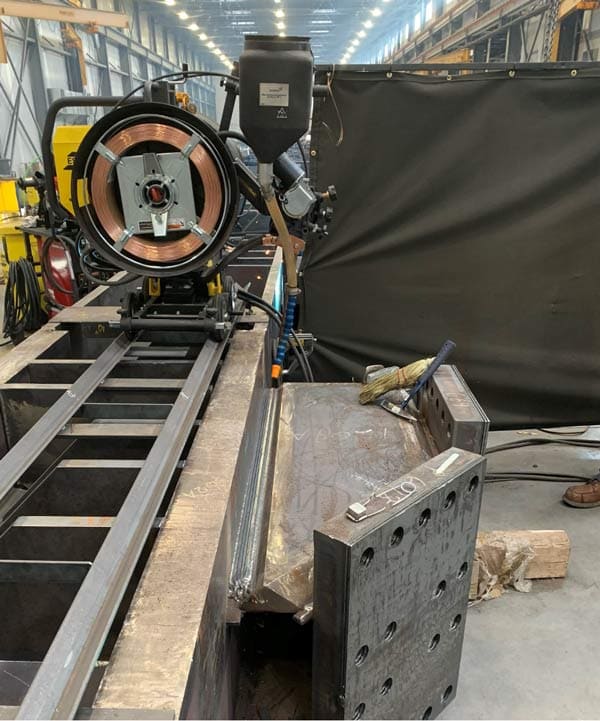
As fabrication demands evolve, relying solely on manual welding processes is becoming increasingly difficult. Mechanized welding tractors offer a practical path forward and can deliver measurable improvements in productivity, quality and operator safety without the capital expenditure, risk and workflow barriers that are typically associated with automation.
For companies seeking to increase throughput, shorten lead times and better utilize their workforce, the message is clear: Meaningful gains do not always require a giant leap. Sometimes, they begin with a steady, controlled move forward – one weld at a time.
If you’re looking for more information about welding tractors or the latest technology advancing the welding industry, check out our extensive welding archive.
Five reasons fabricators should consider mechanized welding
Productivity: Welding tractors increase travel speeds and deposition rates compared to manual welding. They move faster, don’t need to stop for repositioning and enable welding with higher parameters and larger diameter wires.
Consistency: By making continuous welds, tractors reduce rework associated with start/stop defects. In applications where a uniform weld bead profile and penetration is expected, tractors deliver consistency without the cost or complexity of automation.
Flexibility: With compact, lightweight portability or easy disassembly, tractors are ready to go to where the work is located.
Ergonomics: Tractors reduce operator stress by reducing fume and UV radiation exposure, as well as minimize welding in uncomfortable positions.
Job creation: Automation creates more employment opportunities by expanding the operator pool and enabling fabricators to bid competitively on more jobs.