
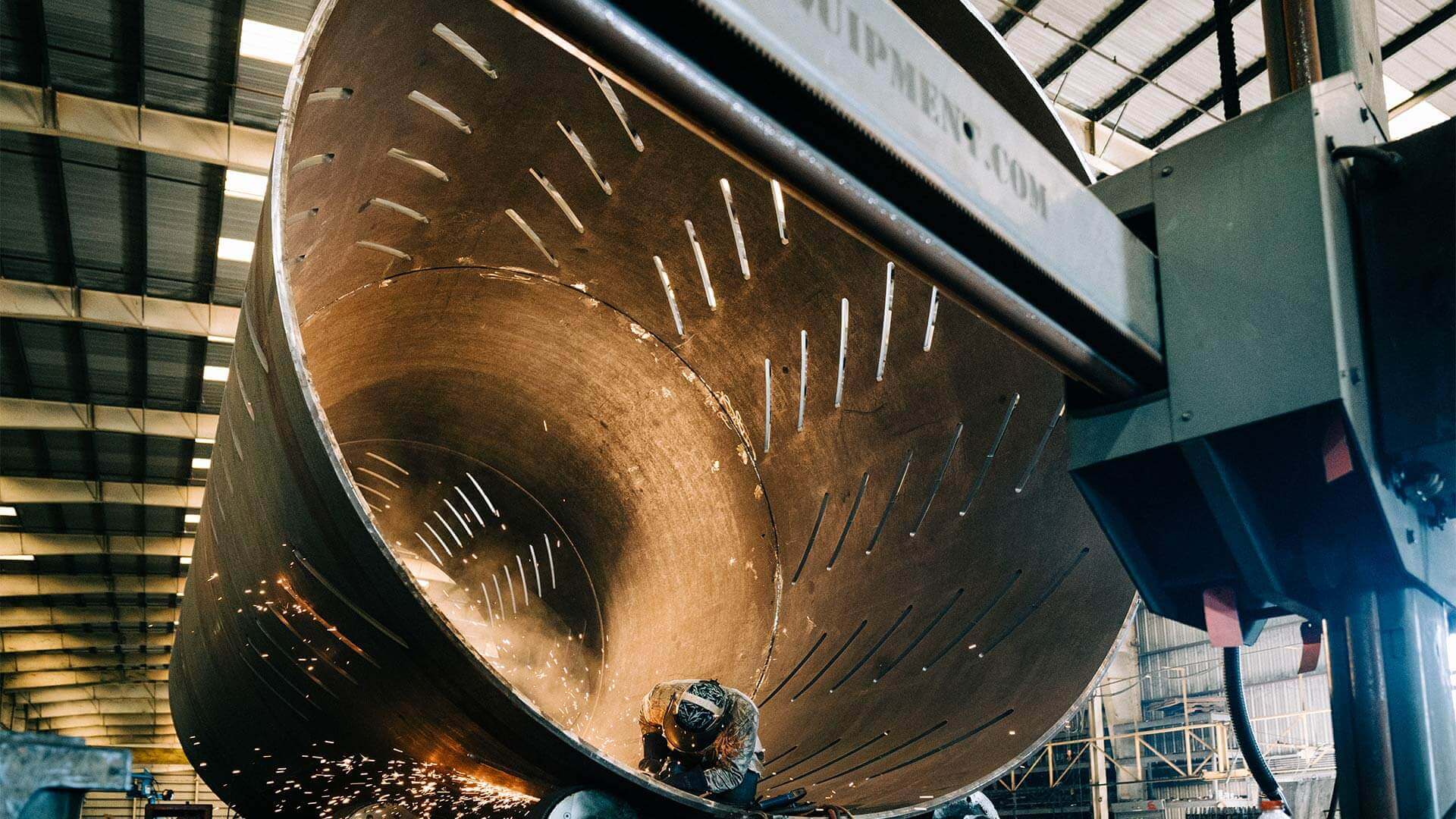
When asked what his shop makes, Tim Maneval, vice president of operations at Hammer Haag Steel, replies with a “yes,” indicating the custom structural steel fabrication facility basically makes anything. He says if a customer can design it, nine times out of 10, the shop can make it.
That can-do mindset originated with the beginning of the Clearwater, Fla., shop more than 15 years ago. That is when Hammer Haag Steel opened its doors as a support fabricator for the robotic parking garage industry. Unfortunately, that type of work was too sporadic to support the growing shop, so it started sourcing other types of work, like huge steel fabricated structures for customers producing large-format cranes.
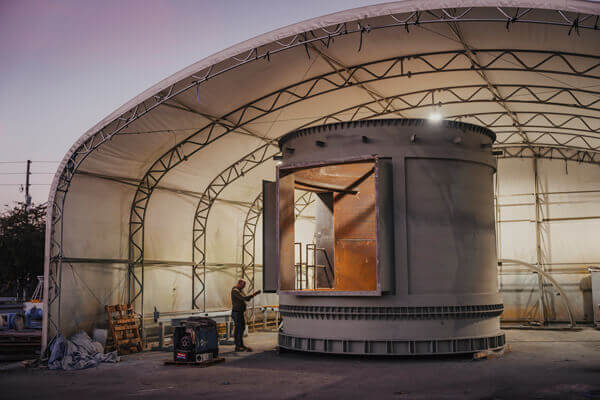
Hammer Haag continued to strive for diversification and now focuses on 12 to 15 key industries. The applications are far-ranging: amusement park rides, walkway supports, bulk handling equipment, piping, foundation beams for metal foundries and metal poles for electrical power transmission. Hammer Haag’s application expertise also includes structural components for structures such as bridges, buildings and other constructions. Undoubtedly, Maneval could add more to the company’s ever-growing list.
“Most of our custom fabrication work typically involves large structures and components,” he says. “For instance, there are only a few fabricators that could have produced the huge structural components that were needed for a temporary ship loader while repairs were made to the Francis Scott Key bridge.”
Maneval is referring to the bridge that was struck by a container ship in 2024 and the massive work that was required to fix it. Regardless of the project, thanks to Hammer Haag’s unique custom fabrication experience and capabilities, the shop is now one of the few in the country that specializes in really big jobs.
Embracing diversification
Constantin Haag is the CEO and founder of Hammer Haag Steel. The shop occupies 170,000 sq. ft. and is in the process of expanding to a new second building while also establishing a West Coast regional facility. It employs about 160 people, and employee experience ranges from those with three years to those with more than 15 years with the company. Regardless of their tenure at Hammer Haag, most have been doing structural steel fabrication their whole lives.
Within the industries the shop serves, the number of design engineering firms is quite small, and most are aware of and have worked with Hammer Haag. The shop’s sales and marketing teams also cultivate new customers in industries requiring similar custom large fabrication work like cable tension-type roofs for indoor sports stadiums that house professional soccer and football teams.
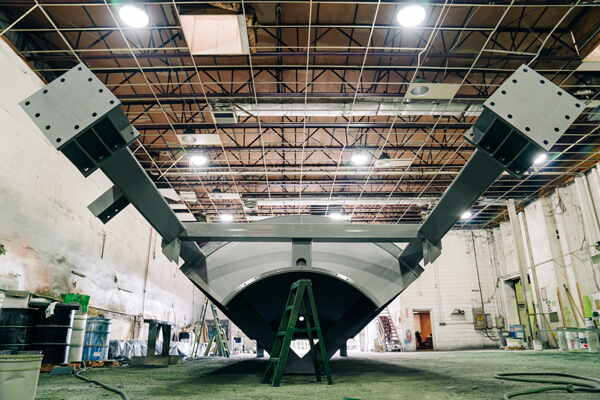
As Hammer Haag diversified, it realized that big, heavy-duty work required high-quality equipment, especially in terms of plate and angle rolling machines.
“With higher quality, top-of-the-line equipment, we gain the flexibility to handle a wider range of work,” Maneval says. “Yes, we can roll thinner gauge material if needed, but our goal is to accommodate the big stuff.”
The shop angle rolls I-beams, square tube, and angled and channeled materials. Examples of jobs the shop plate rolls include smokestack components from plate measuring 0.500 in. thick and 10 ft. wide that involve three diameters of 10 ft., 12 ft. and 15 ft. and debarking drums made from multiple 1.5-in.-thick, 8-ft.-wide plate joined in a submerged arc welding process to create a 45-ft.-long vessel.
Investing in precision
Hammer Haag’s first plate roller was an old, used three-roll plate rolling machine but eventually, the company realized it needed a four-roll type. That’s when it acquired a CNC four-roll plate rolling machine and an angle rolling machine, both from Davi Inc.
The MCP 26 three-roll double pinch angle rolling machine features two side rolls moving against a fixed top roll. With it, the shop generates structural shapes for everything from amusement park roller coaster tracks to components for swim-up bars on cruise ships. For such jobs, according to Maneval, there are basically no straight shapes and components – all involve curves/arches and radii.
The MCB K30 four-roll plate rolling machine handles medium- to heavy-duty applications and has a bottom roll that clamps plate, guaranteeing precise control throughout the forming processes.
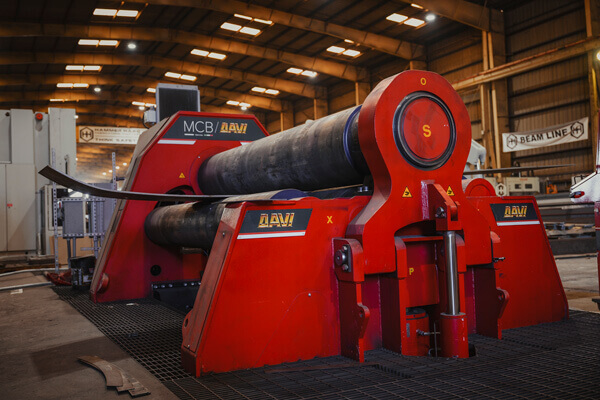
For both machines, the side rolls, actuated by Davi’s planetary guides technology, provide the necessary bending force for achieving tight diameters while maintaining high accuracy.
Besides Davi, the shop, of course, did its due diligence and looked at other four-roll plate rolling machine brands. Its criteria were that the machine had to have the capability to handle up to 2-in.-thick, 10-ft.-wide plate and higher tensile strength 70-ksi steel. While other machine OEMs could supply such a machine, according to Maneval, the shop needed a supplier that would stand behind their product and, if there were issues, quickly respond.
“With Davi, we believe that we invested in the right company as far as quality, performance, reliability and service,” he says. “Plus, with our Davi machines, we don’t worry about downtime or maintenance issues, and the machines allow us to keep the delivery promises we make to customers.”
Automated adjustments
Prior to its Davi plate rolling equipment, Hammer Haag was completely reliant on its operators – some with 50 years of experience – to run the old non-CNC plate rolling machine. Jobs also often involved two processes, both plate rolling and bending. For those, the shop bent the start of the plate on a press brake and then fed it into the plate rolling machine. This was time-consuming and required transferring big, heavy plate from one machine to the next.
“The downside was that if the operator was out that day, the job had to sit until his return,” Maneval says. “This was the case until we acquired our Davi CNC-controlled machines outfitted with AI capabilities. Now, after training with Davi, we have less-experienced operators producing fairly complex shapes. And we’ve eliminated the two-machine process as well as having to take multiple measurements and do re-rolls, which shortened the process.”
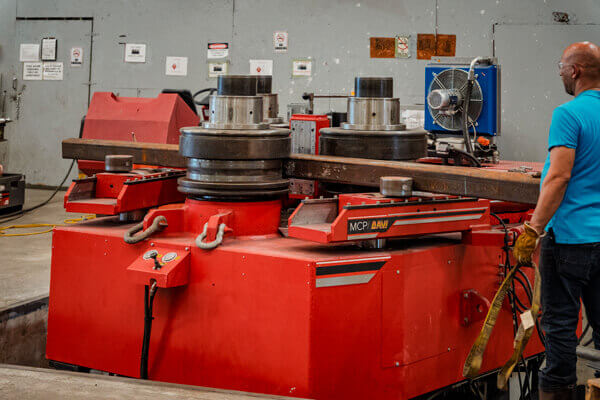
Davi’s iRoll Performance and iRoll eXtreme CNCs incorporate self-adjusting AI to generate fine-tuned programs based on historical parameters collected during the fabrication of similar parts. The controls then divide programs into workflow phases (e.g., loading, pre-bending, etc.) so Hammer Haag can check and edit the generated machine sequences.
For the shop’s multi-radius parts, the control’s Radius Correction System adjusts the workpiece programs based on material supplier and batch, along with the operator’s measured parameters for the actual part thickness and forming radius. As a result, operators can program extremely complex shapes by inputting each segment arc and inside radius, then during forming, they can adjust with a real-time correction function.
Mastering throughput
In terms of production, Hammer Haag’s jobs range in value from $800 up to $2 million or more. The shop always tries to keep about 25 percent of its capacity free to handle emergency jobs that typically require a turnaround within three to four weeks, sometimes sooner. This is unlike other shop projects that involve well-thought-out schedules and timelines for each stage.
In between those projects, the shop handles multiple medium-size jobs. All in all, the shop processes between 6,000 and 8,000 tons of steel through its facility in the course of a year.
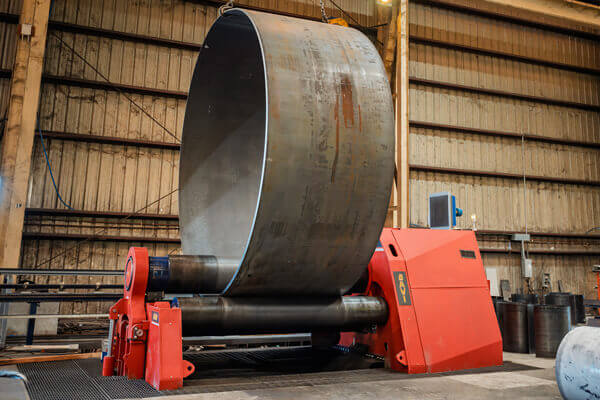
“In high-volume, lean-production environments,” Maneval says, “shops have the luxury of performing processes the same way, day in and day out. When it comes to our huge fabrications, how we carry out processes differs from one job to the next, so we’re constantly adjusting moving parts around (rigging) and determining the space where we’ll work on them. We have to plan for the manpower for a job, as well. We actually train our people on handling and moving large components using cranes and other rigging devices.”
Processes at the shop include prefabrication, fitting and welding, sandblasting, CNC machining, painting, quality control and mechanical assembly, along with shipping and logistics. While most customers want quality work and on-time deliveries, many are looking to cut costs through shorter turnaround times, but not at the expense of quality.
Thanks to successful diversification, the incoming workflow faucet is wide open at Hammer Haag.
“With our work, issues and problems are inevitable because every job we do is custom and hasn’t been made before,” Maneval says. “This requires us to maintain a flexible work schedule and workforce, both of which can quickly adjust to unforeseen issues and workflow changes. Most importantly, however, our business also depends on quality equipment like Davi plate rolling and angle rolling machines.”
We’ve covered all types of situations involving roll forming, so go to our archives and gain access to years of content.


