As it turns out, cobots are good at a lot of things in the industrial world. Initially, machine tending seemed to be their calling, but they quickly found usefulness in a wide range of repetitive tasks. They’re good at palletizing, abrasive and finishing work, plasma cutting, quality inspections, assembly and, of course, welding, which may be the most popular application.
Regardless of the specific task, cobots found their popularity by supplementing manual labor. Cobots can go the extra mile – they can provide continuous productivity in a variety of industrial environments. Even better, they’ve become easier to use and more affordable to acquire, which is why they’ve been popping up in fabrication shops all over the world.
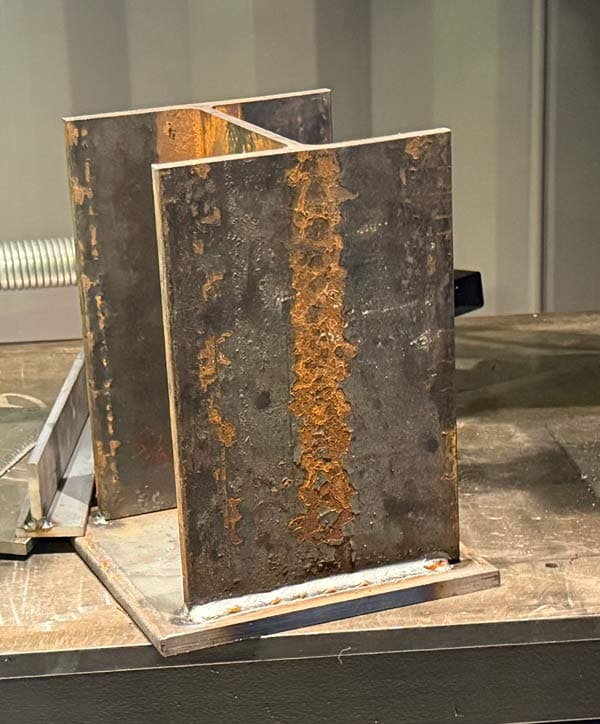
What they aren’t good at, however, is part variances in welding applications. When presented with poor fit-ups, surface scale or even tacks being used to hold two parts together, their performance can be less than desirable.
“When shops try to automate their parts, they realize how much uncontrolled variance is introduced upstream,” says Sam Noland, a welding automation process specialist at Miller Electric Mfg. LLC. “The problems that happen upstream are yet another side effect of the lack of skilled labor in the industry.
“Even when labor isn’t an issue and a part is perfect with no variance, the problem could be its size,” she explains. “A part could be so cumbersome that it’ll inherently be a little off just because it weighs 400 lbs. and fitting it together is hard.”
But we still need to automate our operations, she says, because there just aren’t enough skilled welders available. And when welders are available, we want them to be doing “the complicated stuff, the things that actually take true talent and decision-making,” she adds. “Automation is great, but it’s not always great with variations or if the part is too big to fixture.”
Higher learning
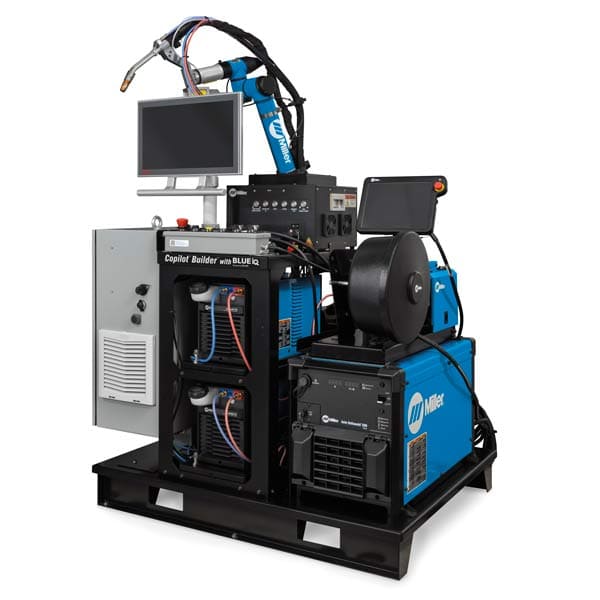
Since their market introduction, the main lesson learned about cobots is that they need precise, uniform parts to succeed. Understanding the realities of the situation, Miller Electric, in collaboration with Novarc Technologies Inc., introduced the Copilot Builder with Blue iQ powered by NovAI to overcome that sticking point. It’s able to thanks to the modern era of machine learning.
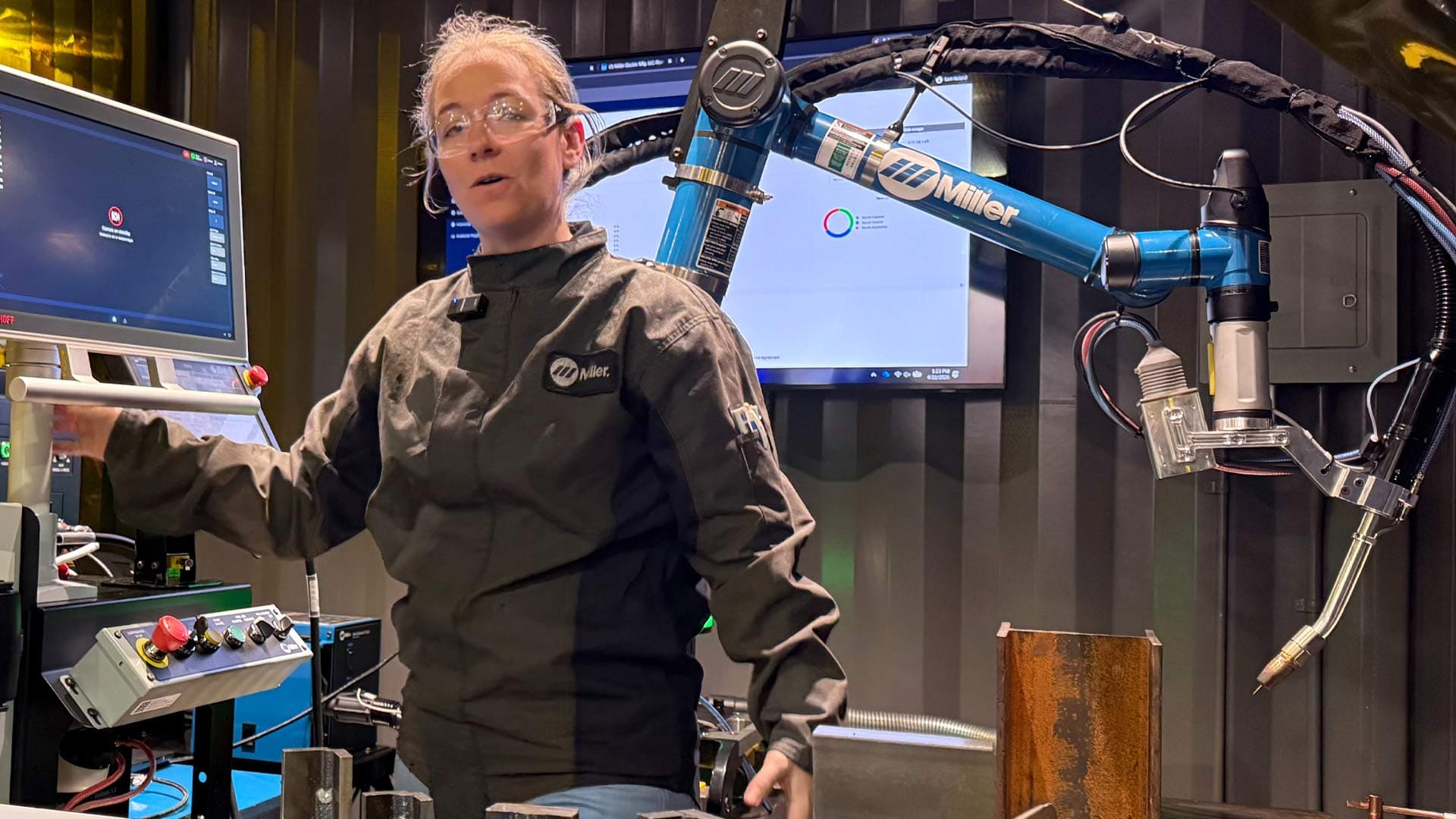
Miller’s Copilot welding cobot has been available in a variety of configurations for some time, but now that it’s enhanced with Blue iQ, fabricators that regularly encounter part variances will have an easier time automating their parts. The system uses machine vision and real-time adaptive control to compensate for the variances that have historically given cobots such a hard time: gaps, misalignments, tack usage and other part-to-part variations.
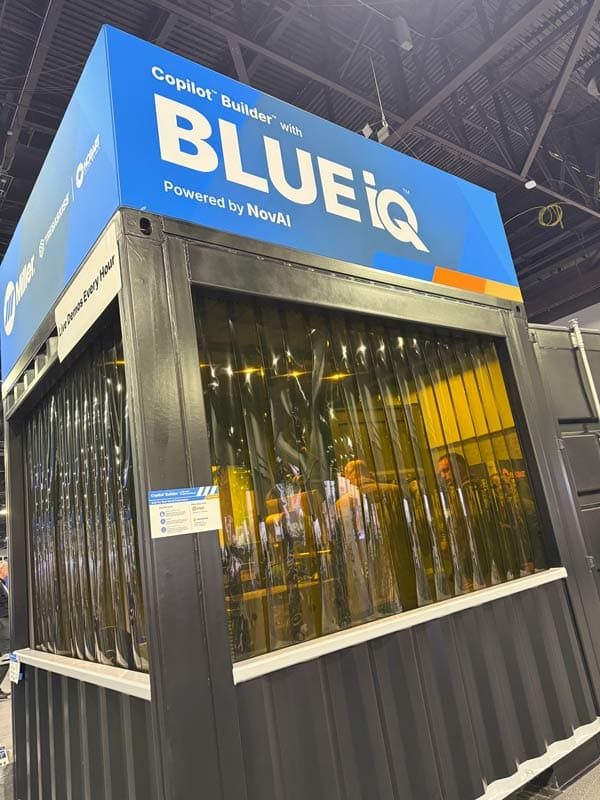
“Blue iQ is powered by NovAI, a computer vision AI solution that we developed to provide adaptive welding capability to all forms of automated welding solutions, including robots, cobots and other types of mechanized welding,” says Soroush Karimzadeh, co-founder and CEO of Novarc. “We provided the vision system and neural networks that understand the weld process and can react to different weld scenarios, such as fit-up, without any prior scanning or knowledge of the weld. Just like a welder would see and react, the system can see and react to real-time scenarios as it starts welding.”
Good decision-making
NovAI is the result of Novarc’s mission to bring physical AI to robotic welding scenarios. Its introduction to the market is the culmination of decades of welding engineering data and the recordings of thousands of actual welds. Karimzadeh explains that the system doesn’t just react after the fact. It looks at the weld pool in real time to see how the parts are fitted together and what’s happening in the joint as it’s being welded.
“All of that information is fed into the system for real-time decision-making,” he says. “Let’s say the opening between the two parts is increasing or a tack is holding the two parts together, which are both very real scenarios in welding. Based on decades of data, the system understands those scenarios and can make the necessary changes.”
The system is the perfect example of modern machine learning. Noland says it “makes the decisions that we’ve trained it to make.” The NovAI platform – the iQ of the overall system – records the weld in real time while combining machine vision and decades of data to autonomously adjust to the part.
“When faced with real-life variances, a welder can slow down their weld speed or perhaps add more wire weave into their process, which will both increase puddle size,” she says. “But we actually taught the system what a welding engineer might do based on a WPS. In the case of thin materials, the system might maintain the travel speed to keep productivity high, but in thick materials, it might focus on deposition to achieve good penetration.
“We’re at the point where we can program the system to make logic-based decisions based on dozens and dozens of variables,” she adds. “Thanks to computing power and vision systems, these capabilities are just more accessible today. The system runs on years of weld data, but operators can also make selections based on the job at hand. They can select a certain level of heat based on the surface condition of the part, for example.”
Substantial savings
Novarc’s achievement – amassing decades of weld data to leverage in automated weld settings – is incredibly impressive, but at the end of the day, potential users want to know how they can save money with it and grow their business.
“Labor-wise, beta users are seeing savings by taking their skilled welders off the parts the cobot can handle and moving them into higher value roles,” Noland says. “Their apprentice or new guy – the employees that eventually want to be full welders – can manage the cobot and actually learn from it. By changing the labor distribution in their shop, they’re becoming more efficient overall.”
Another approach Noland has seen with beta users is having one operator oversee two systems. “Think one guy, two arcs,” she says.
Because the system can correct itself, the operator is primarily there to make sure it doesn’t run out of wire, as just one example. That in itself can be a big benefit and a big money saver. Savings, of course, also come from quality improvements in the form of reductions in scrap and rework.
“Sometimes, a part makes it all the way to painting before you catch that a weld isn’t good,” Noland says. “With our system, you know the weld will be the same every time.
“A subcomponent of that is the ability to avoid overwelding, which is how welders often compensate for bad fit-ups,” she adds. “When welders run into a bad fit-up, they’ll just overweld the hell out of it. But now, we don’t have to worry about that. We don’t waste the wire, the time or the gas.”
Seeing the data
The system’s NovHub data monitoring and quality tracking system is also a major benefit. Also developed by Novarc, NovHub serves as a centralized database that links weld videos, microsecond parameters and inspection records across networked robotic cells to deliver end-to-end operational traceability. Karimzadeh describes it as a digital thread.
“For the first time, the operations or QC manager can actually see the cell’s productivity, what the weld looks like and its parameters,” he says. “They can access what happened with a weld and use that to track and trace any issues that might happen afterward. It’s a very powerful tool especially when you consider that it can be implemented into robotic welders, cobots and systems like Copilot.”
Both Noland and Karimzadeh have seen NovHub used in a variety of ways. The track and trace capability, for example, becomes critical for certain applications, such as nuclear or oil and gas, because now there’s a record of how a weld was completed. For other applications, the value comes in tracking operator or cell productivity, throughput, quality or even raw materials.
“This is the first time that the welding industry is getting the benefit of a new data entity that includes the actual weld video and all weld parameters provided for each weld or part,” Karimzadeh explains. “Think of a shift supervisor that gets to the shop in the morning and learns an occurrence happened in the welding cell the night before. With NovHub, they have a forensic study of what happened. They don’t have to spend hours talking to multiple people to rebuild the process just to find out that it was because the weld tip wasn’t clean.
“With a unified and simplified platform, there’s no guessing at how the weld was done,” he adds. “You can see exactly what was happening at that moment in time, including voltage and current and what the raw material looked like.”
Show me state
For folks interested in learning more, the Copilot Builder with Blue iQ, powered by NovAI, will be on display at Fabtech 2026 in Las Vegas. Noland notes that Miller is doing something that it’s never done before: publishing a demo-on-demand video on the Miller website. The 10-min. video will “cover a little bit of everything,” including a breakdown of how the system works, demos of actual welding, an explanation of the quality tracking and management component, as well as general discussions of its benefits and how it could fit into a shop.
“We’re all from Missouri in the welding industry – you have to show us,” she says. “That’s why we produced the video – so we can show the system to anyone interested in it whenever they want and wherever they are. If they have additional questions, we want them to reach out to us. We’re more than happy to do virtual demos or even live demos at a show or a tech center.
“Just because the tech is new and cool doesn’t mean it’s for everybody,” she adds. “We never want to sell or install anything that ends up as an expensive doorstop. We want it to function, and that means we have to be honest with you about what it can do. You have to be honest with us, too, though, about your expectations and what you want it to do. That’s why we’re all about showing it.”
Noland encourages interested parties to “give us some of your parts, and we can work on it together.” She understands that there’s a possibility that it might not work for a specific part, but that’s the whole point: working together to find a solution.
“If the Copilot with Blue iQ isn’t the right fit, we can look at other technologies,” she says. “Or, maybe we need to fix some issues happening upstream. We just need to have that open dialogue.”
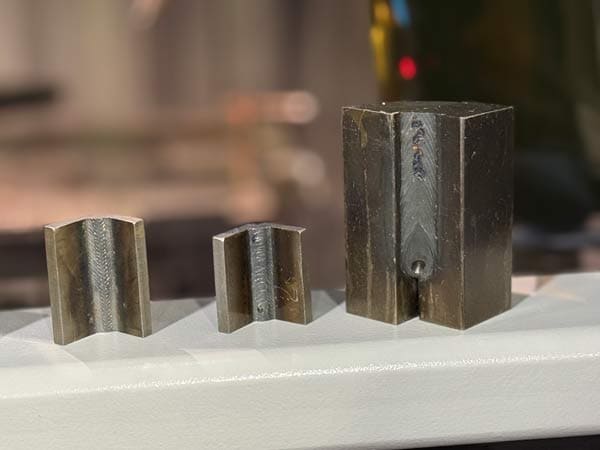
Overall, Noland says shops will discover that the system is particularly useful for simple welds like fillets, V grooves and lap joints. As for future functionality, the team behind Copilot Builder with Blue iQ is excited. With capabilities such as single bevels and aluminum welding on the horizon, the list of tasks cobots are good at is only going to grow.
If you want to stay in-the-know about the latest technology in the welding industry, subscribe to Welding Productivity. It’s free!