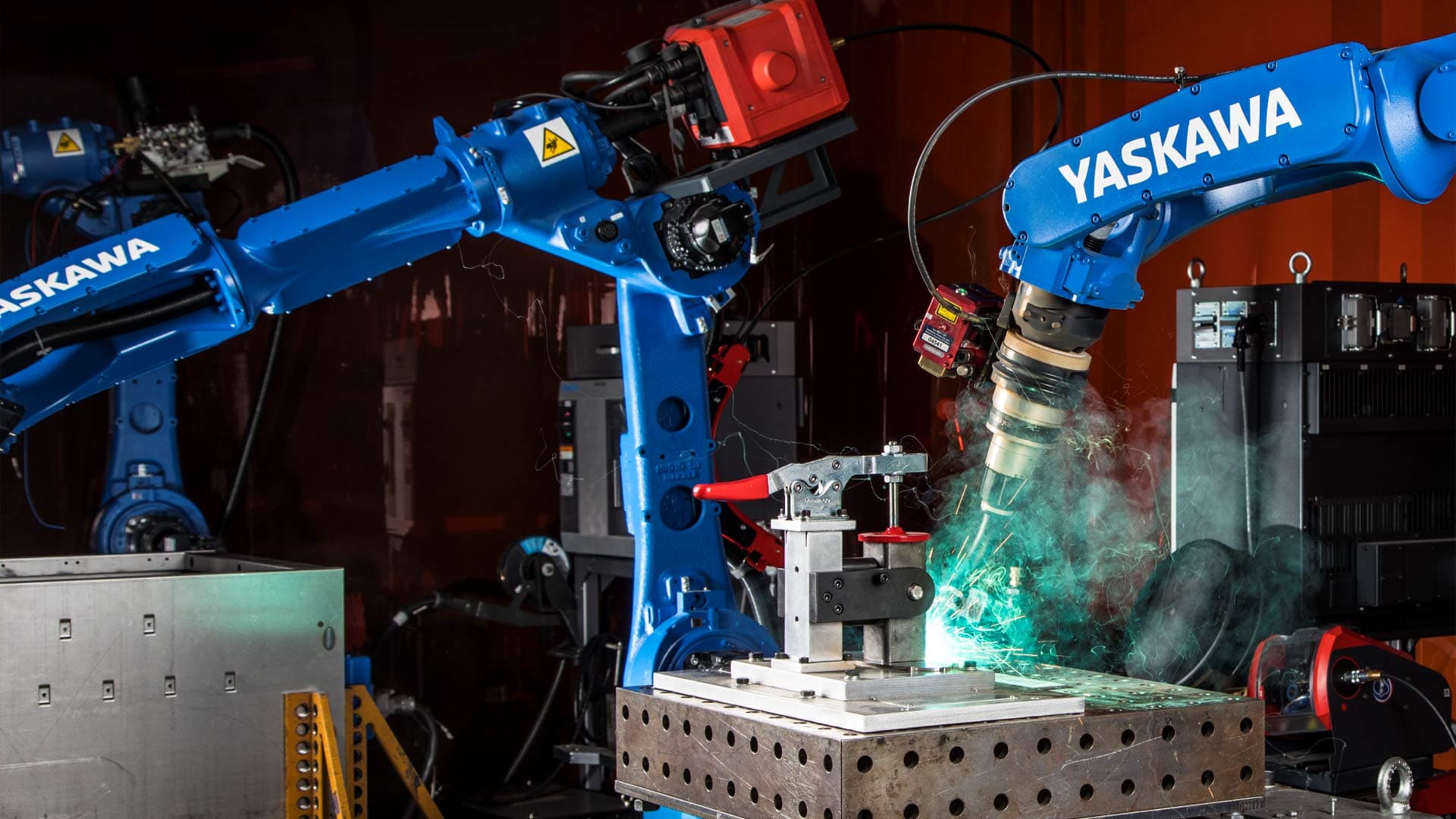
Since the programmable industrial robot was introduced in the 1970s, programming an industrial welding robot has typically meant standing next to it. The programmer holds a teach pendant, drives the robot from point to point with tactile buttons, sets weld parameters, adjusts torch angles, tests the taught path and repeats this process until the job is ready for production. For relatively simple applications, this approach still works well, especially for experienced programmers. But manufacturing automation is changing and so are the expectations placed on robotic automation.
Manufacturers that want and need to automate typically deal with larger weldments, more complex parts and tooling geometries, higher product mix and shorter production runs. Weldments like truck frames, structural steel components and boat hulls may contain hundreds of individual welds and complex tooling and tacking. Programming these applications with a pendant can take even experienced robot programmers many hours or even days.
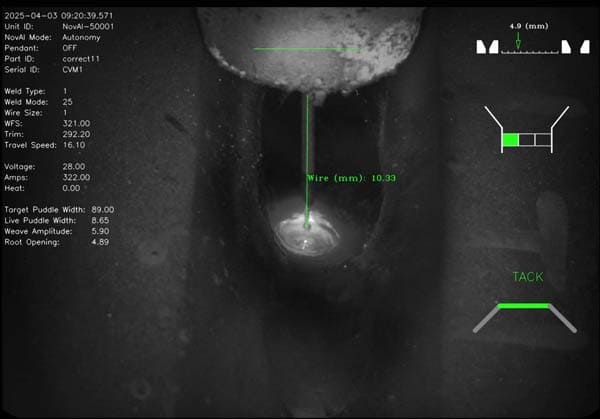
At the same time, most manufacturers cannot afford to take their welding robots offline every time a new part needs to be programmed. That is where offline programming (OLP) has become more important and practical for shops. With the addition of AI, machine vision and digital twin technology, OLP is evolving into much more than simply generating a robot path – it is becoming a tool to improve the entire welding operation.
Beyond the robot
Robot OLP is not a new concept. Motoman introduced MotoSim software suite in 1993 as an industry-first solution to allow users to simulate robot reach, generate paths and evaluate cycle times before sending a program to a physical robot. This allowed users to complete these tasks without standing by the physical robot or taking it off production.
This capability became especially valuable in higher mix manufacturing. Historically, robotic welding is associated with high-volume production, like what is used in automotive. If a shop only produces a few parts before changing to the next job, spending hours programming a robot may not make economic sense.
Experienced workers are leaving the workforce or moving into other occupations. The challenge for manufacturers is not finding more automation – it is finding ways to make automation a practical tool for their operations and their skilled welders.
The capabilities of OLP have expanded significantly since those early simulation programs. Today’s software platforms can include process parameter control for applications like welding and painting, automatic air-cut path optimization, multi-robot and external axis coordination, collision detection and integration with seam finding or tracking sensors. Some programs can also incorporate machine tools, end-of-arm tooling and automated fixture design.
The latest generation of OLP platforms is increasingly built around the concept of a digital twin – a virtual representation of the physical robot cell that can simulate motion, reach, collisions and production processes before changes are made on the shop floor. For manufacturers, the practical benefit is simply to identify problems before they become expensive.
Less disruption
One interesting lesson learned from one of my customer focus groups is that the industry may be overestimating the desire for power-and-force-limited systems that have made hand-guiding and lead-through teaching easier on collaborative robots. When given the choice, these users expressed that they would rather program a job from a computer than stand beside a robot and physically teach every point. However, they value the space savings offered by a cobot.
OLP software on a computer provides a larger visualization of the entire workcell and CAD models can be imported directly. Paths can be reviewed and adjusted without repeatedly moving a physical robot. Having to understand tool frames and Cartesian coordinates is not necessary. Most importantly, programming can occur while production continues.
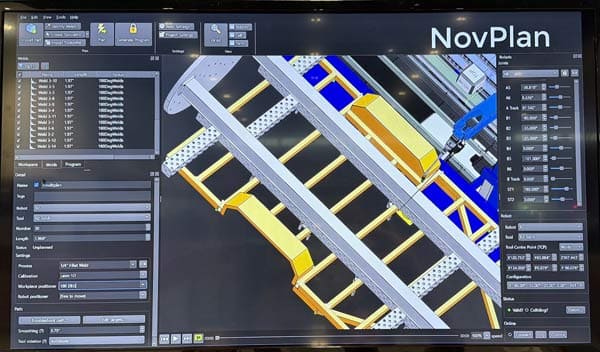
This separation between programming and production may be one of the most important developments for manufacturers trying to automate lower volume and higher mix work.
The goal is no longer just to make robot programming easier. It is to make the entire automation process less disruptive to production and maximize use of the robot.
Adding AI to the equation
AI is now enabling OLP beyond traditional simulation. Novarc Technologies Inc., for example, has developed NovPlan automated robotic weld programming as part of its broader approach to robotic welding automation. The software can support planning and programming while also labeling individual welds for further analysis. This becomes important because a welding program is only one part of the production process.
Modern software platforms are beginning to connect programming, production and quality information rather than treating them as separate activities. Novarc extends this approach with its NovAI technology, combining path planning with adaptive welding capabilities. By integrating real-time computer vision and adaptive control, Novarc’s physical AI solution transforms standard welding hardware into an intelligent, self-correcting system that perceives and adapts to the joint and weld parameters on the fly.
What makes Novarc’s adaptive welding solution unique is how it observes the welding process by using a torch-mounted camera to observe the weld puddle and how it responds during welding rather than relying on a traditional laser sensor to find the joint.
Their software model incorporates information about common joint types, base materials, travel directions and welding conditions. This allows the system to automatically account for the natural variability found in real-world manufacturing.
Len Zapalowski, vice president of business development, Novarc Technologies, says, “Yaskawa brings the robot platform and programming/simulation experience, while Novarc brings the welding-specific intelligence around planning, sensing, adaptation and weld data.”
Welding parts
Anyone who has spent time in a fabrication shop knows the difference between a CAD model and a finished assembly. Parts move. Fit-ups vary. Gaps change. Tacks appear where the robot did not expect them. Fixtures wear. The list goes on.
Traditional robotic automation works best when everything remains repeatable. But increasing flexibility requires systems that can recognize and adapt to the differences between one part and the next rather than investing in a multitude of complex fixtures.
With NovAI, artifacts such as tack welds, gaps and seam variation can be detected automatically, allowing the system to adjust welding and robot parameters to maintain a smooth weld. Essentially, NovAI observes what is happening during the weld and uses that information to respond to changing weld conditions in real time.
Instead of programming a robot to repeat the same motion every time, manufacturers are beginning to provide robots with more information about the process occurring in front of them. The process and robot still benefit from repeatability and precision, but software and sensors provide additional awareness.
For higher mix applications, Novarc also offers a handheld control system that allows users to interact with the process remotely. They can view the welding environment through the torch-mounted sensor while controlling path motion and assisting with adaptation for conditions such as open roots, gaps and changing tack locations. This can be particularly useful for large fabrications where accessing every weld location may require ladders, lifts or unergonomic positioning. Again, the objective is not simply to replace the programmer but to give the programmer better tools.
The digital trail
Perhaps one of the most significant developments in intelligent welding automation is the growing importance of data. NovAI records video and production data for individual welds, which can then be stored through NovHub. This can provide manufacturers with a digital record that includes weld traceability, video, arc information and analytical data.
“Novarc’s comprehensive welding automation ecosystem supports manufacturers at every stage of the process,” Zapalowski says. “NovPlan optimizes path planning and programming before the weld, NovAI delivers real-time adaptive capabilities during the weld and NovHub ensures complete traceability and data analysis after the weld.”
Traceability has traditionally been viewed as something required for highly regulated or safety-critical applications. Aerospace, automotive, defense, pressure vessels and other demanding industries often require detailed documentation of welding procedures and quality.
But digital traceability is increasingly becoming useful across general manufacturing, as well. If a weld fails during inspection, manufacturers can now investigate what occurred during the actual welding process. If production performance changes, historical data may help identify the cause. If programming adjustments are needed, engineers have additional information rather than relying solely on assumptions. Traceability is evolving from a quality record into a production improvement tool.
OLP began to create robot paths without occupying the robot. That is still valuable, but it is no longer the entire story.
The next generation of programming tools combines simulation, digital twins, process knowledge, machine vision, AI and production data into a more complete automation ecosystem. The result is software that can help manufacturers before welding begins, while welding is occurring and after the part leaves the cell. That broader approach may be critical as North American manufacturers face continued pressure from labor shortages, global competition and increasing demands for flexibility.
The future of robotic welding will not be defined solely by faster robots or more sophisticated hardware. It will increasingly be defined by how intelligently manufacturers can program, adapt, monitor and improve the systems they already have. And that means the humble robot program is becoming something much more powerful than a collection of points and positions. It is becoming the foundation of an intelligent production system.
Looking to improve your approach to automated welding. Be sure to check out our extensive welding archive.