

Early in 2026, Murata Machinery USA (Muratec USA) was formally recognized for its approach to workplace safety by earning the Carolina Star Certification. While the distinction reflects the company’s strong safety culture, that same philosophy also influences how the company designs and develops its fabrication equipment.
Administered by the North Carolina Department of Labor, the Carolina Star Program recognizes employers that have implemented comprehensive safety and health management systems. And while Muratec checked off every item on the list of requirements for earning the designation, maintaining that success is an ongoing process that involves a sustained commitment to safety that permeates every level of the organization.
Becoming a star
Muratec’s North American headquarters are located in Charlotte, N.C., so it was a natural fit for Ken Dake, the company’s safety specialist, to take interest in the Carolina Star Program. His commitment to advancing workplace safety, however, began a couple years earlier. Soon after joining the company, Dake began seeking support from organizations that promote safety to help take the company’s initiatives to the “next level.” He evaluated the existing safety programs, engaged employees in various safety committee activities and focused on learning more about the resources available to address safety issues across different divisions within the Muratec organization.
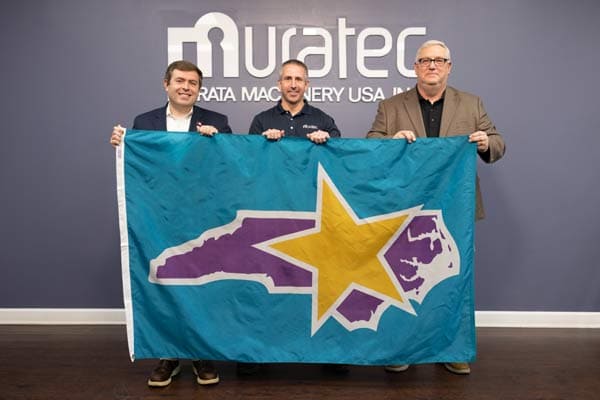
In the process, Dake became familiar with the Carolina Star Program. He engaged in a lengthy evaluation process that culminated in Muratec earning the Carolina Star Certification, a designation that requires a rigorous evaluation process. Muratec demonstrated excellence in a handful of core areas that are crucial to earning the award, including a commitment to management, which involves clear leadership support for proactive safety initiatives.
Dake and his team also proved that employees were proactively involved, that processes were in place to recognize and mitigate safety risks, that safety and health management systems were documented and that a framework was and would remain in place for continuous safety improvements in day-to-day operations.
“It essentially contains all the OSHA requirements, but the Carolina Star Program goes above and beyond that,” Dake says, adding that yet another requirement for distinction is maintaining an incident rate that is better than the industry average.
Ongoing improvements
Earning the Carolina Star designation is only the beginning, Dake explains, as it “gets you in the door, so to speak.” Today, he is involved with mentoring other companies in North Carolina, helping them work their way through the program’s evaluation process. But the education process goes both ways.
“We have a group of dedicated folks that come together at least once a month to share ideas on what’s going on in safety,” Dake says. “A lot of the focus is on the concept of best practices – we want to share those. If something is working well with our employees or we can discuss some of the challenges we’re facing, we can share that information with others and see where others have had success.”
Muratec’s safety committee spans departments, including production, shipping and receiving, and extends beyond state lines to Muratec facilities throughout North America. Committee members observe potential hazards, report them and meet regularly to discuss findings. Dake says the standards they hold themselves to are stricter than federal guidelines – a posture and attitude from which they are unwilling to budge.
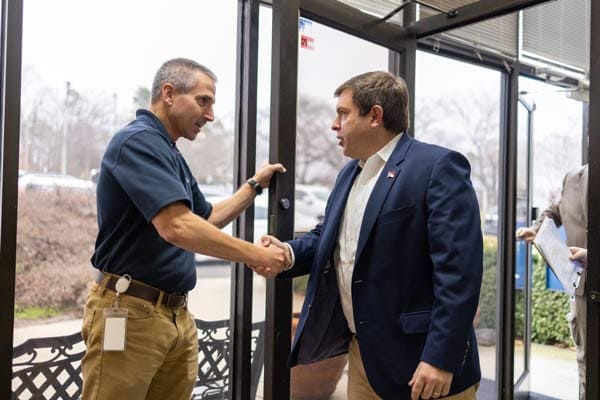
While earning the distinction is certainly a feather in Muratec’s cap, ensuring employees have a safe work environment reinforces the company’s reputation. And, at the end of the day, the investment in safety is not just good business practice, it’s also the right thing to do.
Identifying risk
Establishing a culture of safety is a top priority within Muratec, and that focus also extends to product safety development. Before safety features are designed into a machine, engineers first need to understand where and how injuries occur.
Matt Ward, fabrication business unit manager at Muratec USA, points out that not all injuries occur while the machine is operating. In fact, many are related to material handling. For example, manually moving 5-ft.-by-10-ft. metal sheets is cumbersome, and manually shaking out cut parts can lead to repetitive-use injuries and downtime.
“When operators are unloading material, the sheet is flopping around,” Ward says. “They’re catching their arm with the corner of it, and burrs are flying up. The actual handling of parts once they’re completed in the machine is where a lot of the hazards present themselves in a fab shop.”
For most shops, the bottom line gets the most attention – if you can’t get parts cut, machined and down the path to the next process in a timely fashion, you aren’t making money. Ward is familiar with this challenge in manufacturing – the fact that “the fastest way is by far not the safest way to do things.” In some shops, safety doesn’t always rank very high. Ergonomics related to repetitive-use injuries, therefore, don’t always receive much attention. As an example, Ward points to the work that goes into handling material to and from a turret press: It’s an exertion-heavy process that sometimes takes two or three employees to tackle together.
“It’s not ergonomic,” Ward says of the manual handling approach.
Automated handling
Automated material handling reduces the need for repetitive manual tasks that can contribute to injuries. For example, Muratec’s FG3015, an automated cell loading system that can also pick and sort parts, arranges parts into stacks and presents them at an accessible height.
“It takes out the human element of having to pick up those sheets.” Ward says. “The awkward bends and shifting is where the automation on the fabrication side comes in and really helps out with the ergonomics.”
The FG3015 is the largest in the company’s FG line of advanced servo-controlled pick-and-sort systems, but it maintains a space-efficient design shared with the others in the series. Shops can choose between the FG2512, which can handle sheets up to 4 ft. by 8 ft., and the FG3015, which manages sheets up to 5 ft. by 10 ft.
Combining efforts
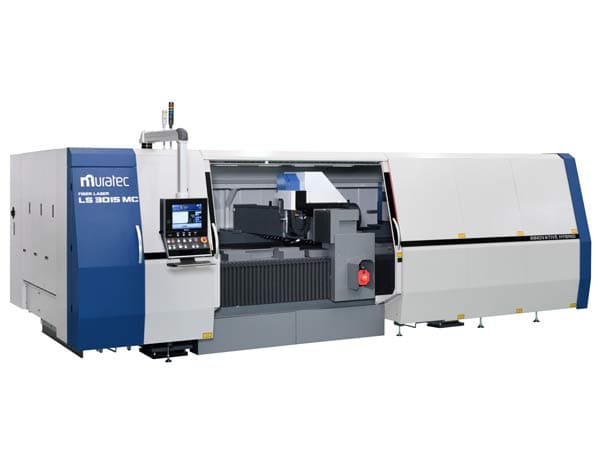
Visitors to IMTS in Chicago last month had the opportunity to see one of Muratec’s newest machines, the LS3015MC (read about the machine’s capabilities here), a machine that marries fiber laser cutting and machining in one compact platform. The production advantages are obvious – the laser cutting, drilling, tapping, counterboring and all the other perks that come with the automated machining system are under one hood. And eliminating the transfer of parts from cutting to machining falls squarely within the company’s safety initiatives.
The reduction in manual handling limits worker exposure to sharp edges, pinch points and repetitive lifting. This reflects Muratec’s safety-first design that is consistent throughout its automated lineup.
Ward notes the safety features within the machine, such as being fully enclosed throughout the entire cutting and machining processes. The windows are UL rated, so bystanders aren’t at risk of laser light injury.
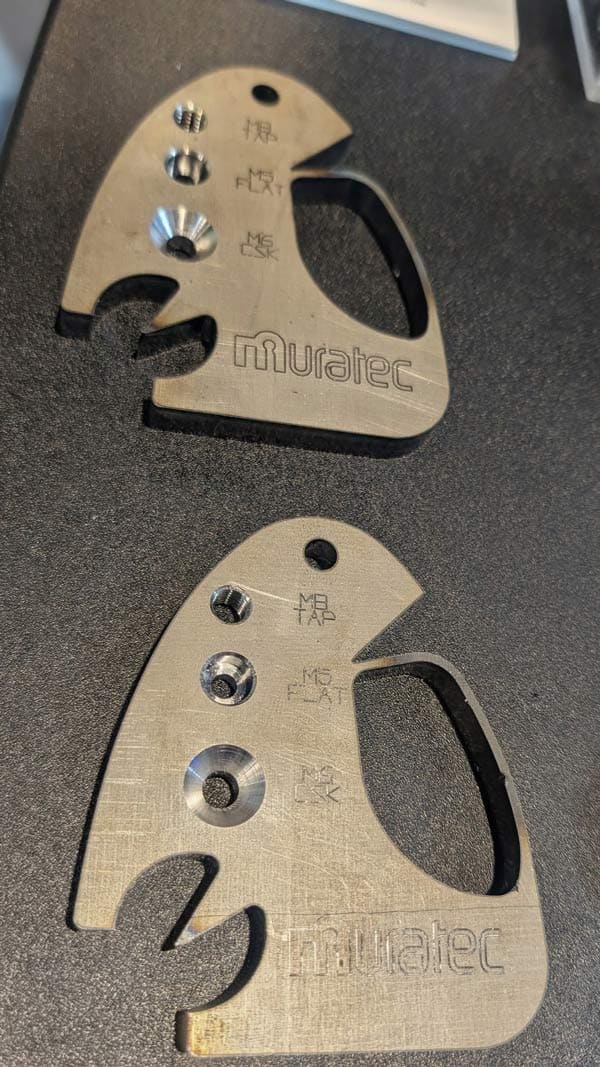
“We have dust collection and ventilation on it,” Ward says. “It’s top-notch all the way around as far as safety features. Parts come off complete, so the user doesn’t have to lug them up and down stairs. There’s no dropping parts on feet, fingers or another machine – it just eliminates all the headaches.”
Dake, being deeply entrenched in safety culture, is privy to various phrases that might not get thrown around much on the shop floor. One that comes to his mind when discussing the LS3015MC and other Muratec solutions is the “hierarchy of controls,” a foundational concept in occupational safety related to focusing on controls rather than worker behavior.
“A lot of our equipment takes the human aspect out of the direct path of moving parts,” Dake says.
Making the investment
It isn’t unusual for a shop to find difficulty in changing the way work has always been done. From building a stronger safety culture to implementing automation, success often depends as much on proactive thinking as it does on technology.
For Dake, that change begins with helping employees understand that safety isn’t about adding rules or checking boxes. Rather, it’s about identifying risk and finding ways to minimize it. The same philosophy guides Muratec’s approach to automation, where engineering controls and automated material handling are intended to reduce workers’ exposure to workplace risks.
The safest fabrication shops aren’t necessarily the ones with the strictest PPE requirements or the most safety signs. They’re the ones that have systematically engineered risk out of everyday operations. Muratec’s position is that automation delivers its greatest value by protecting people while helping manufacturers become more productive, more consistent and better prepared for the future.
“We’re really starting to see where automation is becoming affordable and able to achieve more throughput,” Dake says, “and allowing people to move from handling material to doing more of the programming.”
Murata Machinery USA (Muratec USA)
To read more articles like this one, subscribe to FAB Shop Magazine Direct.


