Advanced laser beam welding systems are increasingly replacing electron beam welding (EBW) in high-power, high-value applications, particularly for complex, critical turbine components in aerospace and electric power generation. Precision manufacturing now depends on laser welding for its unmatched accuracy, depth, low heat input and speed – all while meeting demanding quality and structural integrity standards.
The shift to laser welding is driven by the lower costs of laser systems, improved efficiency from reduced downtime and maintenance, and the systems’ compatibility with automation. These advantages make laser welding an appealing solution, especially given the declining availability of skilled workers and trained welders.
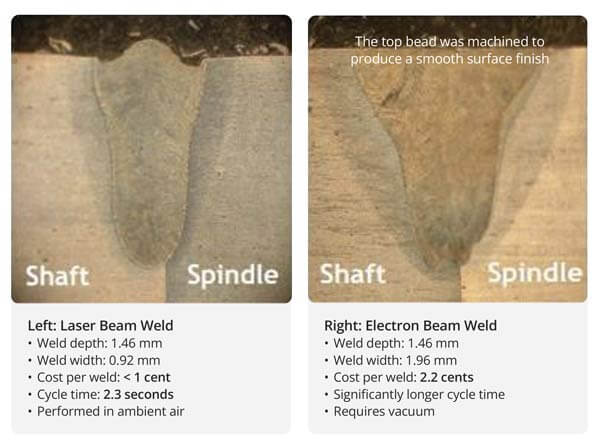
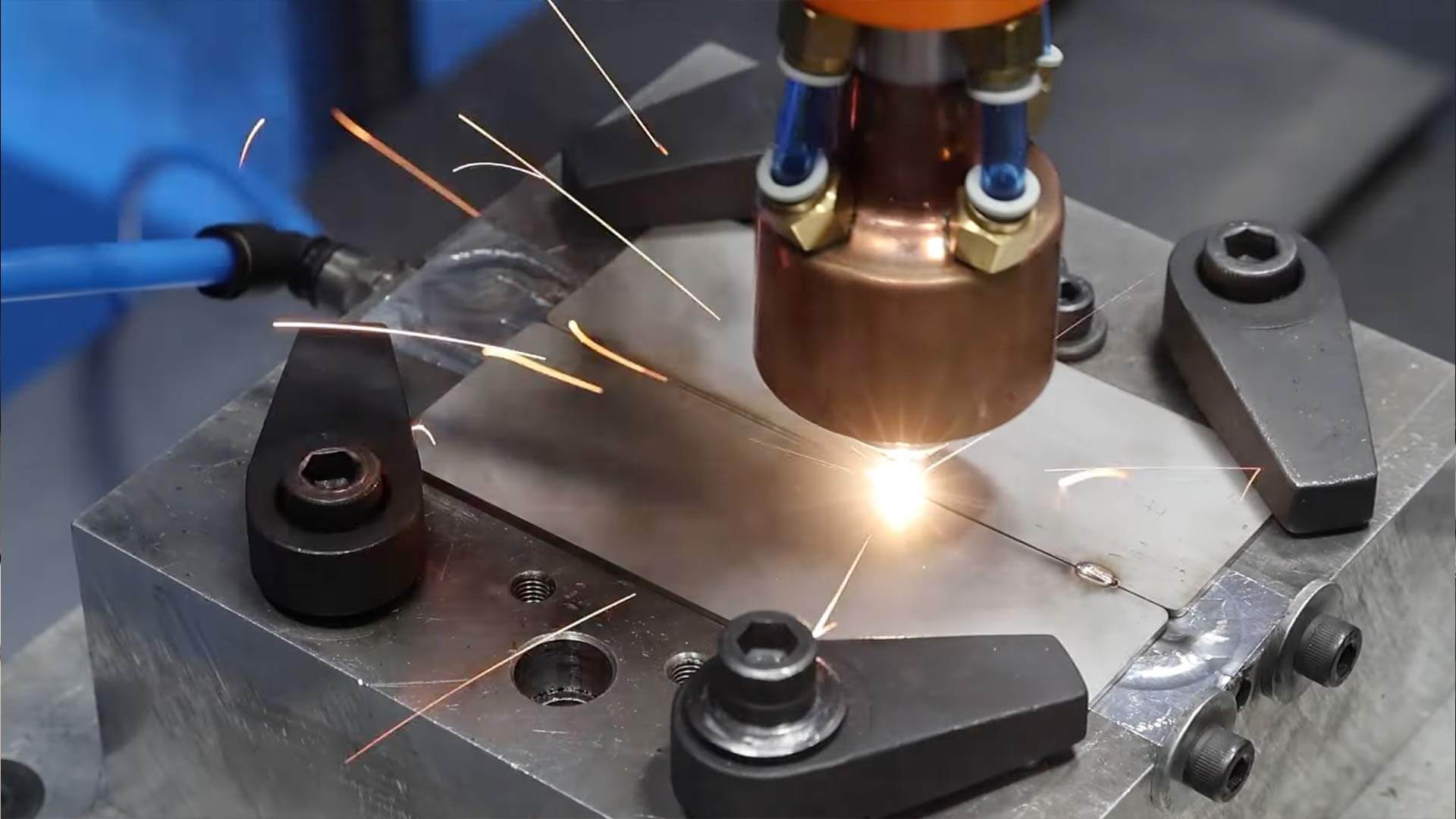
Laser welding and EBW are both high energy density (HED) processes that deliver highly concentrated energy to a precise location to melt and fuse materials. These methods are ideal for welding thick materials, achieving deep penetration, and joining diverse or dissimilar materials.
Both processes operate at high speeds, resulting in low heat input and narrow heat-affected zones (HAZ). The HAZ refers to the area of the base material adjacent to the weld that, while not melted, undergoes changes in its properties due to high temperatures.
Factors like heat input, travel speed and material thickness influence the size and characteristics of the HAZ, which can affect the weld’s strength, ductility and corrosion resistance. Controlling the HAZ is essential to ensure the integrity and performance of the final welded component.
HED vs. arc welding
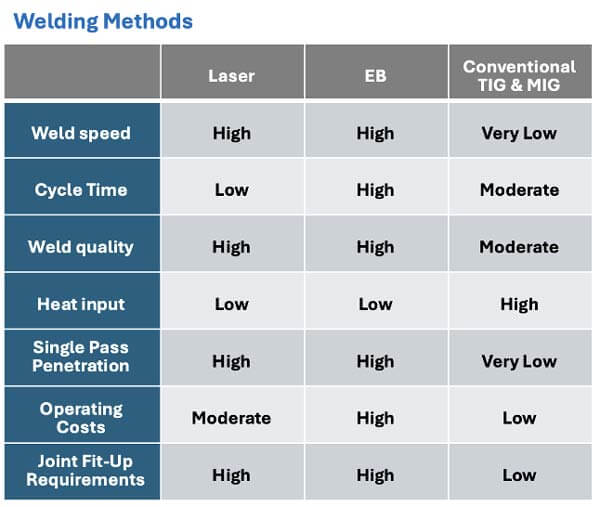
For many high-precision and high-performance applications, HED processes like laser welding and EBW, are the only viable choice. In these applications, traditional arc-based welding methods like TIG and MIG can prove inadequate. HED welding is better because:
- Deep penetration with high precision: Unlike TIG and MIG welding, which struggle with thick materials, HED welding uses highly focused energy to create deep, narrow and strong welds. The result? Minimal distortion, exceptional consistency and welds that are crack- and porous-free and meet the most exacting manufacturer standards.
- A smaller HAZ: Traditional arc welding methods generate a broad heat input that can alter the properties of the base material and compromise dimensional accuracy. In contrast, HED welding minimizes thermal input, ensuring a much smaller HAZ that preserves material integrity and reduces deformation.
- Unmatched process repeatability: TIG and MIG welding heavily depend on operator skill, making it difficult to achieve consistent results across larger production runs. HED processes, however, are easily automated, delivering highly repeatable, precise welds with minimal variation, making them ideal for high-volume or critical applications.
- Versatility in material joining: Welding advanced alloys or dissimilar materials is a significant challenge for TIG and MIG methods. HED welding excels in these scenarios, however, and can achieve tight tolerances and superior joint quality, even for materials with drastically different properties.

Unlike arc welding, both laser welding and EBW can operate in two distinct modes – conduction and keyhole – depending on the material thickness, application and desired weld characteristics.
- Conduction welding: Similar to TIG welding, conduction mode melts the material to form a molten pool that joins the parts. It produces wide, shallow welds with a smooth surface, making it ideal for thin materials or applications that require minimal weld penetration and a refined finish.
- Keyhole welding: Unique to HED processes, keyhole welding vaporizes the metal instead of merely melting it. This creates extremely deep, narrow welds with minimal heat input, resulting in high-strength joints with very low distortion. Keyhole welding is perfect for structural applications requiring deep penetration and robust weld quality, which is something arc welding cannot achieve.
Fundamental differences
Despite their shared focused-beam approach, laser welding and EBW differ fundamentally in their energy source and operating environments.
EBW employs a high-speed electron beam generated in a vacuum to melt and join base materials. The vacuum prevents the electron beam from scattering due to air molecules, ensuring precision and speed. It also eliminates atmospheric gases like oxygen and nitrogen, which can contaminate the weld; cause defects such as porosity or oxidation; and react with molten metal, resulting in brittle or impure welds.
Laser welding utilizes a high-energy beam of coherent light. The most common laser on the market today is the Ytterbium fiber laser, which produces near-infrared light at 1,070 nm. Laser welding systems can be scaled to very high power and can result in excellent beam quality. Modern laser systems operate in atmospheric conditions and can be highly automated with multi-axis positioning to access complex geometries.
EBW gained popularity in the 1950s for producing reliable components. Its ability to weld deep, narrow joints in thick or exotic materials while maintaining good mechanical properties made it a practical choice for industries where joint integrity was critical.
For decades, EBW was widely used to produce turbine blades, structural aerospace parts and nuclear components, often chosen over traditional welding methods such as TIG or MIG for these demanding applications.
Starting in the 1980s, however, laser welding began capturing a larger share of the high-performance, high-precision welding market. Advances in laser welding technology, particularly with high-power lasers mounted on multi-axis Cartesian systems with seven or more axes of movement, have made laser welding increasingly common for these applications. Macroeconomic factors, such as the push for industrial automation and the need to address labor shortages, have further accelerated the adoption of laser welding.
Challenges vs. benefits
While EBW can achieve excellent results, it also presents several significant operational challenges:
- High cost: Requires large, expensive vacuum chambers for operation, significantly increasing both facility and equipment costs.
- Long setup times: Pumping a chamber down to a vacuum can take hours, slowing production, especially when changing over components.
- Safety hazards: EBW generates hazardous X-rays and poses safety risks, particularly if catastrophic failures occur (e.g., puncturing the chamber).
- Complex maintenance: Downtime after chamber or system failure can last weeks, causing major production delays.
- Limited flexibility: Not easily automated and difficult to adapt quickly for different parts or production changes.
- Expensive upkeep: Higher operating and maintenance costs, including frequent and complex upkeep for vacuum systems and safety measures.
Laser welding addresses many of the challenges of EBW while offering additional benefits:
- No vacuum required: Operates in open air, dramatically reducing facility and equipment costs and setup times.
- Faster production: Faster cycle times and easier part changeovers, supporting higher throughput and manufacturing agility.
- Improved safety: No X-rays and no risk from vacuum chamber failures.
- Lower costs: Reduced overall operating, maintenance and repair costs.
- Enhanced flexibility: Easier to automate, supports operator-free and lights-out manufacturing, and adapts quickly to different products or projects.
- Minimized downtime: Maintenance and repairs are completed more quickly, minimizing production interruptions.
- High-quality results: Comparable or superior weld quality, precision and depth, but with fewer logistical and safety challenges.
System design
To unlock the full potential of laser welding, system configuration and component design must be carefully considered. This includes the choice of the mechanical platform, laser head, optical metrology and control system.
The method used to manipulate the laser head over the workpiece significantly impacts welding accuracy, stability and repeatability. The choice often comes down to a Cartesian axis structure versus a robotic arm platform.
Cartesian beam director platforms rely on rigid, linear axes to move the laser head precisely over the workpiece. Their structural rigidity minimizes vibration, which is critical because even minor disturbances can compromise weld integrity. These systems are especially robust for handling heavy or complex parts or in environments requiring the highest levels of accuracy.
On the other hand, robotic arm systems, while highly flexible and commonly used in industrial automation, are more prone to vibration and deflection, particularly in cantilevered designs with significant reach. This makes them less effective in applications that demand ultra-high precision. For high-value, safety-critical parts, rigid Cartesian architectures are generally the preferred choice.
The design of the laser head itself is also fundamental to welding performance:
- Multi-axis capability: Modern laser heads may feature four or more axes of motion (including rotation and tilt) that support complex joint geometries without compromising alignment or access.
- Direct-drive designs: Advanced designs eliminate gears and belts, resulting in higher positional accuracy, faster response and reduced maintenance.
- Power handling: The ability to deliver controlled, high power (exceeding 10 kW in some systems) makes laser welding applicable to even the thickest and most challenging materials.
- Integrated process tools: Features such as integrated cameras, process monitoring and adaptive optics enhance both control and consistency that provide real-time feedback and process verification.
A bright future
Laser welding has advanced to a point where it rivals, and in many cases surpasses, the performance of EBW. It offers exceptional speed and versatility while being significantly more cost-effective, practical and easier to implement. Overall, the shift to laser welding has been driven by lower system costs, reduced downtime and compatibility with automation, making it a sensible choice as skilled welders become harder to find.
Industries such as aerospace, power generation and precision manufacturing now rely on laser welding for its accuracy, depth, low heat input and ability to meet strict quality standards.
Regardless of the chosen process, precision welding is a highly specialized and requires more than just state-of-the-art equipment. Designing an optimal welding process involves tailoring the approach to the specific materials, joint configurations and performance requirements of the application. Achieving the best results necessitates collaboration with an experienced laser welding provider capable of addressing complex challenges with expertise.
Control systems
The complexity and highly specialized nature of precision welding applications push the limits of standard control systems. Therefore, Laserdyne developed its own
proprietary system to enable full process control and communication with the laser hardware for fine adjustments and unique operational capabilities. The approach provides a significant advantage by supporting the rapid development of new features and customized solutions. With full process control, users achieve consistent, high-quality results, necessary for automated and complex welding projects.
Custom integration is a key feature as purpose-built control platforms allow deeper alignment with the laser source, motion axes, process monitoring and automation systems compared to off-the-shelf solutions. Another advantage is enhanced flexibility. In-house control software allows welding cycles, modulation and process adaptivity to be tailored to users’ specific requirements.
The control system also facilitates process monitoring and feedback, allowing for dynamic adjustments to power, speed and focus in response to real-time data, maintaining quality even as material conditions change. Additionally, the ability to quickly implement new features or modify process parameters improves production responsiveness, thereby aligning welding operations with evolving customer or regulatory demands.