

Sometimes the best fabrication solutions are born from firsthand knowledge. That’s the approach Stefan Dolipski and his team at Kasto have used for years – they visit customers and potential customers, witness their manufacturing workflow in person and make informed decisions about how their cutting and material handling solutions can make improvements for the customer.
Industrial efficiency and precision are paramount in manufacturing, but there are almost always pain points to address, some more critical than others. One of the most glaring issues is that shops simply don’t have adequate help. It’s something Dolipski, vice president at Kasto, sees time and again. Compounding the problem is that in some shops, the operators are working with manual or, at best, semi-automatic saws. This was the case on one of Dolipski’s recent visits to a company that produces screws.
“They had a single, simple semi-automatic saw,” Dolipski says. “Once the saw was down, they had to manually bring it back up. That’s a lot of manpower – a lot of time – consumed with just that.”
The obvious solution in this case, and one the company followed through with, was a fully automated sawing solution from Kasto. Instead of the operator manually feeding the machine, the saw itself indexed the material and made the cut with no assistance from the operator. The end result was that the company not only flew through their stock, but they also started picking up cutting jobs for other shops in the area.
“They’ve opened up a little bit of a niche cutting business they didn’t have before,” Dolipski says.
Storage solutions
Plenty of efficiencies can be made by implementing an automated saw, but that alone doesn’t always eliminate bottlenecks. Dolipski brings up another common situation he’s witnessed that he refers to as the “search and find” task, which takes operators away from cutting and on a prolonged search for the material in their cut lists.
Some shops run out of space and start storing material in odd places or out-of-reach areas that hamper workflow. In the worst-case-scenario, following a long search, the operator is forced to spend even more time cleaning the material before they run it through the saw.

“If you don’t have an organized inventory,” Dolipski says, “it isn’t findable. So, at that point you spend hours trying to find the material, which may be still buried underneath another bundle of material, because you just don’t have the space.”
Disorganized inventory can negatively impact a shop’s ability to quote jobs accurately. Fortunately, many storage solutions are available today, and Kasto offers systems of all sizes that are highly customizable.
The unusually complex and large storage systems typically receive the most attention, which could arguably be the case for Kasto’s UniCompact storage and retrieval system. It’s also referred to as the “honeycomb” system due to the appearance of its many storage bins stacked high. The system can be customized to include hundreds of storage bins, called cassettes, each of which are capable of handling thousands of pounds of material. While a sight to behold in a large steel service center, it isn’t one likely to be seen in a small shop.
On the other hand, the Kastoecostore system, which can store up to 6,600 lbs. of bar stock in a vertical shelving/cassette configuration, is an “entry level” system more likely to be implemented in smaller shops. Because of its minimal footprint, it and can be placed near the sawing operation for easy access.

Rather than using a forklift or other lifting equipment to handle material, the Kastoecostore’s hoist system allows automatic retrieval of stock to an ergonomic access point. It’s configurable up to 72 storage compartments. Dolipski says it can streamline material flow while improving operator safety but is certainly a solution to the “search and find” problem.
“The bigger the business gets,” he says, “the more material you’ll want on hand, because you don’t want to run out. Some of the systems we’ve built hold 30,000 tons, so we have material handling products that fit the requirement of what any shop would need.”
One of Kasto’s customers was a perfect candidate for the UniTower system, which is a step larger than the Kastoecostore, but due to the shop’s low ceiling, Dolipski and his team had to take a unique approach.
“We attached the tower system to the outside of the building,” he says, adding that the system took up one parking spot in the lot. “Then, a hole was cut through the wall to feed material through from the storage tower and onto a conveyor.”
Relying on robots
Another pain point is in the outfeed portion – parts coming off the saw. The parts need to be quality checked to determine if they require secondary processing, and some shops might want to label the parts immediately after cutting or send them through a deburring process – the list goes on and on. The parts also need to be sorted into specific bins. In a traditional shop, this requires a lot of labor.
“The outfeed side,” Dolipski says, “is another area where a lot of our customers are struggling simply with the manpower; you need to have somebody taking care of the parts coming off the saw.”

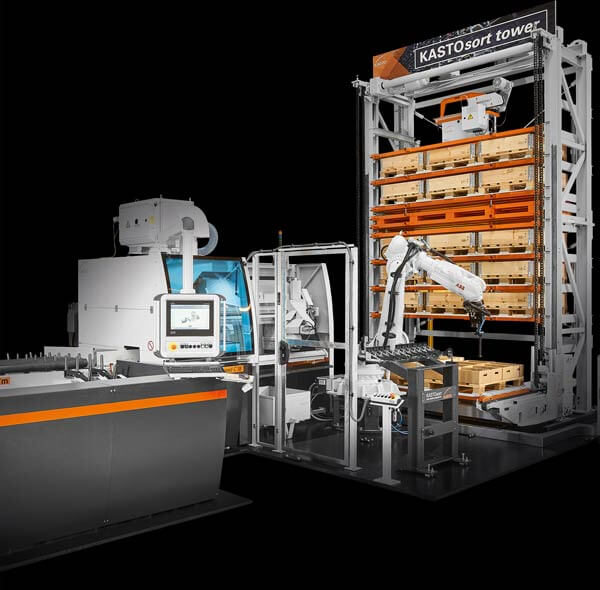
But given the labor shortage in manufacturing, the need is growing for automated solutions that allow shops to do more with fewer workers. One of Kasto’s more recent developments in this arena is Kastosort, a robotic material handling system. It obtains all the information it needs through the shop’s ERP system, which means no programming expertise is required of the user.
A large electric motor company in Germany is a recent adopter of Kastosort, as well as other highly automated material handling systems.
“We’ve installed a robotic solution that separates the pieces,” Dolipski says. “Once they come off the saw, the robots check them and deburr them, and once they’re all good, they go into a bin. From there, an automatic guided vehicle picks up the bin, takes it into a storage space, and from there it gets moved on to the machining centers.”

Dolipski emphasizes the importance of the inspection of parts coming off the saw, which is a crucial step that can be automated.
“You can essentially guarantee 100 percent inspection of all pieces with the robot without actually having a person standing there and checking every piece,” he says. “You’re increasing the quality of the product you’re outputting, meaning less machining to be done.”


