

Silence may be golden, but noise pays the bills. The hum of the shop floor – machines cutting, conveyors rolling and robots working – is the sound of money being made. Since the Industrial Revolution, manufacturing equipment has kept the lights on, driven growth and made stakeholders happy.
But when the noise stops, so do production and profits. Unplanned downtime is a manufacturer’s worst enemy. A Forbes article reports that manufacturers lose an average of 800 hours per year to downtime, costing the industry a staggering $50 billion annually. Meanwhile, the costs surrounding the purchase, installation and programming of a new robot make that type of automation out of reach for many manufacturers.

With equipment performance and uptime more critical than ever, manufacturers are literally taking matters into their own hands by diagnosing and repairing machinery in-house to minimize downtime and maximize productivity. This increasingly includes servo motors.
Servo motor role
As production equipment becomes more sophisticated and automated, servo motors have taken on a greater role in providing power and precision. They are now essential in manufacturing applications, including laser cutters, CNC machinery, stamping presses, robots and more. However, when a servo motor stops working, so does the equipment it powers.
Operating under heavy workloads and in harsh manufacturing environments, servo motors are exposed to conditions that can impact their performance. A typical servo motor control system consists of four key components: a DC servo motor, driver, controller and encoder. While any of these can fail, encoder issues are often the hardest to diagnose.
Encoders provide position feedback to the controller, allowing it to calculate rotation angle, speed and travel distance. One often overlooked cause of motor or machine failure is encoder misalignment. Fortunately, with the right diagnostic tools, encoder alignment and other servo motor parameters can be quickly assessed and corrected.
Servo motor repair
The typical approach of manufacturers to servo motor repair is to outsource the entire responsibility. However, to save time and costs, both on repairs and by reducing production downtime, many are beginning to perform some of these tasks in-house. Accurate diagnosis is critical in a manufacturing environment. A common frustration arises when a repaired servo motor is reinstalled, only for the issue to persist. Sometimes, the motor was never even the problem. Other times, repairs were inadequate.
To avoid unnecessary downtime and expenses, more manufacturers are investing in diagnostic tools to identify servo motor issues before acting. Servo motor testing tools help prevent these setbacks by verifying motor performance before repairs are made and before the motor is returned to operation.
The right tools
Using the right tools for servo motor diagnostics and repairs eliminates guesswork, reduces downtime and ensures equipment operates at peak performance. Investing in proper testing and validation tools ultimately saves time, money and resources, preventing costly breakdowns and production delays.
Attempting repairs without specialized tools introduces significant risks, including inaccurate diagnostics, inefficient fixes and extended downtime. General-purpose tools, such as oscilloscopes and multimeters, are useful diagnostic tools, but alone are inadequate for the special job of diagnosing servo motor issues. They lack the ability to represent resolver voltages as angles, cannot interpret serial encoder data streams and fail to effectively verify counts per revolution on a high-resolution quadrature encoder. As a result, misdiagnoses occur, leading to unresolved problems, wasted time and increased repair costs.
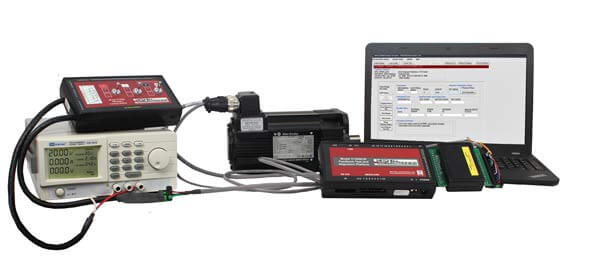
Common challenges faced when repairing servo motors without the proper tools include:
- Inaccurate diagnostics: Many technicians rely on general-purpose diagnostic devices, but these tools lack the precision needed to detect servo motor-specific issues, such as encoder feedback errors, commutation faults and motor winding problems. Without specialized testing equipment, misdiagnoses are common, often leading to unnecessary part replacements, additional damage and prolonged downtime.
- Encoder alignment issues: Encoders are vital to servo motor performance, but testing them without proper tools makes it difficult to verify alignment or detect issues like signal degradation and noise interference. Misalignment affects torque and velocity control, leading to inconsistent performance, reduced accuracy or complete system failure. Even minor deviations in encoder alignment can cause significant operational disruptions.
- Extended downtime: Without precision diagnostic tools, troubleshooting often becomes a cycle of trial and error. Technicians may misidentify root causes, leading to ineffective repairs and unnecessary part replacements. Additionally, servo motors are sometimes sent out for repair without first being diagnosed in-house, an avoidable mistake that can increase costs and delays.
- Incomplete repairs and validation failures: When repairs are not properly validated, lingering issues can escalate, resulting in decreased efficiency, premature failures and costly unplanned downtime. Poor validation methods can disrupt operations, delay orders and even risk lost contracts. Ensuring repairs are thoroughly tested before returning servo motors to service is crucial for long-term reliability.
Eliminating guesswork
Mitchell Electronics Inc. specializes in motion control and diagnostic solutions, providing advanced servo motor testing systems for manufacturing applications. Stuart Mitchell, vice president, explains that a growing number of manufacturers are taking a proactive approach to servicing servo motors.
“The ability to perform a diagnosis and pinpoint problem areas eliminates subjective trial and error and allows repairs to be focused where needed,” he says. “This saves time and costs, not only in terms of the repair itself but in minimizing downtime and its effect on production.”
Diagnosing servo motors on the spot slashes downtime by only repairing motors that are truly defective. Lead times on certain repairs can be reduced from several weeks to a matter of hours. Manufacturers are still encouraged to work with servo motor repair shops when their expertise is needed.
Recommended repair
By following a structured process, technicians can ensure consistent, high-quality repairs across different servo motor brands. Mitchell Electronics published a nine-step process to effectively document, troubleshoot and validate servo motor repairs. That process involves the following directions:
1. Document the motor and power supply. Record key information from the motor nameplate, including manufacturer, model, serial number, voltage, amperage and rpm. Maintaining a data sheet ensures accurate tracking and efficient repairs. Servo motors have separate power and feedback connections. Photographing the power connectors and labeling the wire colors and pin numbers will prevent wiring errors during feedback alignment.
2. Measure motor winding resistance. Use an ohmmeter to check resistance between power connector pins. Look for unbalanced readings or low resistance to ground, which may indicate shorted windings.
3. Determine the number of motor poles. Because this information isn’t always on the nameplate, unlock the brake and apply half the rated current to the motor and then mark the shaft position. From there, rotate the shaft, then reapply current to find the number of lockup positions. Finally, multiply the number of pole pairs by two to determine the total motor poles.
4. Identify the forward direction of the motor. Apply voltage to different pin pairs and observe shaft movement. A systematic voltage pattern helps determine whether the motor’s forward direction is clockwise or counterclockwise.
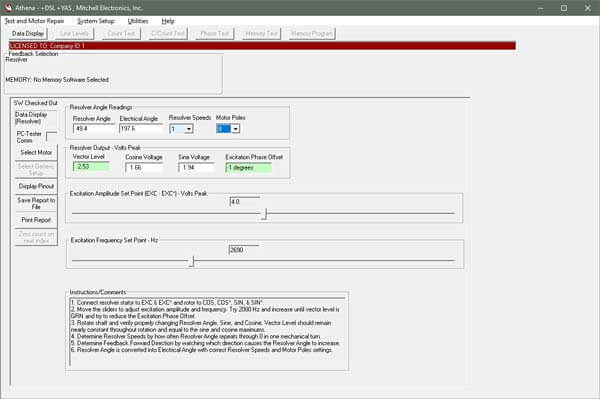
5. Verify the Ke rating. The Ke rating (found on the nameplate) can be validated by spinning the motor and measuring the voltage generated at the pins. Low Ke values may indicate winding or magnet issues.
6. Test and document the feedback device. Before diagnosing the encoder, identify the model or style. This can sometimes be determined from the motor part number on the motor nameplate. Other times, the motor housing must be opened to read the encoder part number or otherwise identify it.
7. Document the forward direction of the feedback device. By observing which rotational direction causes increasing counts, determine if the feedback has a clockwise or counterclockwise forward direction. Correct feedback forward direction is required for feedback alignment.
8. Document the current alignment of the feedback device. Knowing the alignment of the encoder’s connection to the motor is nothing short of critical. Attempting this manually often causes problems because a slight misalignment of more than three electrical degrees can prevent the motor from running or cause it to overheat or run inefficiently. To help ensure proper alignment, document the servo motor’s alignment angle prior to disassembly.
9. Run and test the motor. While some manufacturers use dedicated drives, a universal approach is often more practical for multi-brand servicing. Before operation, manually rotate the shaft to verify signal integrity. Then, run the motor to check forward/reverse motion, speed limits, temperature, vibration and noise levels.
To avoid the sound of silence and keep things humming, manufacturers must respond quickly to equipment problems. More and more, this means having the ability to diagnose and repair their servo motors. As a result, companies are supplementing in-house technical resources with the necessary tools to identify and, in many cases, fix servo motor and encoder problems.
For additional resources on servo motor troubleshooting and maintenance, Mitchell Electronics has produced a variety of tools to use, including a detailed reference guide.


