The shift toward automation in manufacturing is not a passing trend but a transformative movement reshaping industries with new tools and technology. As businesses grapple with rising labor costs and labor shortages, supply chain disruptions and quality control demands, automation emerges more and more as a vital solution. To truly harness its power, companies must identify their unique “why” for adopting industrial robotics and develop strategies to maximize the benefits based on their reasons.
Automation offers solutions to several key challenges in modern manufacturing. By understanding the most common motivations and their associated benefits, companies can make informed decisions about integrating robotics into their operations. Each of these “why” priorities also indicate what the company should focus on when commencing its automation journey.
Finding priorities
1. Increasing product quality
Automation excels in precision and consistency, qualities that can significantly reduce production defects. For example, welding robots produce highly repeatable weld seams, dramatically cutting down rework and recalls and enhancing product reliability. Additionally, even smarter systems incorporating AI and real-time feedback loops are being deployed by companies like Path Robotics and Novarc Technologies to ensure consistent quality improvement.
Automation can reduce defects by up to 75 percent, highlighting its potential to elevate standards across industries. Companies wishing to increase product quality should look for experienced integrators that have likely seen their parts before and have a method to integrate inspection components in line with their robots.

2. Reducing waste and scrap
Industrial robots, such as those used in laser cutting or plasma processes, offer precise movements that minimize material waste. The robot runs programmed jobs with sub-millimeter repeatability. Offline programming packages offer built-in tools that maximize material use and movement efficiency. Many of these factors can be completed by a highly skilled welder, but their efforts can be reproduced through the robot rather than resorting to unskilled labor. Because of these factors, automation can dramatically reduce human errors and optimize material usage compared to manual labor.
When prioritizing reduction in waste and scrap, repeatability is key so companies should focus on addressing consistency with their part suppliers and designing good tooling to minimize variations. Also, they should look at automation upstream in their fabrication process, such as how they cut or press their parts, for example.
3. Addressing labor challenges
Repetitive, dangerous tasks often contribute to high turnover rates in manufacturing. Machine tending robots alleviate such issues, improving worker satisfaction and retention, which is incredibly important as the number of skilled welders is not enough to fill the number of vacancies in this space. The American Welding Society is still predicting 82,500 welding jobs will need to be filled annually between 2024 and 2028. Facilities with automation report a drop in turnover and an increase in worker satisfaction after implementing these tools, and thus, they are becoming more productive and consistent with output.
Addressing these labor challenges should go hand in hand with ease-of-use tools in robotics, such as software solutions like Yaskawa’s WeldBuilder built into the teach pendant. Also, quality training for new programmers and operators ensures long-term success.
4. Boosting throughput
The robot’s ability to operate faster and longer than humans without taking breaks enables a significant increase in production speed. Tasks like welding or assembly become more efficient with automation boosting throughput by 20 to 50 percent, depending on the application according to the International Federation of Robotics.
When boosting throughput, cobots offer a marginal increase in production, but traditional industrial robotic solutions, especially ones using multiple robots, drastically reduce cycle times and, thus, increase the number of parts produced in a given amount of time. All these solutions also offer data collection options through partners like Checkbot to provide visualized key performance indicators (KPIs) to help managers fine-tune their operations.
5. Cutting costs
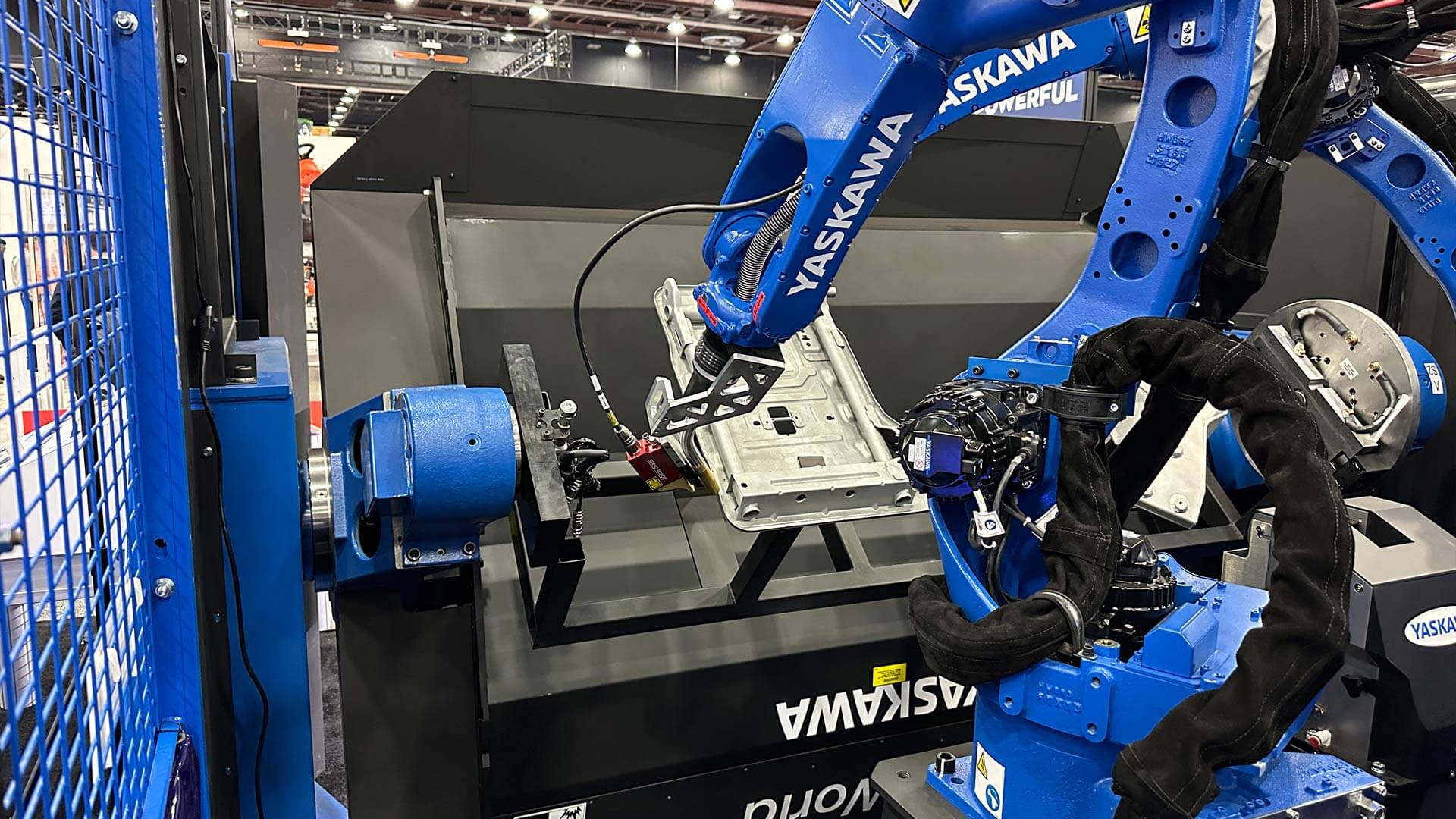
Though initial investments in robotics are substantial, long-term savings make them worthwhile. Cobots are particularly effective for small and medium-size enterprises, performing tasks like palletizing and lowering labor costs and improving material efficiency. The result? Manufacturing cost reductions of 10 to 25 percent in typical installations. For speedy ROI on automation, cobots and pre-engineered solutions like Yaskawa’s ArcWorld welding cells offer fast implementation with the lowest automation costs and proven results.
6. Attracting new business
Automated systems position manufacturers as competitive and reliable partners. With improved scalability, stable quality and on-time delivery, customers note that just having the robots has helped them win more contracts. Enhanced capabilities also allow for more complex orders, broadening customer bases.
To attract new business with automation, companies should look for systems that provide flexibility and quick-change tooling options. These are typically found with pre-engineered cells. Multiple systems that can handle a wider range of part sizes are also valuable.
7. Enhancing health and safety
Liberty Mutual’s annual workplace safety index claims that workplace injuries cost U.S. companies $58 billion per year with the top two being “overexertion involving outside sources” and “falls on same level.” Automation reduces workplace injuries by assigning hazardous tasks to robots, but also reduces some of these ergonomic and common tripping accidents. Research shows that for every 1.34 robots added per 1,000 workers, injury rates drop by 1.2 per 100 workers. This reduction translates to billions in annual savings and improved employee welfare.
To ensure robots are reducing and preventing injuries, companies should use an experienced integrator that will provide a risk assessment. These assessments ensure that all potential safety risks have been mitigated by the engineers of the system. Conveniently, this is also already a part of pre-engineered systems. Also, cobots inherently reduce many of the risks associated with industrial robots, if they can handle the application.
8. Improving manufacturing flexibility
Robots can easily switch between tasks and, through programming updates, offer agility in responding to new product designs or market demands. Automated systems can cut changeover times by 50 percent, ensuring adaptability in dynamic environments.
Flexibility can also be associated with the advantages mentioned about winning new business. With this automation strategy, companies should invest in standard pre-engineered systems. However, they also want to invest in quality programming training for operators. This will ensure all new parts can be programmed appropriately.
9. Strengthening supply chains
Automation enhances efficiency in supply chains, reducing lead times and ensuring consistent product availability. Automated packaging and logistics systems improve operational efficiency by up to 30 percent, mitigating disruptions and inventory errors.
To ensure the supply chain remains strong, companies should look at automating their long lead time parts first. Also, deploying a pre-engineered system typically saves four months or more on installation execution. Data collection of the KPIs previously mentioned will also help ensure the right number of parts are being made to quality expectations.
Strategic planning
Realizing the potential benefits of automation requires a well thought-out strategy aligned with a company’s operational goals. Successful automation begins with defining the “why” and progresses through careful planning and execution.
An effective automation program starts with identifying the core challenges a business faces. Whether addressing labor shortages or quality concerns, aligning automation goals with broader operational strategies ensures impactful outcomes. McKinsey emphasizes that automation projects must demonstrate clear ROI to gain executive support.

Standardized metrics are essential for evaluating the success of automation projects. Metrics such as overall equipment effectiveness (OEE), defect rates and labor savings provide valuable insights. Establishing benchmarks before implementation allows companies to track progress and make data-driven adjustments.
Overcoming challenges
Despite its advantages, automation presents challenges that businesses must address to ensure success:
• Resource availability: Automation requires significant time and expertise. Companies should assess their internal capabilities and consider external support if needed.
• Cost justification: High initial costs can deter adoption. Clear ROI calculations, including long-term savings and productivity gains, are crucial for stakeholder buy-in.
• Training and adaptation: Employees must be adequately trained to operate and maintain automated systems. A focus on ease of use and quality training mitigates resistance and fosters collaboration.
As industries evolve, automation is expected to play an even more prominent role. The manufacturing sector, for instance, faces ongoing labor shortages and supply chain disruptions. Automation not only addresses these immediate issues but also positions companies for resilience in a rapidly changing landscape.
Key to success is starting small. Instead of overhauling entire processes, companies should focus on automating straightforward tasks with measurable benefits. This approach builds confidence and lays the groundwork for scaling up.
Finding the “why” for automation is not just about adopting technology; it is about solving real-world challenges and unlocking opportunities for growth. By understanding the motivations behind automation, planning strategically and addressing potential hurdles, businesses can maximize the transformative power of industrial robotics. As the manufacturing landscape continues to shift, companies that embrace automation with clarity and purpose will lead the charge into a more efficient and sustainable future.