

Despite their relatively simple design, pressure vessels and tanks can present complex fabrication challenges. Charged with storing liquids and gases (often hazardous or corrosive) under sometimes demanding conditions, there can be no questions surrounding their structural integrity. Consequently, manufacturing these impenetrable chambers requires that metal be formed, cut and welded to exact specifications.
Because pressure vessels must withstand intense forces and high temperatures, their construction is guided by stringent safety, environmental and regulatory requirements. This includes standards such as the American Society of Mechanical Engineers (ASME) Boiler and Pressure Vessel Code. Compliance involves extensive documentation, regular inspections and adherence to strict fabrication standards.
Depending on their usage, pressure vessels and tanks are constructed from a variety of material types, with the most common being stainless steel, carbon steel and specialized alloys. Material selection is nothing short of critical as the wrong type or thickness can lead to premature wear, leaks or even a catastrophic failure.
Material thickness and quality welds are key to safety and reliability. For pressure vessels, the higher pressure and vacuum along with the outside diameter (OD) determines the thickness of plate required for the vessel. As an example, a 120-in. OD by 600-in. horizontal vessel with 40 bar pressure requires a 1 3/4-in.-thick shell. Comparatively, a vessel of identical size and pressure with a 144 in. OD requires a 2 1/4-in.-thick shell.
In the past, fabricators were limited in terms of metal bending. Today’s equipment allows industrial pressure vessels and tanks to be constructed from the thickest materials. The walls are formed by a method known as plate rolling. The process involves bending a flat plate into a curved circular shape. The ends are then welded to form a single cohesive cylinder.
Over the centuries, fabrication has evolved from a primitive hand forming process to one driven by industrial steam and later electric motors. Advancing technology has had a measurable impact on pressure vessel and tank fabrication. Powerful equipment can roll increasingly thicker plate resulting in larger and stronger pressure vessels and tanks.
Keys to operation
With more than 70 employees, Waterford Tank & Fabrication Ltd., Beverly, Ohio, is a full-service manufacturer of above-ground storage tanks and custom ASME pressure vessels. Certified in ASME Section 8 Division I, API-12F and UL 142, the company boasts a 90,000-sq.-ft. fabrication facility housing an extensive arsenal of equipment, including a plasma table, combination plasma-oxyfuel table, press brake and 10 overhead cranes. Key to operation is three Davi plate rollers capable of rolling 10-ft.-wide plate ranging in thickness from 0.25 in. to 4.25 in.

Matt Brook, president of Waterford, explains that prior to adding a heavy plate roller, the company’s capabilities were limited from roughly 3/4 in. to 1 in. This limited the services that the fabricator could provide while adding time, cost and complexity to the job. What’s more, Brook knew that growing the business would hinge on the ability to work with thicker plate.
“Prior to investing in a large plate roller, we were forced to acquire thick-rolled plate from the outside,” he says. “Using the services of a third party not only added cost but made the process time-consuming. Before the purchase of the new Davi equipment, we couldn’t roll and pre-bend more than 7/8-in.-by-10-ft. plate. With no pre-bend, we would leave a flat spot on each end of the plate, trim and re-roll. Creating a single tank cylinder would take anywhere from four to six hours to complete.”
Earlier, Waterford had purchased a Davi 1/2-in.-by-10-ft. vertical plate roller followed by a 1 3/8-in.-by-10-ft. Davi horizontal roller. Complementing these capabilities with a plate roller capable of bending heavy plate would allow the company to bring thick plate rolling in-house for pressure vessel and tank work. Brook knew exactly where to turn.
“The first set of Davi rollers remain our workhorses,” he says. “They are reliable, easy to program and have had a real impact on our bottom line. Pressure vessel and tank fabrication requires thick plate rolling, and bringing this capability in-house allows us to take on more jobs, leverage our skilled workforce and grow the business. Our experience with Davi and Moden Machinery Co. was a good one, so we turned to them again.”
As a distributor of sheet metal fabrication equipment throughout Indiana, Ohio, Kentucky and Michigan, Modern Machinery is an exclusive Davi dealer.

A full arsenal
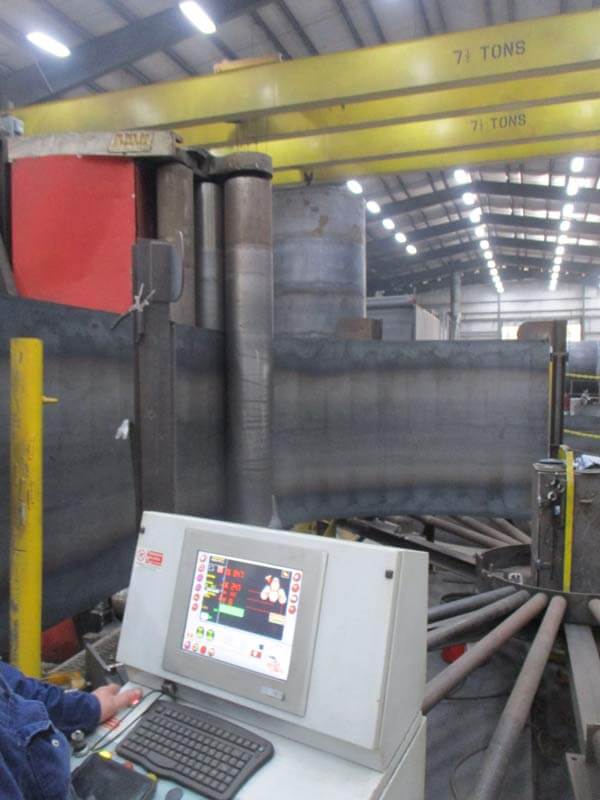
Davi builds plate and angle rollers for any customer application requirements. After meeting with Modern Machinery, Waterford purchased a Davi MCB-T30 plate roller. Davi integrates digital Roll-by-Wire, permanent lubrication and a dual Servo-Tronic parallel system allowing parts to be produced accurately and reliably while ensuring a maintenance-free plate roller. With 6.5 tons of bending power, the MCB-T30 can roll up to 20 ft. of plate per min. ranging from 5/8 in. to 4 in. thick and more, depending on yield and tensile strength.
Unlike on a 3-roll plate roller, there is no need to pre-bend the two edges of the plate first and then roll the cylinder. A cylinder can be rolled, including the pre-bending of both ends, feeding the plate forward through the rolls in a single motion using Davi’s CNC 4-roll technology.
Mark Clayton, sales representative, Modern Machinery, explains that Davi’s CNC controls can be self-programmable, which includes the innovative iRoll eXtreme control system.

“Fully customizable, the iRoll eXtreme is a high-technology control system that is easy to use for programming automated sequences and manual mode rolling,” Clayton says. “The system’s high-resolution touchscreen includes live 3-D graphics that create a smartphone-like environment. This makes operation easy and intuitive for novice and experienced operators.”
Additional features include advanced diagnostics, a template library for standard and custom shapes, and assisted manual mode for experienced operators.
The addition of the Davi heavy plate roller provides Waterford a full arsenal of plate rolling equipment. The company can now offer turnkey pressure vessel and tank fabrication services with greater production efficiency faster at lower costs. With this combination of equipment and resources, Waterford is well-positioned to expand its offerings and add to its growing customer base.
“In today’s manufacturing landscape, one must be willing to take full advantage of available technologies,” Brook concludes. “It’s true that capital equipment is a significant investment, but for those who truly understand the benefits that the right equipment can deliver, the results can have a measurable and sustained impact on the bottom line.”
Waterford Tank & Fabrication Ltd.


