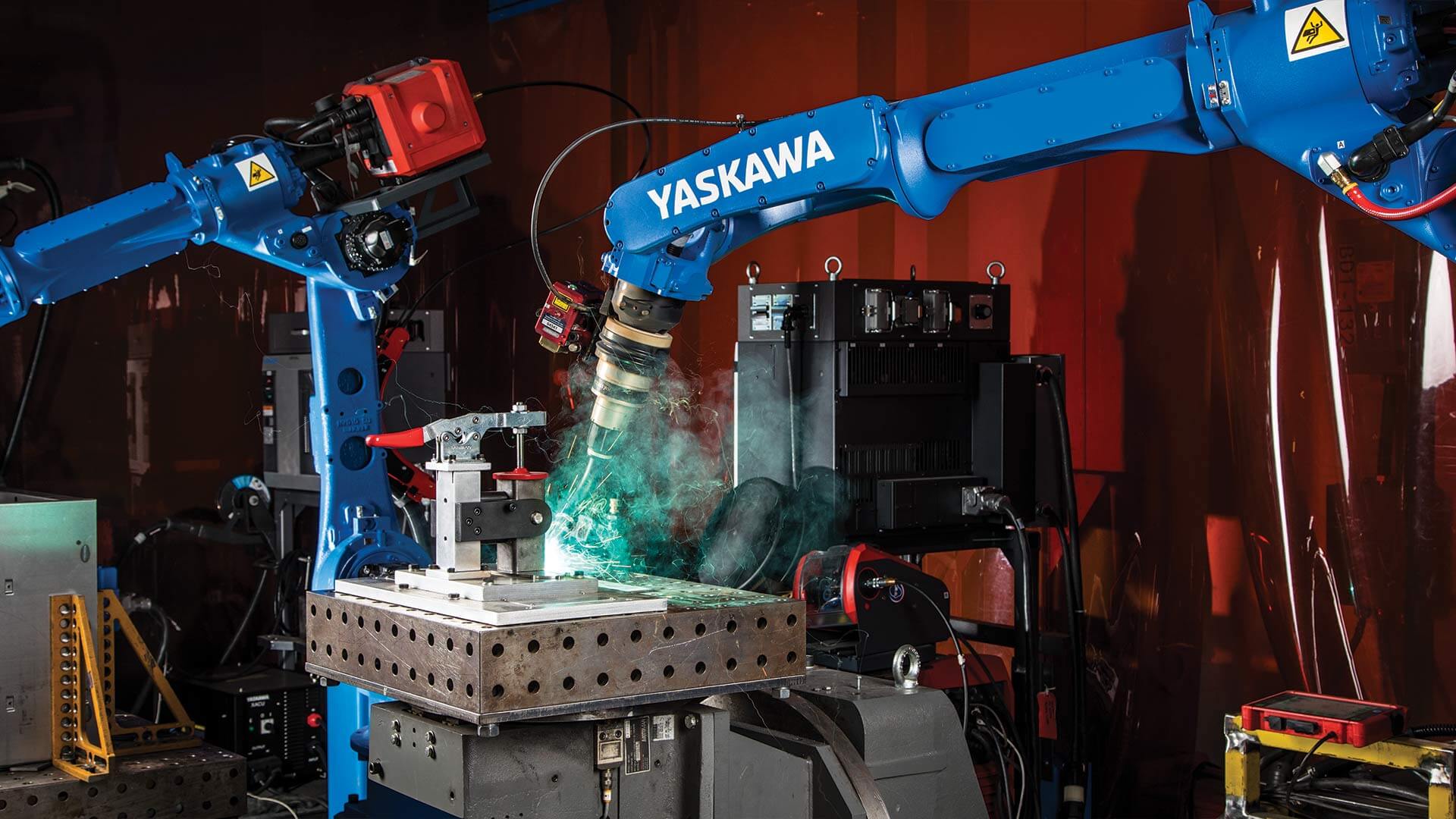
To create value at scale, companies are strategically incorporating a range of advanced technologies, cultivating highly efficient workspaces that unlock drastic reductions in operational downtime and costs. A key driver for this success is the integration of high-performance robots with intelligent peripherals, including an influx of Industry 4.0-inspired inter-connected sensors and devices for predictive maintenance, production monitoring and asset management.
As a result, businesses of all sizes throughout the industrial sector are undergoing complete digital transformations. They are optimizing manufacturing environments and creating integrated smart factories that effectively meet rapidly evolving demands.

Successfully integrated factories have the potential to be “knowledge goldmines,” providing valuable insights that assist with tracking overall equipment effectiveness (OEE), maintaining process efficiency and monitoring part quality. From robot controllers, weld interfaces and power sources to 3-D perception systems and more, a variety of machines and devices provide data for dynamic decision making. A great deal of information can be captured to enable data-driven actions, such as process times, part counts, weld parameters and consumption rates.
The right platform
Collected via inclusive cloud-monitoring systems that support an array of heterogeneous equipment, including third-party applications, modern-day platforms utilize a common connectivity framework or communication protocol for intelligently networking devices. Companies seeking to implement a protocol for low-resource devices in low-bandwidth settings with high latency may find benefit with Message Queue Telemetry Transport (MQTT).
Well-suited for embedded computers, low-power sensors, microcontrollers or mobile devices, lightweight message protocol platforms like MQTT work via a Publish/Subscribe (PubSub) model that uses an open-source message broker (a.k.a., server). In essence, this method facilitates a server to receive data then distribute it back to subscribers who request the data.
For expanded open-sourced options, Ethernet-based Open Platform Communication Unified Architecture (OPC-UA) interfaces, such as Yaskawa Cockpit, enable an integrated, intelligent and innovative (i3-Mechatronics) approach to data harvesting. Using a one-to-one topology – where clients (a.k.a., devices, sensors, robots, etc.) request data and servers timely respond with said data – this feature-rich option enables decision makers to see what is happening at any point on the value creation chain to gain actionable insights for customizing operations. Each client can interact with multiple servers and vice versa.

Sometimes, a single device may even operate as both a client and a server. If needed, additional functionality is available via an OPC-UA PubSub AddOn.
Regardless of the platform used, data is essential to staying competitive. Whether used to maintain key performance indicators (KPIs), train a robotic application via artificial intelligence (AI) feedback or something else, the value this knowledge can provide for actionable insights should not be overlooked in fabrication operations – as short-term and long-term benefits can offer substantial impacts.
Short-term benefits
Robots equipped with intuitive technology and sensors can capture a wealth of data to influence greater agility, consistency and efficiency. In the short term (and, sometimes, almost immediately), tangible benefits can be experienced using the following actions:
• Pass/fail inspection. Robotic welding workcells are designed to complete a thorough weld sequence. Part of this is to provide a pass/fail response, checking weld seam accuracy and quality. Inspection sensor options use state-of-the-art laser vision technology to evaluate weld joints. From measuring welds and determining porosity to detecting burnthrough and more, multiple devices exist to optimize various welding processes.
A unique solution, IBM’s Smart Edge system uses live visual and audio data taken at the time of the weld, allowing AI and machine learning models to analyze weld quality and prompt remediation action, if needed. Solutions like this substantially reduce the time between defect detection and rework, contributing to overall cost savings while providing recorded data for further traceability.
• KPIs. Every company has goals and metrics that it needs to reach, and all the data collected can be used to create insightful charts and graphs to visualize performance. This can be helpful for at-a-glance status and achieving different strategic goals. Ideal for cycle time and part count, monitoring KPIs in real time can help determine which workcells, shifts, etc. are more efficient and accurate, revealing the “why” behind things like slow throughput.
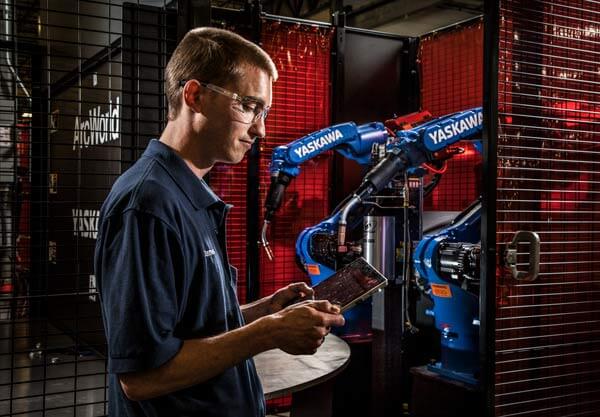
• Predictive maintenance. The more devices on the production floor, the more data that can be collected and analyzed. By tracking sensor and usage data on factors such as time, vibration, torque and temperature, maintenance needs can be anticipated and addressed before untimely breakdowns occur. Applications can also be built and provide timely reminders when specific maintenance needs to be performed.
Long-term advantages
Over time, companies that successfully integrate robotic automation, along with smart technologies for machine monitoring, will have greater capacity to scale operations for meeting mission-critical business goals. In the long run, data harnessing can provide transformational benefits in the following ways:
• Continuous improvement. As data is accumulated, comparisons can be made. Questions, like, “Do different welding processes yield fewer failures?” can be answered, and fine adjustments can be made moving forward. Changes regarding existing jobs, filler metals, torch type and waveforms can all be made to generate refinements – with cycle time often seeing improvement.
• Traceability. Especially important for automotive manufacturing and the formation of safety critical welds, the use of sensor technology provides the needed traceability for processes like weld seam inspection. And while this is important in the short term, the data collected can also contribute to future failure rate calculations and design revisions, if needed.
• Training AI. AI can use data to make automated changes to a system. Applications once thought impossible are coming to fruition, improving operations for more fabricators. AI models, based on loads of data for machine learning, are enabling robots to yield high-quality parts in record time, exceeding consumer expectations for long-term customer satisfaction.
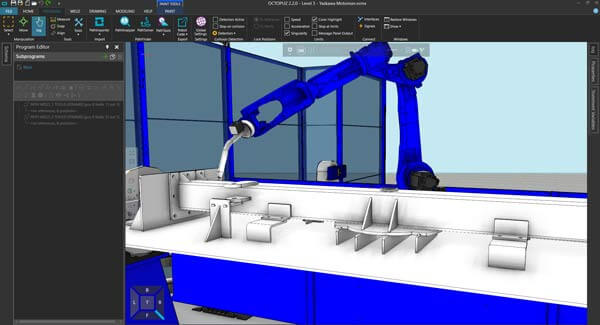
• Machine optimization. From warranty analysis to machine design, long-term data collection over a robot’s life cycle can aid in various ways. Offline programming packages, like MotoSim EG-VRC, Robotmaster, Delfoi, Cenit and Octopuz, utilize a variety of tools to take a user-programmed job and provide path and process optimization for the shortest possible cycle time. As mentioned, this data can also be used in modeling for AI-powered adjustments.
• Process improvement. Data collected over time can help shape internal processes, establishing Kaizen and lean manufacturing practices. Identifying waste, such as excessive downtime, underutilized equipment and disproportionate defects, can help eliminate bottlenecks and provide a more efficient manufacturing flow.
Tangible fabrication goals
Whether utilizing individual devices or a comprehensive monitoring tool that provides the flexibility to monitor the health, status and performance of a networked production environment, decision makers looking to leverage the advantages of data should first establish operational objectives.
Setting clear goals is crucial as it helps focus efforts toward specific outcomes such as optimizing OEE, reducing downtime, removing bottlenecks, increasing throughput, improving quality and other anticipated results. Long-term and short-term goals, along with quality standards and cycles per minute/day/hour, are all things to consider where welding is concerned.
Once goals are established, a roadmap for success can be made, including a list of reasonable action items that should be achieved. Overall, the ability to efficiently capture data and harness its insights can be extremely valuable for fabrication operations, and it can be an operational gamechanger leading to a greater competitive edge.