Flip through the articles in any fabrication-related trade magazine and you will find yourself looking at topics like automation, robotics, welder shortages and other similar items related to workforce and productivity challenges. According to the American Welding Society, the United States is in need of more than 320,000 welding professionals by 2029.
While many factors contribute to this, the fabrication industry often is not viewed in a positive light by the next generation of skilled professionals. Faced with shortages of skilled welders, limited workforce experience and barriers to robotic welding adoption, technology companies like Fronius are developing new tools for fabricators to overcome these challenges.
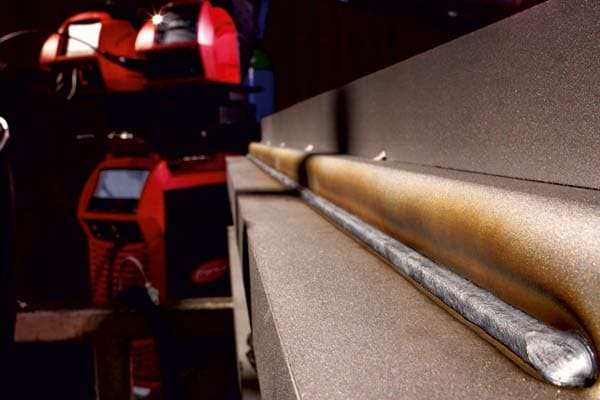
Long welds are a challenge even for experienced welders. Consistent speed and precise torch guidance are crucial for weld quality but are difficult and physically demanding over longer distances.
Fronius’s Velocity Assistant (referred to as Velo) makes it possible, for the first time, to control the welding speed during manual welding. The system is particularly suitable for applications with long, uniform welds, such as in commercial vehicle manufacturing, heavy machinery construction and general fabrication. It can be used for welding thin sheet metal and thick plate for steel; high-strength, low-alloy steel; and stainless steel.
Weld quality is a significant topic for companies building products, especially when manual welding is integral to the fabrication. Robotic welding has long offered consistent welds from part to part with weld length only limited by the robot’s reach. Welders performing manual welding must control their speed and reposition or strain to perform longer welds. Weld quality is directly affected by their skill, level of fatigue and practical reach. Velo was developed with this factor in mind.
When developing a welding procedure for a part, nearly all the parameters for the GMAW processes can be controlled by the machine, but the required travel speed and stickout are solely controlled by the welder. This directly affects the weld size, bead profile, penetration and heat input.
Making the case
The addition of a guide wire and travel speed control allows the welder to operate on “cruise control,” maintaining the travel speed that determines the weld size. The wire feeding system also maintains consistent stickout. The result is robotic-quality weld seams with the flexibility of a manual welding system.
The central element of Velo is a second wire – the so-called Velo wire, which operates without an arc or additional gas supply. This wire touches the workpiece in a stationary state and generates forward movement through friction. The feed rate of the Velo wire determines the welding speed.
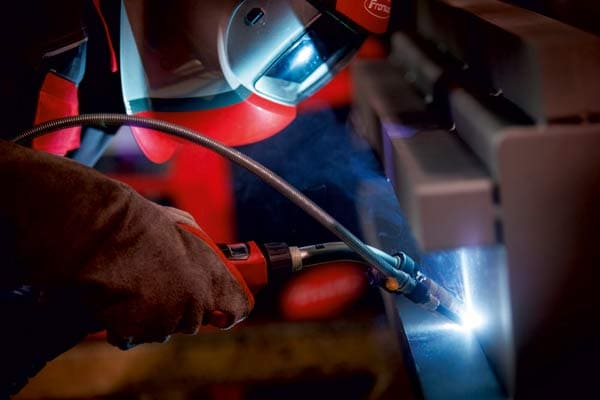
The Velo wire maintains a constant distance between the workpiece and the contact tip and moves the torch along the weld edge, notch or chamfer without any special joint preparation. Very little additional material is introduced, meaning that wire consumption corresponds only to the length of the weld seam.
The assisted guidance makes it easier for beginners to achieve consistent welds and relieves the strain on experienced welders during long or demanding tasks. This helps to maintain consistent weld quality across all skill levels. Under suitable conditions, Velo also enables welding speeds approaching those of robot-assisted processes, which can increase productivity.
Doing the math
The Velo, or guide, wire holder can be rotated 360 degrees without tools and securely locked in place. In areas with limited accessibility, the peripheral components can be easily removed from the holder and stored away. This flexibility makes the system suitable for all welding positions, including pipe welding with 360-degree seams and multi-layer applications. The feeding system is designed for use on 12-ft. to 15-ft. torches. Activation is directly at the torch, allowing for easy switching between manual and assisted wire feed, as needed.
Doing quick math on weld size versus weld metal deposited, consider a weldment that requires a 1/4-in. fillet weld. Maintaining that weld size can be difficult, especially on longer welds, and over-welding is common. For a weld that is just 1/16 in. larger, increasing from a 1/4-in. to a 5/16-in. fillet weld uses 56 percent more filler metal. An oversized weld has a direct impact on the cost of the filler metal per part not considering the extra labor and heat input into the part.
For a stainless steel part, the ROI becomes clear quickly. When the filler metal is more than $10 per lb., that 50 percent more cost-per-weld in filler metal has a significant impact.
When access is difficult or the second hand is needed for support or positioning, this one-handed welding solution also helps achieve consistent weld quality. If the wire gets in the way in confined spaces, it can be easily removed and welding can continue conventionally.
A challenge arises when welding over tack welds with a trailing torch movement, as these are sometimes overlooked or noticed too late. Assistance with a lifting torch motion is necessary. Ideally, tack welds are applied to the back side, ground down on the face or provided with a small guide groove for the guide wire.
The shorter learning curve and reduced potential for errors make this manual welding method especially attractive amid a growing shortage of skilled workers. It also makes a variety of circumferential welds on upright pipes easier to perform consistently.
Getting the assist
With Velo-assisted welding, an innovative extension of GMAW semi-automatic welding is introduced, which enables a constant welding speed and significantly improved seam quality through an additional non-energized guide wire.
The guide wire handles the feeding motion, but it also manages the positioning and centering of the torch along the weld line. This significantly reduces the demands on manual torch guidance and opens new possibilities for consistent and reproducible welds, especially for less-experienced users.
Comparative tests with conventional MIG/MAG processes demonstrate significant advantages in terms of process stability, weld quality and ease of use. Furthermore, Velo offers a future-oriented solution for increasing efficiency and quality assurance in manual welding especially in light of the increasing shortage of skilled workers.
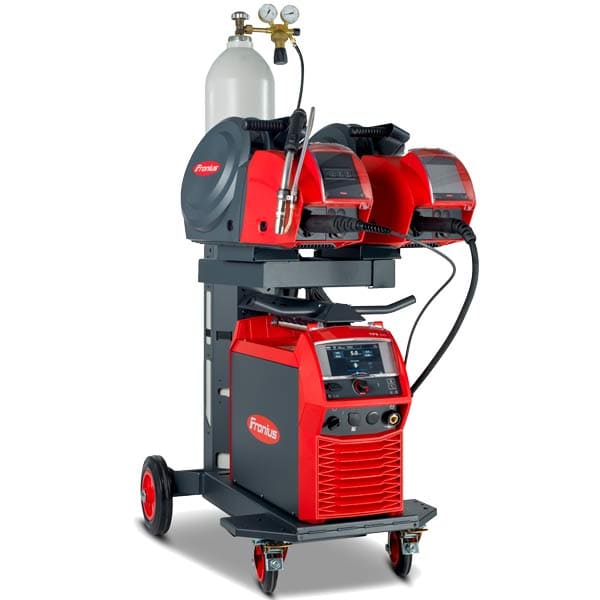
The guide wire does not provide a significant impact on wire deposition or penetration of the weld puddle. It is easy to position for left-handed or right-handed welders and can also be removed easily when not in use.
The wire retracts as part of the process when the weld is terminated. With a JobMaster torch, users can turn off the process at the torch for welds where the assistance system is not required.
Welding procedures must often be developed around what a typical welder can maintain for travel speeds. If a procedure is created for 40 ipm travel speed using pulse GMAW, then users have to consider what the typical welder is capable of on a daily work task. A more typical travel speed would be less than 30 ipm with Velo, which allows users to perform welds at robotic speeds because the fatigue and skill level of the welder is optimized by the welding system.
Manufacturers can now deploy a tool in their manually welded parts where weld size, stickout and travel speed is consistent. The travel speed can also be positioned near the higher end of the curve because the concerns about skill and fatigue is addressed.
Compatibility
Velo is compatible with the TPS/i systems (TPS 320 to 600i) and iWave (300 to 500) Multi-process Pro (GMAW) systems. It is also possible to retrofit an existing system already in production use. Only the following are required:
- Additional wire feeder, WF 25i Velo 4R/FSC, and mounting accessories
- Compatible Fronius torch with Velo feeding hardware (JobMaster suggested)
- Push or CMT torches are supported when using steel or stainless wire
- Velo software activation
Integration into existing systems is quick and requires no extensive modifications. Also, the guide wire should be the same alloy as the filler metal and must be a solid wire either 0.040 in. or 0.045 in. Smaller or larger wire is not supported, and aluminum is not possible due to the low-column strength for applying the friction properly.
Fronius is focused on providing manufacturers with real-world solutions. With this latest development, professionals now have access to a new tool to reduce welder fatigue, optimize process variables, control filler metal costs and stabilize weld quality. In addition, Velo can be paired with WeldCube Navigator, giving users total step-by-step control of welding fabrication from start to finish.
Learn more about automated processes that can improve welding productivity by visiting our free archive of material.