In today’s manufacturing environment, resistance welding performance directly impacts productivity, quality and profitability. Inconsistent welds lead to scrap, rework, missed deliveries and dissatisfied customers.
At T.J. SNOW, we see firsthand that most spot, seam and projection welding problems are not caused by a single failure. Instead, they result from a combination of equipment limitations, maintenance issues and process application challenges. Understanding these factors allows manufacturers to correct problems quickly and build stable, repeatable welding systems.
This column outlines the most common sources of weld discrepancies and provides practical guidance in pinpointing those areas to improve production performance.
Equipment factors
There are two primary sources of weld discrepancies, and they are related to equipment and process application. The welding machine is the foundation of the resistance welding process. If the machine cannot deliver stable current and force, even a well-developed weld schedule will fail. Common machine-related issues include:
- Improper machine selection or insufficient kVA capacity
- Limited adjustment range for current or force
- Poor fixture design
- Excessive friction or inertia in the ram system
- Electrode tip skidding
- Transformer saturation
- Damaged primary or secondary leads
- Oxide buildup in secondary circuits – resistance
- Line voltage fluctuations
- Inadequate cooling systems
- Poor mechanical and electrical repeatability
These conditions create variability that cannot be corrected through parameter adjustments alone.
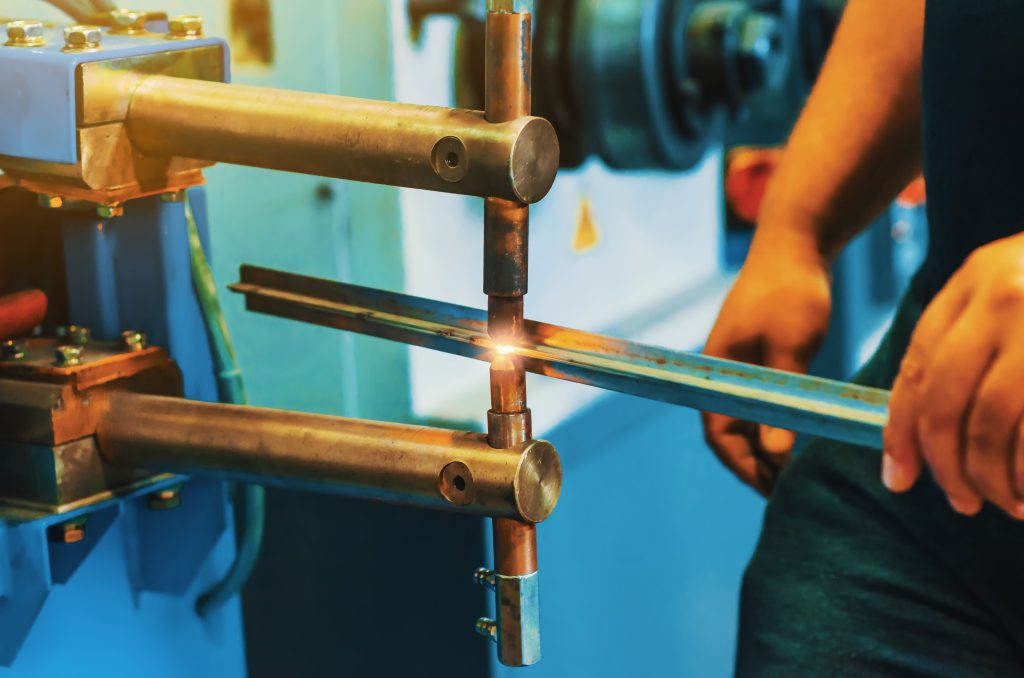
Electrodes play a critical role in heat generation and force application. Their condition directly influences weld consistency. Electrodes are considered the No. 1 common cause of weld failures. Common electrode-related problems include insufficient water cooling, worn or deformed tips that reduce current density, and tip misalignment or poor maintenance practices. Other issues such as incorrect face geometry (current density) and incorrect electrode class (alloy) selection are also common.
Regular inspection, dressing and alignment are essential to maintaining stable production.
Modern microprocessor weld controls offer advanced functions to manage heat input and weld repeatability. However, these features must be properly applied. Controls settings should be matched to the application and verified through regular testing. Typical control-related issues include missing or improper function use such as upslope, preheat, pulsation forge or temper. Inconsistent repeatability due to improper weld parameters is another problem to be aware of along with improper parameter settings for the material being welded.
Process application factors
Process application factors are the second primary source of weld discrepancies. Process application factors include joint design and part fit-up, surface condition, current shunting, weld parameters and process selection.
Joint configuration determines how force and current are delivered to the weld interface. Good weld quality begins with good joint design. Common joint-related concerns include:
- Poor part fit-up
- Inadequate joint overlap
- Sub-optimal part design
- Limited accessibility
Surface conditions have a major impact on contact resistance and heat generation. Stable welding requires consistent surface preparation. Typical surface-related problems include:
- Inconsistent thickness of finishes
- Oil, paint or drawing compound contamination
- High-resistance coatings
Shunting occurs when current bypasses the intended weld location. Shunting reduces effective heat input and weakens welds. Common shunting paths include:
- Previous welds – weld spacing
- The workpiece – contacting part other than at the electrodes
- Tooling and fixturing
Incorrect process selection and poor schedule development remain major contributors to welding problems. Common issues include:
- Using the wrong welding process parameters
- Improper weld schedule selection
- Incorrect projection size or location
- Welding too many projections simultaneously for the weld current available
- Improper projection spacing
Proper schedule development must be supported by destructive testing and process validation.
Common problems and causes
The key to avoiding problems often starts with the ability to identify them when they arise. The following highlights typical shop floor weld defects and their most frequent root causes.
Expulsion and porosity are conditions that create unstable molten metal and trapped gases. They are often caused by surface contamination, poor fit-up, low force, excessive current or weld time, and short squeeze time.
Undersized weld nuggets, a leading cause of field failures, and poor penetration are commonly linked to low current or short weld time, improper force, poor electrode geometry, dissimilar material heat imbalance, current shunting and voltage fluctuations.
Excessive indentation and surface marking, which reduce cosmetic and functional quality, are typically caused by excessive weld heat, improper weld force, defective or scarred electrode faces and misalignment of electrodes (skidding).
Cracking and nugget displacement compromise long-term weld durability and are often related to improper welding process for high-strength materials, delayed forging force, inadequate quench/temper mode, poor electrode design and dissimilar material combinations.
Warpage and distortion are known to increase downstream assembly problems. Common causes include excessive weld heat input, closely spaced welds, poor cooling (flood cooling in seam welds), improper weld sequencing (seam welds) and over-constrained fixtures.
Projection weld set-down issues can be a major setback as proper projection collapse is critical for consistent strength. Set-down issues are typically caused by low force, machine deflection, poor tooling, improper projection design and insufficient weld force follow-up.
Electrode wear, mushrooming and sticking are all undesirable electrode conditions, which are among the strongest predictors of weld stability or lack thereof. These conditions are frequently linked to:
- Excessive heat input – time
- Poor cooling; missing water tube
- Improper force; high resistance at faying surfaces
- Undersized electrodes; incorrect selection or dressing
- Coating on material – galvanized, galvanneal, aluminized
- Surface contamination such as stamping oils, dust
A practical approach
Successful resistance welding programs are built around systematic process control – not trial-and-error adjustments. This structured approach minimizes variation, improves uptime and supports long-term quality. A proven improvement strategy includes:
- Verifying machine capability and calibration
- Implementing disciplined electrode maintenance
- Validating weld control functions
- Reviewing joint design and fit-up
- Standardizing surface preparation
- Confirming weld schedules through testing
Consistent resistance welding does not happen by accident. It is the result of properly selected equipment, disciplined maintenance, validated processes and trained personnel.
Most weld discrepancies are preventable when manufacturers understand how equipment performance, electrode condition and application variables interact. By applying proven troubleshooting methods and sound process control principles, manufacturers can improve weld quality, reduce operating costs and increase overall productivity.
For more than six decades, T.J. SNOW has helped manufacturers achieve reliable resistance welding performance through equipment, service, training and technical support. When weld quality matters, experience makes the difference.