The landscape of robotic welding continues to evolve, not just with more capable robots, but with smarter ways to use them. For years, Yaskawa has been a leader in automated welding systems, offering industrial solutions that boost productivity, repeatability and quality. Yet even the most advanced welding robot is only as efficient as the programs that drive it.
Programming robotic welders traditionally meant stopping production and manually teaching every weld path – sometimes painfully one point at a time in hard-to-view areas of parts while avoiding collisions with tooling and the part itself. That is where offline programming (OLP) steps in. This mature, yet continually evolving, approach allows users to program robot paths, plan cycle times and even design tooling without taking a robot offline. The result? Higher productivity, faster launches and greater flexibility.
OLP refers to the ability to program robotic tasks using simulation software, rather than manipulating the robot directly on the shop floor. It began decades ago with tools like Yaskawa’s MotoSim software, first released in 1993, which allowed engineers to test and refine programs in a virtual environment.
Today, the technology has expanded far beyond basic simulation. Modern OLP tools offer 3-D digital twins of the robot cell; intuitive interfaces for defining weld seams; and features that automatically generate paths, validate reachability and check for collisions. Many packages now include capabilities for cycle time optimization and fixture design, transforming OLP from a convenience into a core capability.
OLP reasonings
The main reasons manufacturers turn to OLP include:
- Minimize downtime, maximize output: With OLP, programming is no longer tethered to the shop floor. Users can program parts, refine sequences and prepare entire jobs while the robot cell continues to weld previously programmed jobs. This eliminates the productivity loss that comes with live programming and frees up valuable process hours.
- Accelerate learning curves: Manual pendant programming often requires experience and patience, especially when working with complex geometries or awkward weld positions. OLP software shortens the learning curve by using visual interfaces, predefined motion libraries and automated path generation. Even inexperienced programmers can quickly generate efficient paths and get parts into production faster.
- Optimize cycle times: In traditional programming, refining cycle times often takes a backseat to getting the robot cell running. With OLP, users can iterate and improve path efficiency offline, even weeks ahead of a production run. Small refinements in torch angles, approach distances and part presentation can yield significant time savings without the time pressure of a running production line.
- Enhance safety, reduce risk: Simulation tools can model robot makeup and reach envelopes and tool center points, allowing users to catch potential issues like over-traveling, collisions and joint limits before physical commissioning. This leads to safer deployment and fewer surprises during startup.
Real-world impact
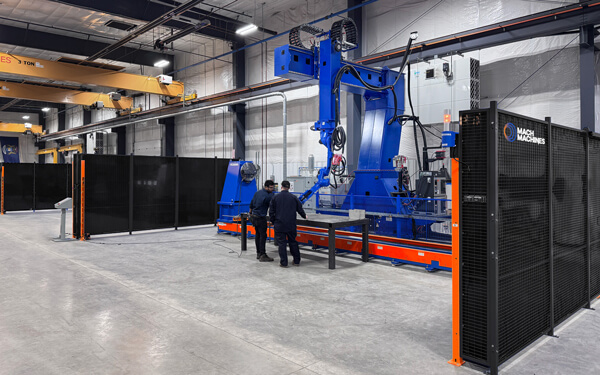
Consider a manufacturer that worked with one of Yaskawa’s premier integrators, Mach Machines, to integrate a dual-robot welding system. The existing setup included two 6-axis robots mounted on coordinated 4-axis positioners, resulting in a 22-axis system. The initial programming effort was overwhelming: operators were standing on ladders while manually jogging weld paths – weeks of work yielded minimal progress.
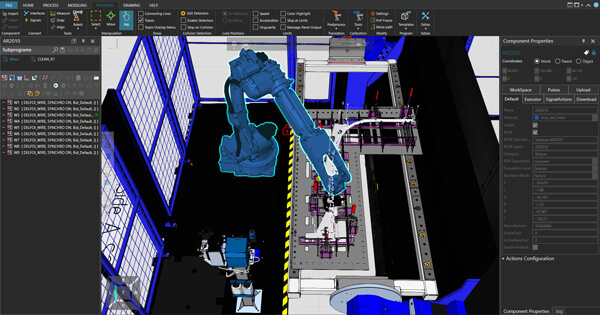
Mach Machines proposed a different approach. Using OLP and a true digital twin of the robot cell, they simulated every movement, factored inverse kinematics, synchronized robot-to-robot and external axis coordination, and generated a working weld program without ever touching the physical robot. The improvement was immediate.
“A key differentiator in our approach is the true digital twin,” says Jandre TerreBlanche of Mach Machines. “Every robotic system we deliver includes a virtual replica that allows users to visualize the entire production cycle before execution. This reduces risk, enhances programming accuracy and streamlines troubleshooting.”
This approach not only got the customer up and running but set the stage for fast, repeatable programming for future parts, which is critical for manufacturers dealing with high-mix, low-volume production.
Design gamechanger
OLP is not limited to robot motion. Part tooling plays a critical role in weld quality, and now, some OLP platforms integrate fixture design into the same workflow.
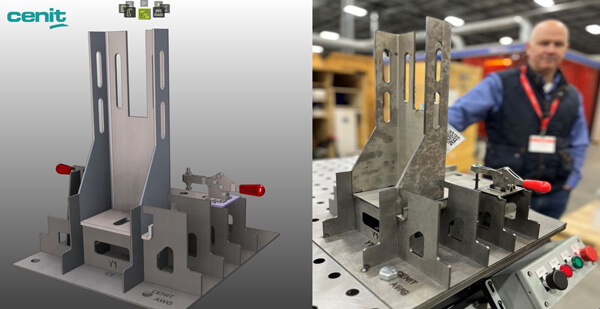
Traditional fixture design requires dedicated engineers, custom fabrication and long lead times. Now, software like Cenit or Nucleo enables users to import their CAD models and automatically generate fixture designs conducive with the robot path. These fixtures are often designed to be cut from sheet metal via laser or waterjet cutting with interlocking tab-and-slot construction that requires no special machining.
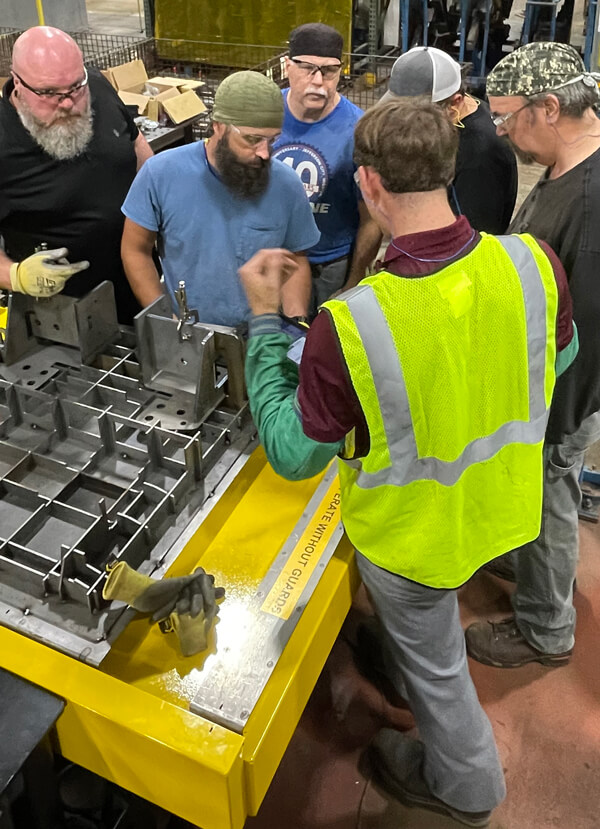
After assembly and some tack welds, the fixture can be quickly positioned on a welding table with minimal adjustment. The software calculates and compensates for fixture location, ensuring the programmed weld path lines up precisely with the physical part. This seamless integration allows for reliable, repeatable part setups even in low-volume or prototype work.
Additionally, these virtual and physical fixtures can be stored and reused alongside robot programs, creating an inventory of tooling solutions. This means the corresponding robot jobs can be recalled and set up in minutes rather than hours or days, which is ideal for high-mix, low-volume operations.
Companies like Flextur, which also offers this OLP fixturing feature as a service, take it a step further by offering a patented clamping table solution with repeatable zeroing points and pneumatic clamps. These tables ensure the fixture aligns consistently, even after multiple changeovers. This supports the high repeatability necessary for quality welds.
Not just for welding
While arc welding is one of the most common uses for OLP, the applications do not stop there. Painting, dispensing, machining, grinding, cutting, pick and place – any robotic process that benefits from simulation, collision checking or path optimization can take advantage of OLP. Integrators and end users alike are expanding their use of OLP beyond welding to maximize ROI across multiple robotic systems.
As automation becomes more accessible, manufacturers need tools that scale with their complexity. OLP is no longer just a feature – it is a foundation for smarter robotic workflows. It enables integrators to deliver more value faster and empowers manufacturers to handle higher part variety, reduce changeover times and get the most out of every robotic hour.
It is also paving the way for democratized automation. By removing the steep learning curve of pendant programming, OLP puts sophisticated robot control into the hands of more users – whether they are programming their first weld or managing a fleet of systems.
OLP applications have grown considerably in recent years. Today, it is an indispensable tool for manufacturers that want to boost efficiency, reduce downtime and achieve more from their robotic welding systems.
From robot path planning to fixture design, OLP gives users a complete digital environment to plan, validate and deploy their processes before setting foot on the shop floor. In a world where flexibility, speed and precision are everything, that kind of advantage is hard to ignore.