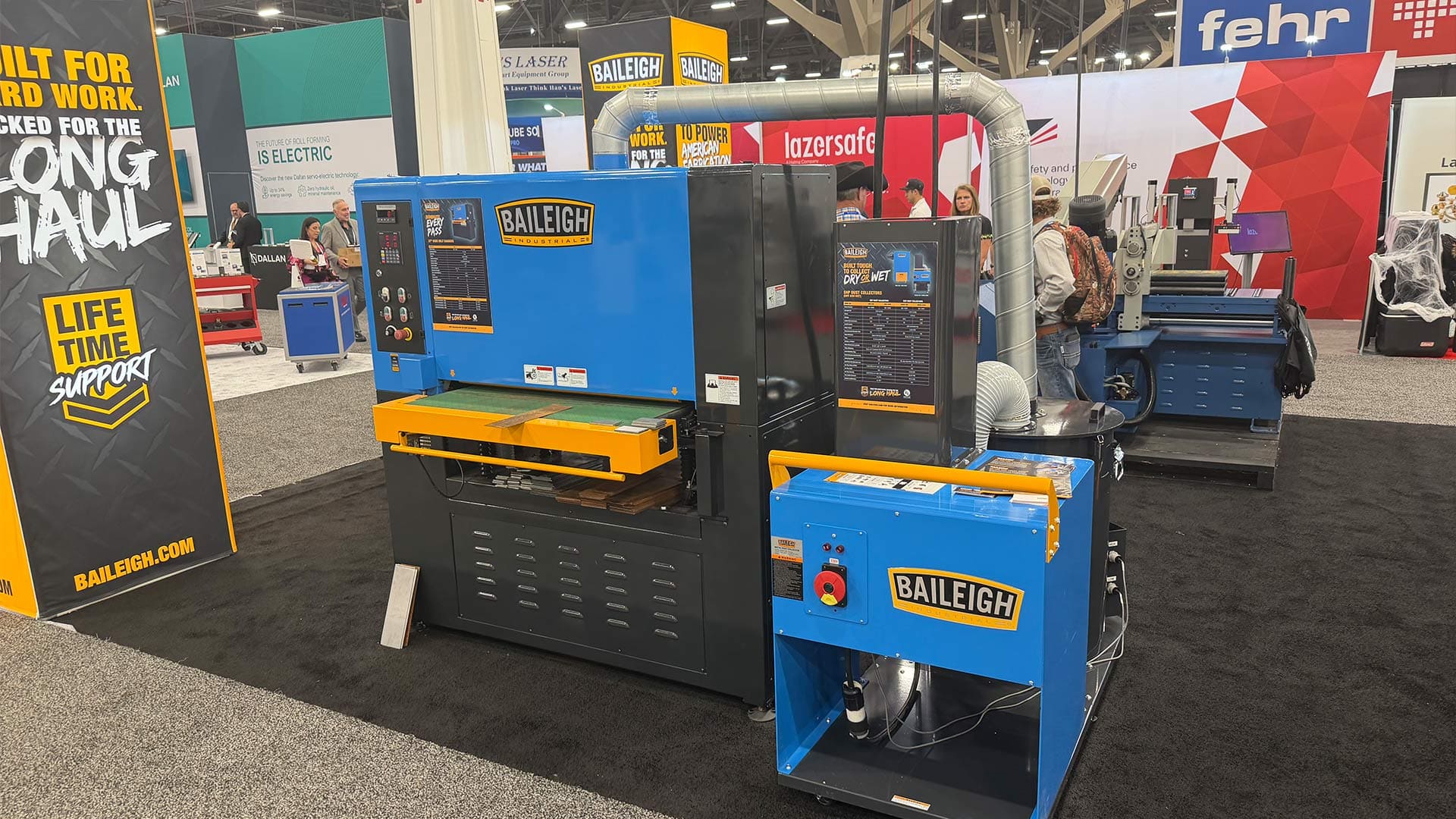
When Baileigh Industrial representatives hit the floor at Fabtech in Las Vegas last month, the expectation was that the press brake and horizontal bandsaw they brought would be the center of attention. And while plenty of inquiries were focused on those machines, a 37-in. belt sander generated a buzz of its own.
The WBS-37 is still fairly new to the market, having been released in August, says Travis Resendez, senior marketing manager at JPW Industries (parent company of Baileigh), so most Fabtech attendees were seeing it for the first time.
During Techgen Media’s visit to the Baileigh booth, Resendez noted the belt sander “has been getting a lot of attention.” And that’s because many of the 30,000-plus attendees at the show came looking for technology to improve their fabrication operations. For shops using plasma, waterjet or laser cutting tables, Fabtech offers first-hand opportunities to research and vet equipment for cleaning up cut parts.
“You don’t want to put freshly cut workpieces with burrs, slag or dross into a press brake,” Resendez says. “If you bend that piece right on the press brake, your die is going to get chipped. You have to knock all of that off first. When you run it through a belt sander, you’ll have a nice, clean surface.”
Problem-solver
One of the advantages of bringing products to Fabtech is that exhibitors get a chance to communicate with fabricators and hear detailed accounts of their challenges. Over the three-day event, Resendez and Dylan Pearson, technical sales specialist at JPW, heard from countless attendees that said they’re bogged down with manual processes.
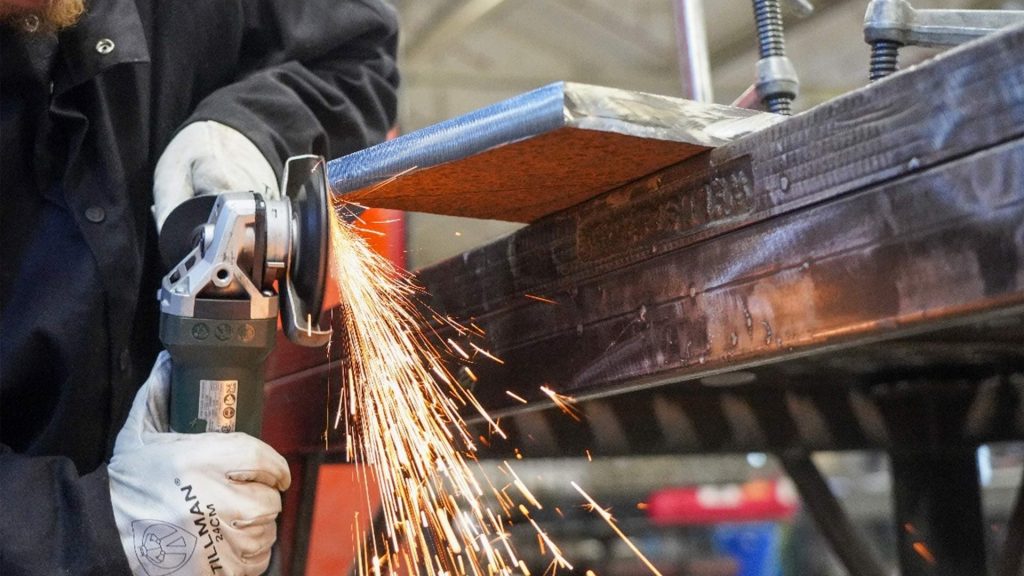
“We heard a ton that they’re doing it by hand with a flap wheel and an angle grinder,” Resendez says. “Our belt sander, however, is exponentially faster.”
Resendez is referring to the WBS-37, which uses a 37-in.-by-60-in. abrasive belt powered by a 10-hp main motor. It delivers belt speeds up to 2,700 fpm, and its variable-speed conveyor can be adjusted from 2 fpm to 26 fpm. Its capacity accommodates workpieces up to 37 in. wide and from 1/32 in. to 6 in. thick. It’s built to process mild steel, stainless steel and nonferrous metals.
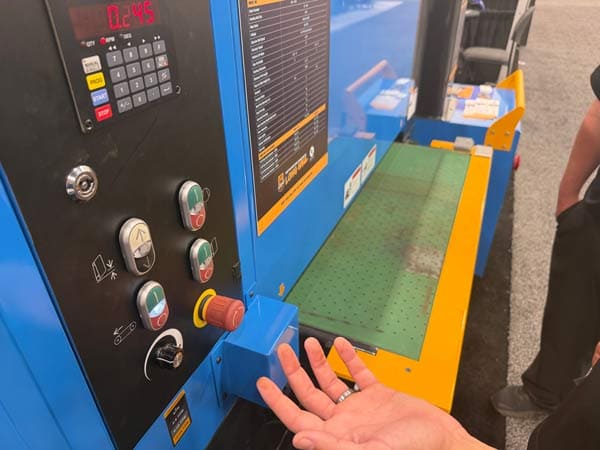
The machine also features an automatic height adjustment tool positioned at the front edge of the machine where operators can place the workpiece to measure its exact thickness prior to processing. A digital readout makes operation easy, and there are 10 programmable height presets for repeat jobs. Resendez says the presets are a timesaver for operators processing a mix of different part sizes. Automatic belt tracking keeps the abrasive centered, which helps limit uneven wear.
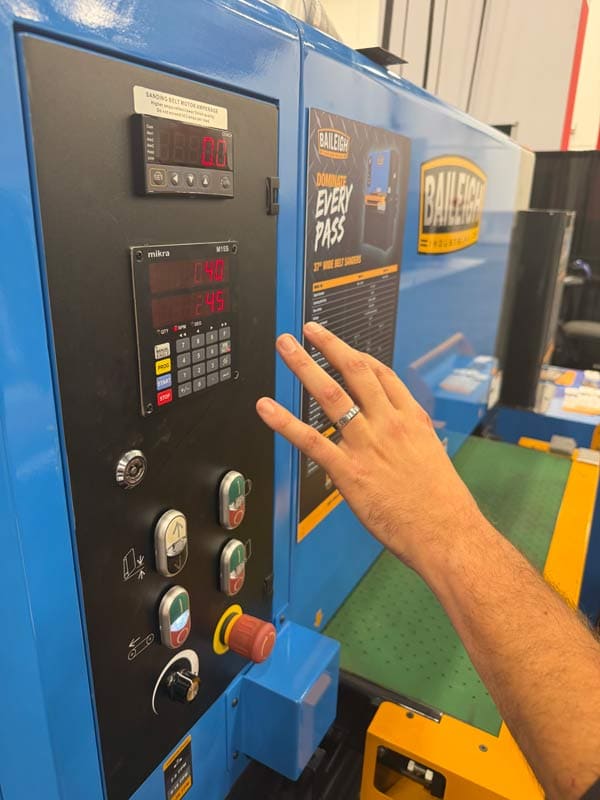
Resendez explains that operators can also fine-tune the machine depending on how “aggressive” they want the belt sander to be. They can slow down or speed up the rate at which material is fed through the machine, and they can also adjust the pressure of the sander on the workpiece.
“You can play with the finish you want and how aggressive you want to be with just a couple of adjustments,” he says.
Baileigh offers the WBS-37 in four configurations to match a shop’s electrical service and workholding needs. The standard WBS-37 operates on 230 V without a vacuum table while the WBS-37H uses 460 V without a vacuum. For vacuum workholding, the WBS-37V operates on 230 V, and the WBS-37VH combines a vacuum table with 460-V service.
Safety features
A modern belt sander needs to do more than deliver a consistent finish, though. It also needs safety features built into its design to protect operators. With that in mind, Baileigh equipped the WBS-37 with an emergency stop, a quick-stop bar and door interlocks.
The emergency stop and quick-stop bar give operators ways to stop the machine when a problem occurs. The door interlocks help prevent operation when the access doors are open. So, if the operator needs to switch out a belt, the interlocks will prevent the machine from running.
The machine’s e-brake adds another layer of protection by bringing the belt to a rapid stop. Pearson explained that when the operator turns the machine off, the belt keeps spinning, slowly winding down to a full stop. However, in an emergency situation, “the motor brake on it will actually stop the motor from spinning.”
Busting dust
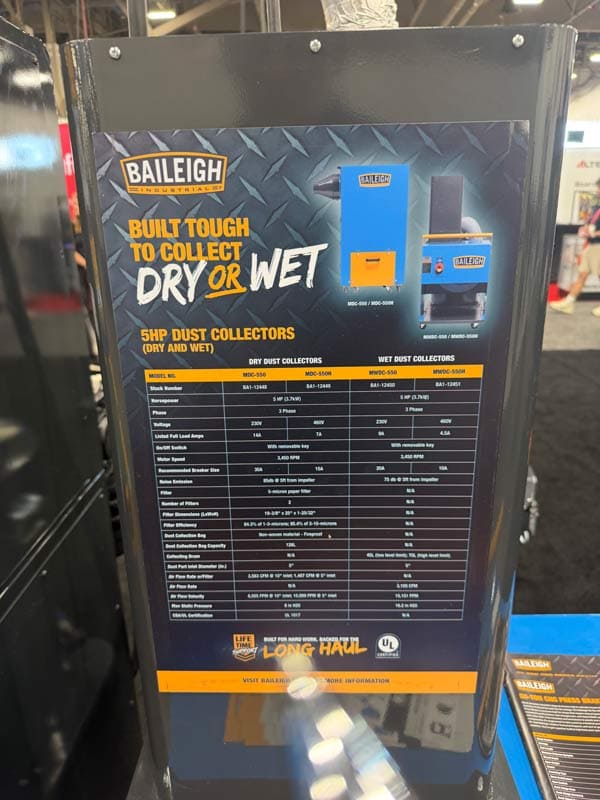
Baileigh introduced a dust collection system at the same time as the launch of the WBS-37. The 5-hp dry and wet collectors are designed to support sanding, grinding and polishing applications. Shops can install the collector on the WBS-37 or existing machines.
The dry model uses dual 5-micron filters to collect particles. The wet model uses water to capture fine particles and polishing fumes. The collectors feature 5-in. ports and a dual inlet design, providing flexibility when connecting sanding, grinding and polishing equipment.
Pearson says shops processing aluminum favor the wet model, as sanding aluminum creates a fine powder that can “gum up” equipment. The wet model helps create a cleaner work environment.
“You only get one set of lungs,” Pearson says.
Tony Topf, Baileigh’s director of product management, said in a news release that production environments demand equipment that performs reliably while helping operators work efficiently and safely.
“Our new wide belt sanders and dry and wet dust collectors are designed to work together to improve finish quality,” he said, adding that they were equally designed to “reduce airborne contaminants and keep shops running at peak performance.”
From belt sanders to grinders and everything in between, if you need to know about finishing your workpieces, check out our abrasives and deburring archive.