The best way to get started in robotic automation is rarely the flashiest. Instead, the best way is typically built around a stable process, a clear operational problem and a team that’s prepared to own the result. Automation conversations in 2026 frequently become overly optimistic and futuristic.
After years of hearing cobots would solve all problems, talking heads and analysts now focus on physical AI, robots that interpret less-structured environments, better vision systems, force sensing and software that can reduce the amount of traditional programming required. Those developments are real and important, but for most, the fundamentals still determine whether the first automation project becomes a platform for growth or an expensive lesson in scope creep – colloquially referred to as “moving the goalposts.”
To avoid the uncontrolled expansion of a project’s original framework, the best advice for those starting an automation journey is this: Don’t start with the robot. Start with the work. The best “first” project is attached to a process that’s painful, repeatable and measurable. It should solve a real production problem, weather its safety, quality or staffing.
Beyond that, it should be narrow enough that you can learn without putting your entire plant at risk. In some cases, there will still be a physical AI component to the solution, but in many more cases, the answer will be an established solution with traditional programming.
The best applications
The old shorthand for something worth automating – the dull, dirty and dangerous stuff – still holds up. Over the last few years, another common theme has arisen: “difficult to staff.” Ergonomically demanding or production-constraining tasks that involve repeated lifting, awkward reaching, exposure to fumes, heat, sparks, sharp edges or moving equipment are the tasks that deserve attention first. Along with those jobs that regularly go unfilled on second or third shift or operations where inconsistent staffing prevents a plant from using equipment it already owns.
A good candidate also has enough process stability to automate. The part, fixture, material flow and quality requirements should be reasonably understood. If operators currently succeed only by making constant and informal adjustments, either process modifications will likely need to be considered or another area for automation should be found.
Robots are excellent at doing the same defined task repeatedly. New sensing and AI are expanding what can be handled, but technology shouldn’t be used to hide a process that nobody has taken the time to define.
The best deployment location for robotic automation is often at the edge of a process rather than in the middle of a plant’s most interconnected production line. An end-of-line station, machine cluster, welding or finishing cell, kitting area or inbound/outbound material handling point can all deliver meaningful value while limiting the number of upstream and downstream dependencies. That containment makes commissioning easier, protects the rest of production and allows for more directly defined expectations.
Applications that make strong first projects:
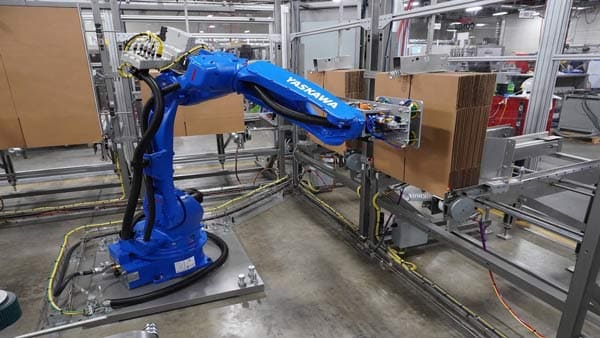
- Palletizing and depalletizing: End-of-line palletizing remains one of the clearest starting points because the work is repetitive, physically demanding and easy to measure. Product dimensions, weights, rates, pallet patterns and available floor space can usually be defined early. Depalletizing can be more variable, especially with mixed loads, damaged cases or inconsistent pallets, but layer handling and well-structured inbound loads can still be strong candidates.
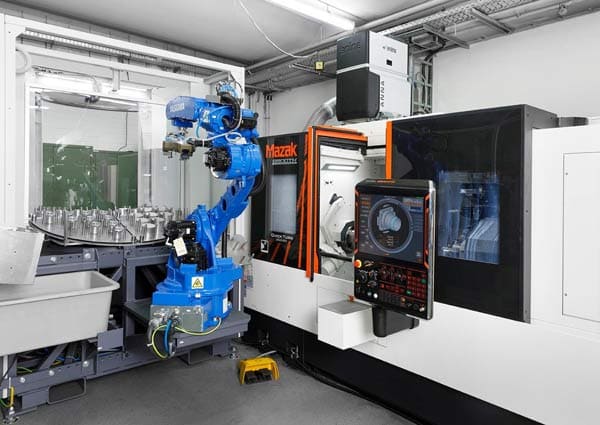
- Machine tending: A robot serving a CNC machine, press or test stand can extend productive hours, improve consistency and free skilled employees from repetitive work. It’s especially attractive when a machine is waiting for an operator more often than the operator is waiting for the machine. Start with a stable part family, reliable workholding and clear provisions for chip, coolant, door and part orientation issues.
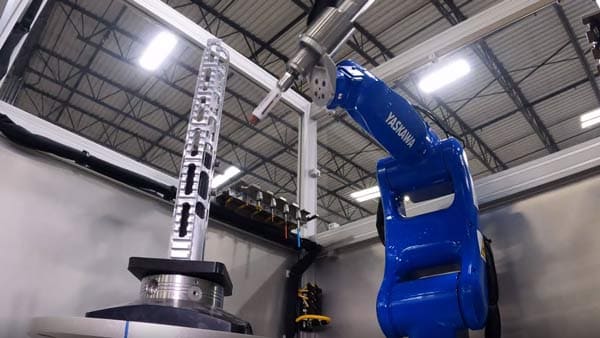
- Welding, cutting and material removal: Robotic welding is a proven path when part fit-up, fixturing and weld access are controlled. Grinding, deburring, sanding, plasma or laser cutting, and similar processes can reduce exposure to unpleasant or hazardous work while improving consistency. These applications can be excellent first projects, but they place more emphasis on process knowledge, tooling, consumables, dust or fume control, and part variation than a simple pick-and-place task.
- Material handling, packaging and kitting: Moving parts between repeatable locations, orienting components, loading trays, packing cases and building kits can remove a surprising amount of non-value-added labor. The key is part presentation. A robot can’t compensate economically for every disorderly tote, tangled component or uncontrolled conveyor unless the business case supports the vision, sensing and software needed to manage that variability.
- Inspection and process verification: Vision systems and robots can create repeatable inspection paths and capture data that supports traceability. This is often a strong second project after you have learned how to integrate automation with quality systems and production data. If inspection is the current bottleneck or a major source of escapes, however, it can justify moving it to the front of the line.
The simplest technology
A conventional industrial robot is often the right answer when speed, payload, reach and cycle time dominate. A cobot can be a good fit when the application benefits from close interaction with a human, hand-guided teaching, space-efficient deployment or frequent redeployment. Neither type of robot is universally better, and a cobot doesn’t make a given application automatically safe. Beyond the robot, end-of-arm tooling, workpieces, process and motion all have to be included in a risk assessment.
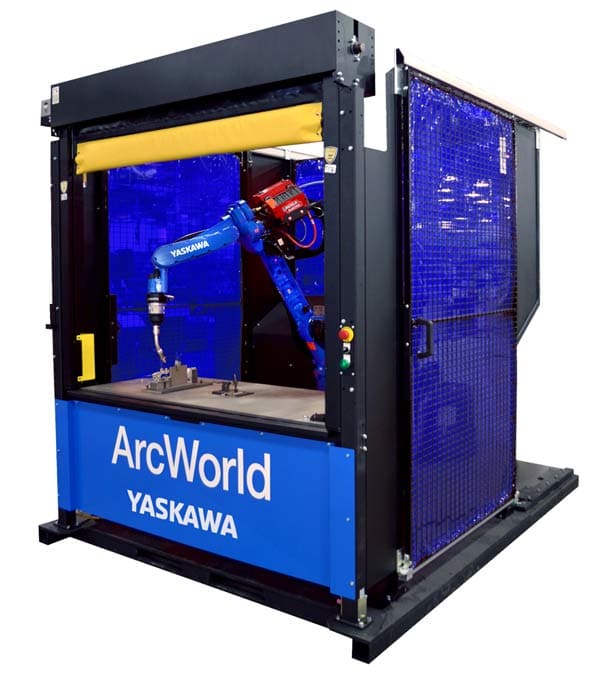
One encouraging shift is the growth of application-focused software and pre-engineered systems. Instead of engineering every cell from a blank sheet, you can start with proven architectures for picking, palletizing, machine tending, welding and other common tasks. Yaskawa’s ArcWorld series is one example of the broad industry direction. Combine the robot, process hardware, programming options and defined operational outcome. For a first-time adopter, that can reduce integration risk and make future replication more realistic.
Hardware is becoming more application-specific as well. New hygienic designs, higher payload cobots and expanded heavy-item handling manipulators show that you no longer have to stretch a general-purpose robot into every environment. Selecting a robot built for the payload, reach, cleanliness, washdown, ingress protection and process requirements will usually carry a lower cost over a system’s life than compensating for a poor hardware fit with custom engineering or consumables.
AI belongs in this conversation as well, but it should enter for a reason. Earlier this year, Yaskawa released its Motoman NEXT platform, which offers more agentic task planning, along with a separate validation of physical AI techniques for handling deformable objects such as wire harnesses. Think of this as an important glimpse of where automation is heading; robots will handle more variation and recover from more unexpected conditions.
AI can also be leveraged to enable no-code deployment for simple tasks that have been automated repeatedly. These two justifications are at opposite ends of the equation, but both exhibit strengths of physical AI today. It doesn’t mean that every first cell needs an AI enhancement, but it’s a sign of what can be accomplished.
Use AI when variability is the problem to be solved or when AI can overcome programming requirements. Don’t stretch your application to rely on advanced technology simply because AI is available and currently on the hype cycle.
Quiet mistakes
The first mistake is automating a broken or undefined process. If your scrap rate is high, fixtures vary, upstream flow is unreliable or the required cycle time changes depending on who is asking – automation will expose those disagreements rather than resolve them. Stabilize inputs and process, agree on the operating window and define expectations before requesting a quotation.
The second mistake is specifying a robot before specifying a job. Payload must include the end-of-arm tooling, adapter plates, cables and the product. Reach studies need to consider approach angles, singularities, interference, service access and future part changeovers. Cycle time may include timers for sensing, gripper actuation, machine communication and exception handling or recovery. The robot’s fastest motion is rarely the best judge for a cell’s throughput.
The third mistake is underestimating everything around a robot that makes the work flow. End-of-arm tooling, part presentation, guarding, controls, utilities, conveyors, fixtures, dust collection, weld equipment, vision, floor condition and upstream reliability often determine performance more than the manipulator does. Budget and schedule the system, not the robotic arm.
The fourth is designing only for normal production. Every cell will eventually see a mis-pick, empty feeder, bent part, damaged pallet, tool fault or loss of communication. Operators should be able to understand the condition, recover safely and resume production without calling the original programmer. A cell that runs well in a demonstration but is difficult to recover won’t earn trust on the shop floor.
Finally, avoid turning the first project into a custom engineering monument. A focused cell that can be copied is usually more valuable than an ambitious one-off system that tries to automate five unstable processes at once. Leave room for future products, but don’t make hypothetical future flexibility more important than today’s defined production need.
Define success
A project needs a baseline and a finish line. Before issuing an RFQ, document current throughput, cycle time, labor hours, overtime, quality losses, ergonomic exposure, unplanned downtime, changeover time and the amount of time critical equipment sits idle. Then define the target state in the same terms. Financial return matters, but a good business case can also include capacity that enables growth, reduced injury risk, better process consistency, lower scrap, improved traceability and the ability to staff the less-desirable shifts.
Success criteria should be testable. Agree on the representative SKU mix, rate, uptime window, changeover method, acceptable fault recovery time and quality requirements. Use real parts and site acceptance testing, including reasonable edge cases, not only the best samples saved for the demonstration. Use a run-at-rate test to measure the complete cell under realistic operating conditions.
Safety has to be designed in from the beginning. The ANSI/A3 R15.06-2025 standard, the first major U.S. update in more than a decade, clarifies functional safety requirements, integrates collaborative application guidance and brings cybersecurity into safety planning. That last point matters as robotic cells become more connected. Network architecture, remote access, user permissions, patching and data ownership should be addressed during design, not after the cell is connected to the plant network.
Internal ownership matters just as much as the acceptance test. Identify a production owner, maintenance owner, and engineering or controls champion. Involve operators early enough that their process knowledge shapes the cell. Train more than one person. Establish preventive maintenance, spare parts and escalation plans before commissioning ends. Choose an integrator and technology suppliers based not only on the initial concept, but also on their ability to support the system after the people who launched it move on to the next project.
A successful first automation project should teach you how to find, justify, specify, accept and support the next one. Capture what worked, what caused delays, what should become plant defaults and which components should be standardized. If the first cell uses common controls, safety practices, training methods and data definitions, the second and third cells can be deployed faster and supported more consistently.
The most advanced automation available in 2026 is exciting and it will continue to expand the range of tasks it can address. But the best place to begin is still refreshingly practical: find the work that hurts, understand why it hurts, define what better looks like and choose the simplest dependable system that gets you there. Done well, the first robot does more than improve one operation – it provides a repeatable way to automate with confidence.