

While not everyone wakes up thinking about press brakes, fortunately, there are people who do. In fact, the folks at SafanDarley are all about what happens at the press brake, how quickly a job can be programmed, how easily an operator can run it, how much energy the machine consumes, how automation can address labor challenges and, ultimately, how many good parts can come off the machine in a shift.
That thinking will be on full display at Fabtech 2026 from Oct. 21-23 in Las Vegas in Booth No. C3444. There, attendees will see how machines, automation and software come together to address some of bending’s biggest productivity challenges. Fabricators looking to overcome labor constraints, control costs and get more production from their people and equipment should plan a visit to the SafanDarley exhibit.
Moving to automation
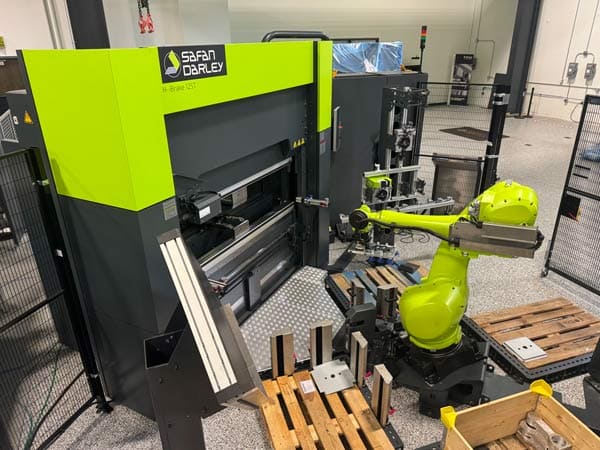
From an equipment perspective, SafanDarley will highlight its E-Brake 35T Premium Mini Cell and E-Brake 100T press brakes. The Mini Cell combines servo-electric bending, robotic material handling and software in a compact automated production cell. At its center is a 35T E-Brake paired with a Fanuc robot capable of handling up to 25 kg. Configurable infeed, deposit and discharge options keep parts moving through the bending process with minimal operator involvement.
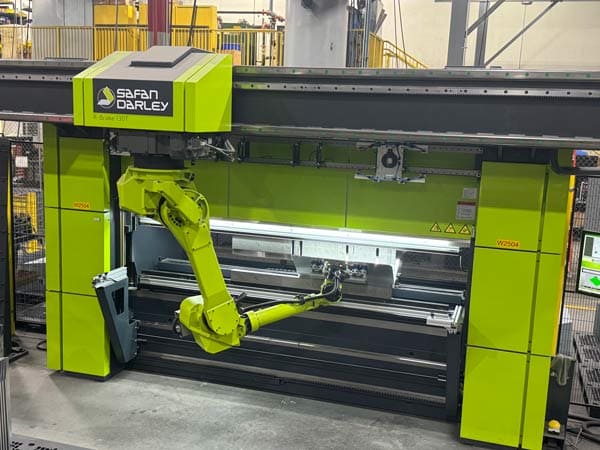
Automatic tool and gripper changing, angle measurement and additional product tables further expand the Mini Cell’s capabilities. It can also be equipped for more than eight hours of unattended production. The result is productivity gains of up to 30 percent and energy savings approaching 50 percent. For fabricators looking to incorporate robotics into bending operations, the cell provides an automated solution that can expand as requirements evolve.
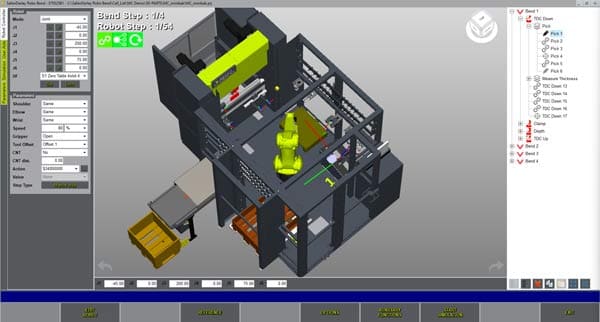
An accessible entry point for fabricators moving to servo-electric bending, the E-Brake 100T provides 100 tons of force across a 10-ft. working length. The press brake employs SafanDarley’s fully electric drive technology. Compared with hydraulic press brakes, the machine is shown to deliver productivity improvements of up to 30 percent along with energy savings of up to 70 percent.
Eliminating the hydraulic system means eliminating hydraulic oil along with pumps, valves, seals and filters. According to Matt Garbarino, president of SafanDarley North America, this really adds up.
“Our servo-electric design reduces wear components, lowering maintenance and energy costs immediately,” Garbarino says. “Reliability is especially critical when the conversation moves beyond purchase price to total cost of ownership. With labor at a premium, downtime erodes margins quickly, so a machine that runs consistently protects profitability.”
Software control
SafanDarley will demonstrate AutoPOL, RoboBend and ASC-Control, three software technologies addressing different stages of bending and automation. The result is an integrated manufacturing environment where AutoPOL helps prepare the bend, RoboBend helps prepare the robot and ASC-Control orchestrates all those pieces coming together on the production floor. For fabricators evaluating automation, this may be one of the most important things to see at the show.
AutoPOL addresses the challenge of using valuable machine time to program jobs instead of making parts. By moving programming offline, the 3-D bending simulation software allows programmers to import and unfold a sheet metal model, select tooling, determine the optimal bending sequence and establish stop positions without tying up the press brake. The entire bending process can then be simulated and validated before the program reaches the machine. As a result, operators spend more time producing parts.
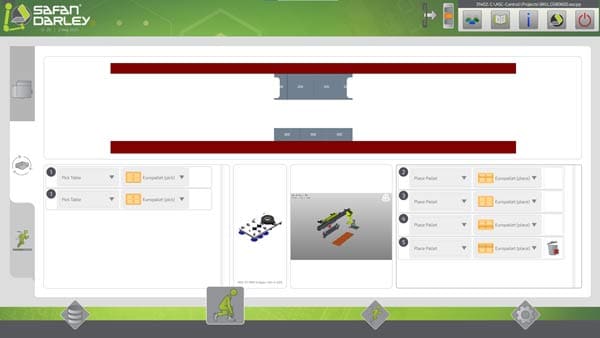
RoboBend extends that concept to robotic bending. The offline software coordinates the press brake and robot, automatically determines bending sequences and helps generate robot movements required to manipulate the workpiece. Collision detection and simulation allow the process to be virtually evaluated prior to production.
Bending operations are often complex:
- The robot needs to know what part it is handling
- The press brake needs the correct program
- The right tooling and gripper need to be available
- Parts need to move into and out of the cell
- Production orders have to be managed
- The cell may need to communicate with other production equipment
Automated Solutions Cell (ASC) serves as the management platform for the automated cell. It continually communicates with the robot and press brake, monitors cell status and tracks parts throughout the system. Rather than having operators manage individual pieces of automation separately, ASC provides a central interface for controlling production flow.
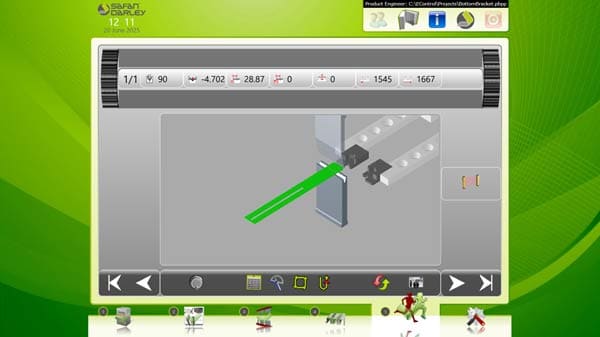
ASC is designed around the reality that not everyone interacting with an automated cell has the same skill level. Access levels can be established for product engineers and machine operators, allowing employees to interact with the system at the level appropriate to their responsibilities. As Garbarino emphasizes, that is an important distinction.
“ASC is unique in that it ties the entire automated solution together,” he says. “Instead of asking the customer to manage the press brake, robot, tooling and material flow as separate pieces, we bring those functions together through a single platform. That makes automation easier for the fabricator while providing flexibility to expand as their needs change.”
Plan the day
Attendees also have the opportunity to hear from Mike Ruediger, SafanDarley’s senior robotics applications engineer, during his breakout session, “Press Brake Automation Helps with Versatility and Labor Gaps.” Ruediger will address an increasingly important question: How can a company leverage press brake automation not simply to replace labor, but to create a more versatile and productive operation?
Automation is increasingly about allowing people to accomplish more. Offline programming can move programming away from the machine. Robotic bending can automate repetitive production. More intuitive controls can shorten the learning curve. And integrated software can reduce the complexity that can make robotic bending intimidating for smaller fabricators.
With thousands of products competing for attention, Fabtech attendees have to plan their stops carefully. SafanDarley provides several compelling reasons to put Booth No. C3444 on their list.
See the Mini Cell running automated bending operations. Compare servo-electric bending with traditional hydraulic technology on the E-Brake 100T. Catch AutoPOL and RoboBend demonstrations. Learn how ASC is simplifying the increasingly complex world of robotic bending. And since you’re in Las Vegas, you might as well try your luck. Pick a number, let the robot roll the dice and see if you walk away a winner.
So, while you may not wake up thinking about press brakes, a stop at SafanDarley during Fabtech 2026 might just have you leaving Las Vegas thinking about your machines a little differently.
More than a decade of press brake coverage, all in one place: Check out our archive.


