In bridge fabrication, production schedules are tightly connected to construction timelines. Steel components must arrive on the jobsite exactly when they are needed, and fabrication delays can quickly ripple through an entire infrastructure project. For fabricators supplying structural steel bridge components, maintaining consistent quality while meeting strict delivery deadlines is essential.
At Canam-Bridges, one of the leading bridge fabricators serving projects across Canada and the United States, this challenge became particularly visible in the grinding and surface finishing stage of production. The company processes hundreds of tons of thermally cut parts each week, and the manual grinding work required to prepare those parts for coating and assembly was becoming difficult to scale.
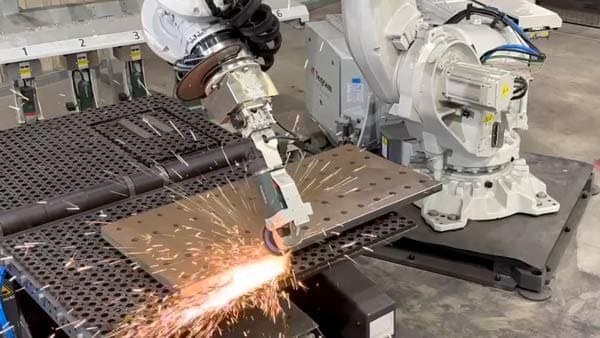
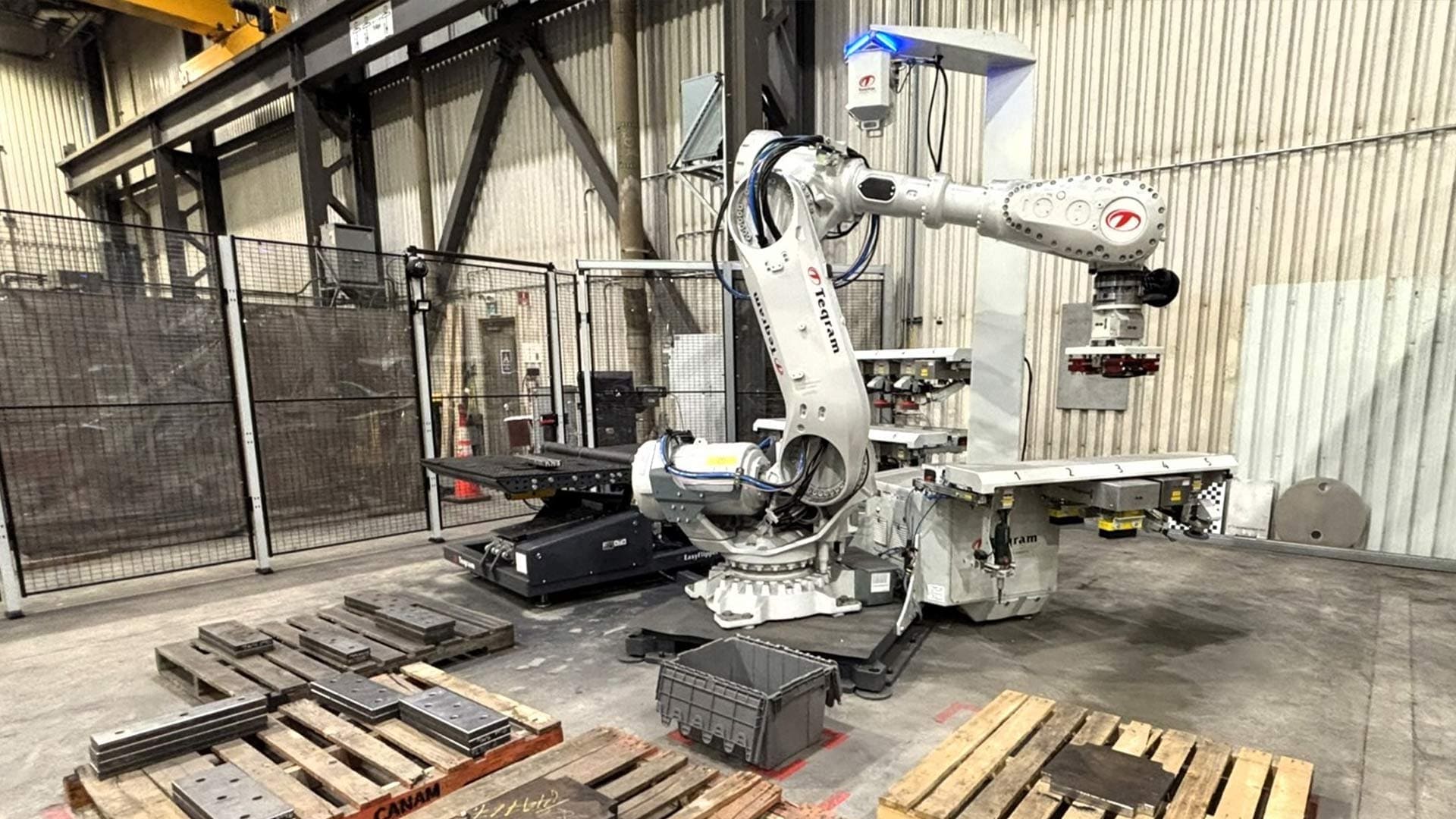
To address the issue, Canam-Bridges implemented the EasyGrinder autonomous robotic grinding system, developed by Teqram. The system now handles finishing for small and medium-size parts, significantly reducing manual grinding while improving consistency and working conditions on the shop floor.
Grinding need grows
Canam-Bridges manufactures structural steel components used in bridge infrastructure projects throughout North America. The company fabricates complex steel elements that must meet strict engineering specifications while also being delivered to construction sites on schedule.
“Product quality, jobsite management and deadlines are critical factors in every project we execute,” explains Mathieu Larouche, project engineer at Canam-Bridges.
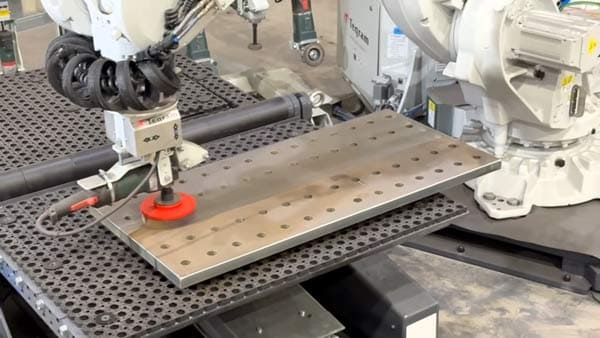
Bridge fabrication is high volume and high mix. Each project may include thousands of parts with different geometries, thicknesses and finishing requirements. At Canam-Bridges, approximately 300 tons of steel parts are processed every week using plasma and oxyfuel cutting. After cutting, the parts move to the grinding department where several finishing steps must be completed before they can move to assembly or coating operations such as painting, galvanizing or metalizing.
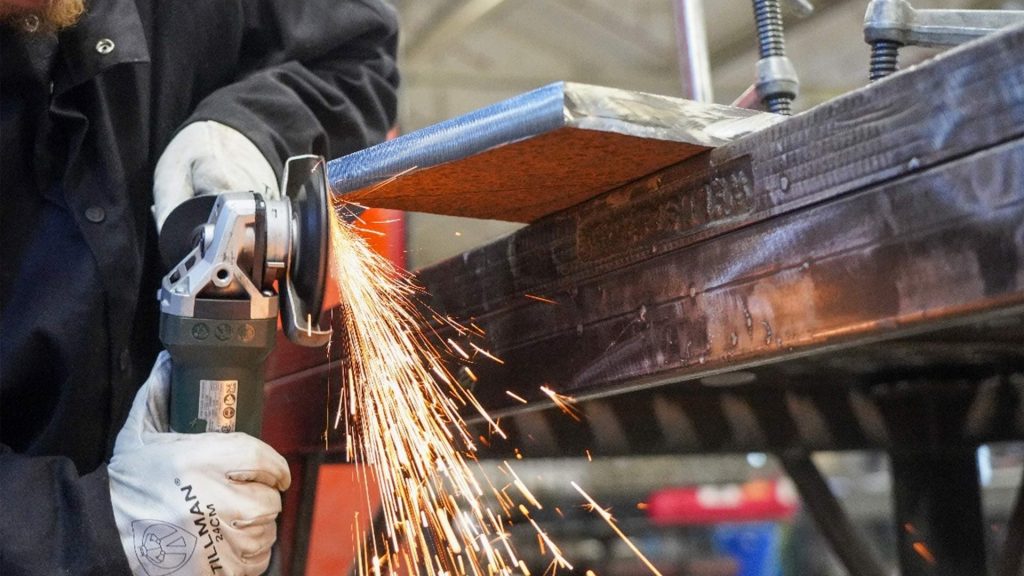
Thermal cutting leaves slag on the edges of the parts and creates a heat-affected zone that often must be removed. Edges also need to be deburred and rounded to meet coating specifications. In many cases, oxide layers must be removed and lead-in marks from the cutting process need to be ground away. For years, these tasks were handled entirely with handheld grinders.
Reduce manual grinding
As production volumes increased, the grinding department grew into a large operation. At one point, Canam-Bridges had between 16 and 18 grinding technicians working across three shifts to keep up with demand.
While the team was skilled, the work was physically demanding and repetitive. Technicians had to lift and position steel parts while performing grinding operations throughout the shift. Dust and debris were common in the grinding area, and they often worked on the same part geometry for extended periods of time.
“In that situation,” Larouche says, “the process simply wasn’t scalable anymore.”
With multiple bridge projects running at the same time, the company needed a way to increase productivity without adding more manual grinding capacity. Improving working conditions was also an important goal. The search began for a more modern approach to surface finishing.
Automation sans programming
Many robotic grinding systems require extensive programming for every new part. In bridge fabrication, where geometries can change from project to project, that level of programming would quickly become a bottleneck.
Canam-Bridges looked for a solution that could automatically adapt to different part shapes. That requirement led the company to the EasyGrinder system. Instead of relying on traditional programming, the robot uses a 3-D vision system called EasyEye to scan each incoming part and determine where grinding is required.
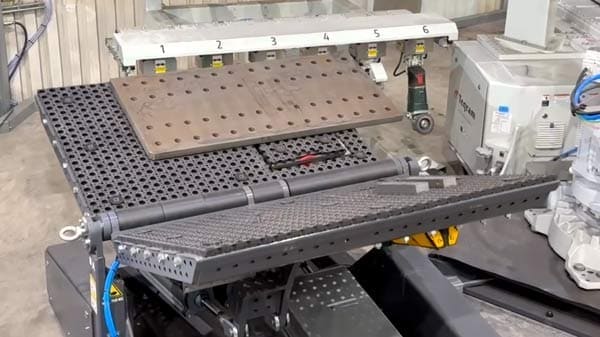
“The EasyEye vision system was really an eye-opener,” Larouche says. “No programming is needed, even for complex parts.”
The system detects edges and contours, then automatically generates the grinding path for the robot. This allows a wide range of parts to be processed with minimal setup time. For a structural steel fabricator producing many different parts every day, that flexibility is critical.
Today, the EasyGrinder processes all small and medium-size parts produced by the cutting department. The system automatically performs deburring, edge rounding, oxide removal and grinding of the heat-affected zone. The impact on labor has been significant.
“For the parts processed by the EasyGrinder,” Larouche says, “we’ve reduced labor hours by about 60 percent.”
Where several grinding technicians previously worked on these tasks, the process now requires only a single operator who mainly manages logistics and adjusts robot parameters when needed. The change has also improved working conditions.
Grinding work is often repetitive, especially when technicians must process the same part for days at a time. By automating those tasks, the company was able to shift employees into less physically demanding roles.
“The EasyGrinder really made their job easier,” Larouche says. “There’s no heavy lifting anymore and much less physical strain.”
A good balance
In bridge fabrication, edge preparation plays an important role in coating performance. Proper deburring and rounding ensure that protective coatings adhere correctly and provide long-term corrosion protection.
According to Larouche, the EasyGrinder has delivered excellent consistency since it was installed.
“The system always produces the same high quality,” he says, adding that the robot initially produced a surface finish that exceeded what was required for some applications. “In the beginning, the finish was sometimes almost too perfect. We adjusted some parameters so we could increase throughput while still meeting the specifications.”
After optimization, the system achieved a good balance between productivity and finishing quality.
Another surprise for the team was the speed of the robotic grinding process. Once the system was running, it quickly became clear that the EasyGrinder could process parts faster than anticipated.
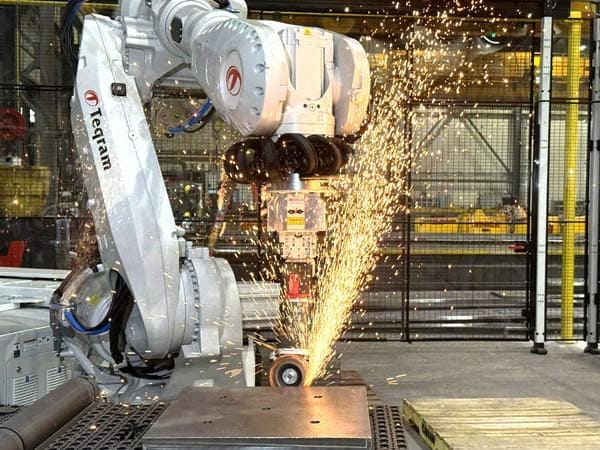
“We were surprised by how fast the robot could handle the parts,” Larouche says. “We actually had to reschedule the cutting department to keep the EasyGrinder supplied.”
In other words, grinding was no longer the limiting step in production. With the finishing process running faster and more consistently, the flow of parts between cutting and downstream operations improved.
The installation of the robotic grinding system also showed the importance of flexibility during automation projects. During the implementation phase, the layout of the production area changed several times. At one point, Canam-Bridges asked if the system could be delivered two weeks earlier than originally planned. According to Larouche, the request did not disrupt the project timeline.
“The Teqram team was very flexible,” he says. “Even with layout changes and the earlier delivery request, everything was delivered on schedule.”
The next step
Today, the EasyGrinder is a stable part of the finishing process at Canam-Bridges. The system handles a large portion of the company’s cut parts while delivering consistent results and reducing the need for manual grinding.
Larger components are still processed manually, but the success of the system has already sparked discussions about expanding automation.
“We’re definitely looking at ways to automate the finishing of larger parts in the future,” Larouche says.
For bridge fabricators dealing with increasing workloads, tight schedules and ongoing labor challenges, autonomous grinding systems may offer an effective path forward. By removing one of its most labor-intensive bottlenecks, Canam-Bridges has taken a significant step toward a more efficient and scalable fabrication process for the bridge infrastructure projects of tomorrow.
Looking for more information about leading grinding technology? Find everything you need in our archive.