

Conventional coil-fed blanking lines are the principal processing method for a range of metal manufacturers. From the coil material standpoint, it can increase material utilization, requires less labor for setups and is, in general, cheaper to purchase in bulk. Meanwhile, conventional blanking lines are known for achieving some pretty impressive stroke rates, providing cost-effective, high output.
But, when those same metal manufacturers need faster turnarounds for higher mix, lower volume scenarios, the setup times and die changes associated with conventional blanking operations can be a major thorn in their side. For short runs, the benefits of coil-fed press lines virtually disappear.

Conversely, flatbed fiber laser cutting machines are the go-to equipment for traditional high-mix, low-volume fabricators that use sheet material. That’s because fiber lasers are known for their fast setups, high precision, capability to cut complex designs and minimal material waste thanks to smart nesting. They’re also known for producing high edge quality that requires minimal, if any, post-processing. And, when last-minute parts need to be processed, changeovers can happen fast. The only drawback is that they don’t accept coil-fed material, which is typically more cost-effective and offers higher material utilization compared to sheet material.
Recognizing this, Andritz Schuler developed its Dynamic Flow Technology (DFT) to close the performance gap between laser blanking lines and conventional press-based processing. For the fabricators and manufacturers accustomed to using coil material, Andritz Schuler’s solution capitalizes on the benefits of both coil-fed processing and fiber laser cutting.
Interested parties
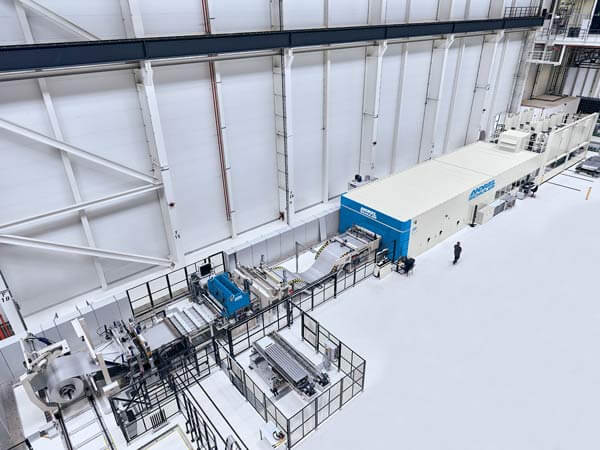
According to Justine Fonteyne, Andritz Schuler’s area sales manager for the Americas, the company’s laser blanking lines are ideal for manufacturing applications with frequent product changeovers. That’s in part because laser blanking lines don’t require dies, eliminating the need to change over dies for each new run. When coupled with DFT, the laser blanking lines are even more productive as they process material continuously and combine the speed of a conventional blanking line with the flexibility of flatbed laser systems.
“Dynamic Flow Technology eliminates the stop-and-go motion of coil-fed laser lines by continuously moving material through the laser blanking line,” Fonteyne says. “Instead of stopping the strip for cutting, a laser head travels in sync with the moving material, enabling cutting at speeds up to 60 m per min. with outputs as high as 50 parts per min. That can add up to roughly 15 million parts annually.”
In general, the company’s offering is well-suited for anyone that uses coil material, but specifically, Fonteyne says it’s great for automotive OEMs – EV manufacturers and established automotive manufacturers that are transitioning to new models. When production volumes are uncertain, frequent die changes can result in delayed market launches while the investment requirements for new dies can hamper product development.
“EV OEMs tend to have maybe four or five models,” she says. “They aren’t tied to the legacy practices of having dies for every model and can save all the die-related investment costs when they choose to go with a laser blanking line.”

Steel service centers are also a promising customer base. In recent years, service center business models have changed due to customers asking for more value-added services that often involve small batch sizes. Wanting to utilize their own coil material to increase margins, the laser blanking lines with DFT allow service centers to quickly respond to customer demands.
Greenfield projects are another emerging market for Andritz Schuler’s laser blanking lines because they don’t require the deep foundation work typically required for press systems. They’re also easier to integrate into facilities that have space constraints. A standard laser blanking line can measure about 26 m long while conventional press lines can be up to 50 m long.
“Greenfield projects often start right away with laser blanking versus a press-related system based on the construction considerations for each,” Fonteyne says. “Press systems need a very deep loop pit, which requires a lot of extra groundwork. You also need a strong foundation for press systems to take on all the force they produce. With laser blanking, you don’t need any of that.”
Basically, any manufacturer with high-mix, mid- to low-volume production needs is a strong match. These companies benefit from eliminating die changeovers, reducing setup times and nesting multiple part geometries from coil.
System options
To accommodate the various types of customers that could benefit from dieless, coil-fed processing, Andritz Schuler produces standard laser blanking models as well as custom models and configurations.
Automotive customers, for example, need systems based on their facility layouts and specific, high-level requirements. Regardless of the customer, the goal is to provide the solution that is most cost-efficient and productive. Overall, the options are highly configurable.
“If you’re focused on crosscuts – trapezoids or rectangular blanks – but also need to add various unique parts, DFT is the perfect technology for that,” Fonteyne says. “And we have a variety of systems available, be it for small batches or thick materials up to 15 mm. Depending on the application, we probably have a special line design for it, or we can create one.
“We also have single- or dual-head laser systems that are optimized for a variety of applications, material widths and accuracy requirements,” she adds. “Dual-head systems share the work to achieve higher output speeds in high-volume automotive production for outer body panels, as just one example. Compact single-head lines are well-suited for steel service centers and smaller batch production. Whether it’s a one- or two-head setup, the fiber laser cutting heads deliver the burr-free edges, minimal heat input and improved weld quality typically associated with sheet metal lasers.”
Fonteyne goes on to say that for thicker material, where the laser often moves through the material in a slower manner, it might make sense to go with a dual-head laser system. For identical nesting scenarios, Andritz Schuler also offers the option to add a second cutting head on the same gantry to reduce the floor space required.
The company also offers various power levels based on customer needs. Typically, a 4-kW laser is sufficient, but for thicker materials, 10-kW through 15-kW systems are available.
The laser blanking lines can also be configured with various types of automation, such as AGVs and pick-and-place robotics; quality vision systems and measurement tools to gauge roughness, oil thickness, material thickness and more. A line can also be fitted with any quality control systems available on the market that Andritz Schuler might not currently produce in-house.
Secret sauce
No matter the configuration, number of cutting heads or power level, DFT is the secret sauce behind Andritz Schuler’s laser blanking lines.
“DFT is basically the reason we can cut so fast with our lasers,” Fonteyne says. “Traditional coil-fed laser lines work in a stop-and-go manner, meaning there is a feeding time and then a moment when the material stops for cutting. With DFT, we’re moving the material constantly through the laser cell, so there is no stopping time.”
To fortify that secret sauce, Andritz Schuler also focused on the software that line operators use. Recently, the company announced the launch of its LBL-Studio Pro, an upgrade from the basic software previously available.
“Our programming tool is a key product behind our laser blanking lines,” Fonteyne says. “It’s so simple to use compared to what we see on the market because it’s totally based on drawings. You simply upload a part drawing and then select the areas you’d like to cut.”
The new software offers offline programming capabilities from part drawings, eliminating the need for separate 2-D CAD tools. Users can define cut contours, takeover points, scrap areas and robotic pick-and-place actions through an intuitive drag-and-drop interface. New features also include integrated analytics, quality options and automated stacker setups to reduce setup time and help manufacturers quickly move from coil to finished blanks.
Reducing downtime
Truly, the goal of the new DFT – along with its accompanying software – is to keep uptime high especially when batch sizes might be low. Stampers looking to expand into higher-mix, lower volume work must stay very aware of the issues that cause downtime. Often, that downtime is due to the die-based nature of traditional blanking lines – die changeovers and setups are the most common sources of lost production time.
Typically, each new part requires a dedicated die set, which must be prepared, installed, aligned and validated before production can resume. In high-mix environments, these setups can be required multiple times a day. Additionally, there are often sensors involved with stamping operations that need to be checked and calibrated.
Material handling and scrap issues also contribute to stoppages. Material can pile up, misfeed or jam within the die or downstream handling equipment, forcing the line to stop until operators can intervene. There is also die wear, damage and maintenance that can drag down productivity. And finally, burr formation – especially when processing soft materials like aluminum – that leads to quality issues and secondary post-processing work is an issue.
Facility and mechanical constraints can also be a time suck. New press systems typically require deep loop pits that can create a whole host of construction headaches. Sturdy foundations are also a hurdle to overcome. Knowing all of this, the process for installation is also something that Andritz Schuler takes seriously.
“We have a system where we pre-install everything on-site at Andritz Schuler,” Fonteyne explains. “When the system is fully installed here, the customer will come on-site for an approval process. Once the customer is satisfied, we disassemble everything and ship it to their facility for a quick setup, which is followed by customer training.”
With 24 laser blanking lines installed worldwide – most of them with the DFT – Andritz Schuler has confidence in delivering equipment smoothly and quickly.
“We have more than 15 years of production experience in laser blanking,” Fonteyne says. “We had a high learning curve with our first system because laser blanking can be a more complex process than a press blanking system; more attention is required to bring the material in for leveling and guidance during cutting, for example. So, it isn’t that we’re just taking a simple coil line, replacing the press with a laser cell and that’s it. Everything has to be perfectly in sync, and we take that very seriously.”


