

Barry Dowda says the ROI easily surpassed expectations – it took roughly half as long as management anticipated when going into the project. But perhaps the biggest and most unexpected benefit was improved material utilization.
“Over the two months since we put them into production, we’ve seen a 70 percent scrap reduction for those two lines alone,” he says.
Dowda is plant manager for Advance Storage Products’ manufacturing facility in Cedartown, Ga., and he’s talking about one of the company’s recent equipment purchases: a pair of automated punching and shearing lines from Press Room Equipment Co., a member of the Bradbury Group and a well-known provider of custom press feeding and coil handling equipment for more than four decades.
Repeat business
It isn’t the first such system that Press Room Equipment produced for the racking manufacturer – far from it. As Gary Moore, general manager at Press Room Equipment, explains, the relationship began 20-plus years ago with the sale and installation of “a few air and servo feeds for their presses.”
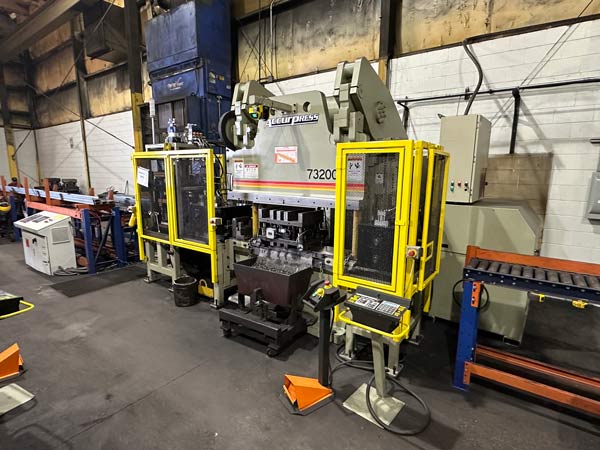
More recently, however, Advance Storage Products upped the ante, asking for support with the design and construction of an automated processing line for the horizontal beams needed to produce the company’s extensive product offerings.
“We actually built two of those lines for Advance,” Moore says. “They liked the first one so much, they asked us to make another for their Salt Lake City facility. This was a column line and it was quite similar in design.”
Established in 1958 by John Krummell Sr., Advance Storage Products is today based in Huntington Beach, Calif. It remains under Krummell family ownership – sons John, Matt and Chris assumed the role upon their father’s passing – and currently employs around 250 people across its three locations, processing a whopping 100 million lbs. of structural steel annually.
The 100,000-sq.-ft. Cedartown plant where Dowda works began operation in 2004 and, together with the newer Salt Lake City facility, produces a wide range of racking solutions. These include pushback systems that support pallet storage on both sides of an aisle, high bay and narrow storage, drive-in racking for customers with lower SKU counts, and pallet and carton flow systems, all of which rely on efficient and accurate manufacturing processes.
Reflecting on efficiency and accuracy, Dowda notes that the new column line – as with the beam line delivered a couple of years ago – has brought improvements well beyond the previously mentioned scrap reduction. Among them are far greater ergonomics, elimination of the sawing bottleneck and, due to more accurate cutting of the C-channel and angle stock used to make the racks, increased efficiency on the company’s robotic welding stations.
Beyond scrap
“You can think of these new machines as roll formers, but for structural steel rather than sheet,” he says. “And while we’d been using a crop shear to cut our beams and columns to length for many years, the machine tends to produce an edge that’s slightly out of square, giving the cut workpieces a parallelogram shape.”
It’s only a small amount, Dowda adds, but enough that the robot has to weave back and forth to fill in the gap. Since switching to the parting die that Press Room Equipment provided with the new machines – what some in the industry call a slug die – the beams now have perfectly square ends that lend themselves better to robotic welding.
“Having a clean, square edge to work with has improved our throughput quite a bit in that area,” he says.
As for the ergonomics part of the story, Dowda says the legacy process “took a lot of manpower” with workers having to muscle pieces of 4-in. channel steel up to 40 ft. long through multiple punching operations, then moving them to the aforementioned shearing step. The new machines eliminate most of this effort.

“It was very fatiguing for the operators to stand there pushing that steel into the machine all day,” he explains. “We did it that way for 10 or 12 years before approaching Gary about building a custom line.”
Moore was happy to pursue the request, but his mechanical design team had to overcome several obstacles first. Top on the list was to eliminate the parallelogram shape produced by the crop shear. This inaccuracy was slowing Advance’s downstream robotic welding cells.
“The other challenge was the factory edge on the C-channel – the ends were so rough from the crop shear they often wouldn’t fit into the punching die, so the operator had to first saw one end to clean it up before bringing the workpiece over to the punching press to punch all the holes,” he says. “This step complete, the operators would move the workpiece back to the saw for cutting to the final length. As Barry told us early on, it was very labor-intensive, and if they made a mistake, an entire length of C-channel could become scrap.”
While Press Room Equipment did the design and assembly work for the new machines, they turned to two other Bradbury Group companies – Beck Automation for the wiring and electrical componentry and Marion Die and Fixture to build the slug dies – each of which they installed on the infeed side of a 300-ton Accurpress bought specifically for this project.

Drop the crop
“Now, the operator just loads the material into the punching press ,” Moore says. “The slug die shears away the leading edge, and a set of servo feeders advance the material in programmable increments until all the punching is finished. The exit feed takes over from there, moving the workpiece to the correct position so that the slug shear can cut it to the finished length. This eliminates most of the manual loading and handling as well as the additional sawing steps they were doing with the old process; at the end of each cycle, they now have a finished product, ready for welding.”
For those scratching their head right now about the mechanics of shearing structural steel and why a slug die produces a cleaner, straighter edge than the crop shear that Advance was using in their legacy process, Moore explains that a slug die is just as its name suggests – the tool contains a blade that’s roughly 0.5 in. wide that removes a slug of material as it passes, leaving behind a nice, clean edge.
A crop shear, on the other hand, works like a pair of big scissors. The machine’s blade comes down at an angle, more or less ripping the material rather than actually shearing it. Not only does this create an edge that’s less than perfectly square, it generates burrs that interfere with the jigs used in Advance’s automated welding process.
“It was giving them a lot of quality issues,” Moore says. “In addition, the blades needed frequent sharpening or even replacement. Barry said it wasn’t unusual for them to eat up a blade in a single shift, whereas the blades that Marion Die uses have a heat-resistant coating and are made of special tool steel. Advance has replaced maybe one blade since they went into production two months ago. It’s phenomenal.”
Because of this, Dowda and his crew are now “big fans” of slug dies and have since added them to their existing beam lines.
“It’s been awesome working with these guys,” he says. “I don’t like to use the term ‘home run’ often, but that’s exactly what I told our corporate team last week. ‘This one was a home run.’ Gary and the others with the Bradbury Group did a great job building these machines for us. We’re seeing benefits both in labor reduction and better material yield, so we’re now able to put more material in front of our welders with less labor. Everything about the project has been successful.”


