

Large-format metal profiles – round, square and rectangular tube and bar as well as beams, channels and angle iron – often find their way into the world’s most massive and memorable structures. From sports stadiums and skyscrapers to suspension bridges and refineries, there is always a major need for big material.
But it’s not just high-profile projects that require large-scale material processing. Overpasses and highways; power generation, chemical processing and water treatment facilities; agricultural and mining equipment; offshore oil rigs and more all need a lot of it, too. Metal service centers and their customers are also big consumers of big material. Clearly, the world runs on large-format tube and profiles.
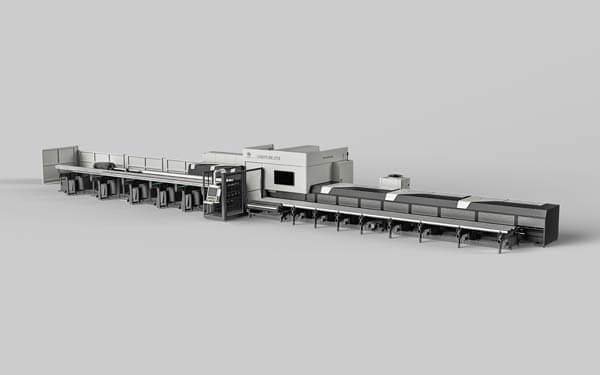
There are plenty of ways to process it, but there are few that can accommodate the accuracy required for downstream processes as well as a fiber tube laser and pipe machine. But not just any fiber tube laser and pipe machine. To overcome the challenges associated with large-format cutting, it needs to be the right machine with the right features.
“Everyone wants a fiber laser because they offer a lot of great benefits,” says Jon Todd, marketing and public relations manager at BLM GROUP USA. “But what has an even greater benefit than the fiber laser itself is the way that the machine utilizes it. BLM GROUP has developed its machines to utilize that laser in a very particular way to eliminate a lot of secondary processes and provide a lot of great value.”
Best of both worlds
Todd could be referencing any of BLM GROUP’s solid-state fiber laser-based equipment, but for the case of large-format tube and structural cutting, he’s giving a nod to the company’s LT12, the latest addition to the company’s line of jumbo tube lasers.
“The LT12 was conceived to bridge the gap between our LT8 and the LT14,” explains Lorenzo Carminato, business development manager at BLM GROUP. “The LT12 handles larger and heavier material than the LT8, but without giving up too much speed. It’s a fast machine that’s incredibly comparable to the LT8.”

Borrowing from its bigger counterparts, though, the LT12 features a chain loader similar to what is found on the LT14 and the LT24 in order to reliably handle heavy loads. For context, the LT8 features a bundle or step loader, which is suitable for smaller material.
“Bundle loaders are great because, especially with smaller tubes, one can load a great amount of material and just let the machine run,” Carminato says. “But, when it comes to larger, heavier material or open profiles like aluminum extrusions or I-beams, that type of material can’t be loaded on the bundle loader to prevent jams.”
The chain loader, however, is made up of a number of chains set in front of the tube line where material is placed. Multiple tubes can be placed on the chains at the same time, which advance the material toward a singularizer that picks up the tubes one at a time. From there, loading arms bring the material to the machine. The arms feature rollers that provide support to the material to prevent sagging and to overcome vibration and movements in the cutting area. When a chain loader is fully stocked, customers can expect 8 to 12 hours worth of processing.
“Another difference between the LT12 and the LT14 and LT24 is its two-chuck system,” Carminato says. “Typically, two-chuck systems are common on smaller machines and are known to be quick and precise, creating another speed advantage compared to larger machines.”
Critical detection
The LT12 also features a tilt cutting head and several features exclusive to BLM GROUP’s smaller machines, such as the company’s Active Scan and Active Weld – major examples of choosing the right machine with the right features. When it comes to the challenges associated with large-format cutting, such as deformations like camber, a bowing or banana effect that happens with longer material, these proprietary features are incredibly critical.
Active Scan checks for defects in the tube or its shape, which can become more of an issue the larger the diameter of the tube. When tolerances of 2 or 3 percent are considered acceptable, 2 percent of a 1-in. tube is quite different than 2 percent of a 20-in. tube.
“It would be great if tubes were always perfectly straight with no defects, but that’s never the case,” Carminato says. “Even if the incoming material isn’t the best, the LT12 can reassess the position of the cut features so that we can produce quality parts.”

Similarly, Active Weld performs a scan of the material to determine the location of the weld seam from the inside and outside of the tube to position cut features away from the weld seam or to modify cutting parameters if cutting through a weld seam is required. “Every time the laser head goes over that weld seam, it automatically boosts the power to make sure that we can cut through that thicker material,” he explains.
“The real value of these features is that they’re fully automated and exclusive to BLM GROUP,” Todd says. “When Active Scan catches an issue, it automatically adjusts all the parameters on the machine without stopping the process.”
Otherwise, an operator could essentially produce a bunch of bad parts and not know until it’s too late. When producing bad parts with small tubes, it’s still bad. But, the larger the tube, the higher the amount – and cost – of scrap. Unsurprisingly, the LT12 also features a scrap efficiency mode, which allows the machine to process until the last 4.5 in. of material.
Universal support
Understandably, some of the challenges surrounding large-format tube cutting include loading and unloading the material and then positioning and supporting it during the cutting process. To prevent the tube from moving once it’s loaded, the LT12 features a universal template for support. Carminato says even small oscillations or shaking can affect the quality of the edges and cut features.
“The universal template provides vertical support and lateral containment and automatically adjusts depending on the size and shape of the material,” he says. “Even when we have long parts where a good amount of material extends past the laser cutting head, if there are rotations, we can impede or contain what’s called a tail wag effect, which can happen when the material is rotating.”

This type of support isn’t necessary on an LT8, for example, considering lighter material doesn’t have the inertia to move or shake. For the LT14 and LT24, a three-chuck system is more than sufficient to avoid tail wagging.
Obsolete options
In addition to taking advantage of the benefits that come with BLM GROUP’s jumbo tube lasers, many customers are motivated to rid themselves of the inherent issues associated with hard tooling cutting options, such as sawing, drilling and machining. They’re also looking to sidestep the heat-affected zones and heavy dross associated with plasma processes.
Dross removal is an unpleasant, time-consuming process, but for many applications, it’s the unavoidable introduction of heat that makes plasma undesirable compared to laser cutting. Too much heat can affect the integrity of the material, create unpredictable failures and reduce the expected life of the part. The high heat input of plasma also makes the accurate cutting of smaller geometries quite challenging as it can melt the material immediately adjacent to the cut geometry and distort it.
“Plasma and even oxyfuel are still valuable processes on thicker material, say over 1 in.,” Carminato says, “but those applications are fairly niche.”
Conversely, hard tooling, such as machining, drilling and saw cutting, doesn’t inject any heat into the process; they’re just slower processes compared to laser and, surprisingly, costly when the associated consumables are taken into consideration. There’s the cost of coolant and the saw blades as well as the downtime that occurs while replacing those consumables.
Underlying efficiencies
For some, it might sound ridiculous to hear that the cost of a metal saw operation is high – especially when it’s compared to laser cutting – but there’s more to that story.
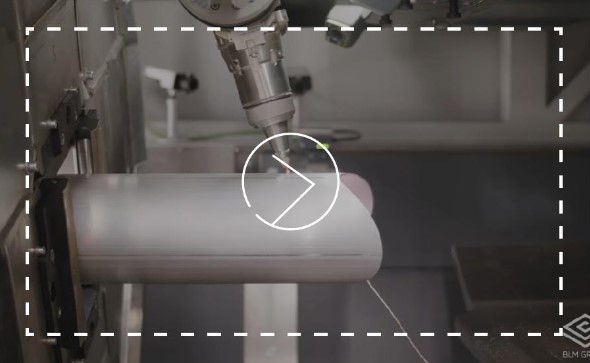
“We’ve talked to customers that bought a tube laser, and suddenly, a dozen machines on their floor are gone because the tube can just do so much,” Todd says. “People don’t always realize all the processes that a tube laser will replace. So, when ROI is in consideration, the tube laser is technically more expensive, but is it more expensive than a dozen machines and the time it costs to run and maintain them?”
Other customers that purchased a BLM GROUP tube laser reported a doubling in their production with the same number of employees – and not just because the tube laser was faster at cutting the material, but because they were able to add features to their parts on the same machine, reduce welding fixturing because of higher accuracy cuts, and minimize or eliminate other downstream operations.
While that efficiency might not necessarily be seen right at the machine, it will be more than apparent downstream with significant increases in overall throughput and quality. The ability to combine processes on one machine is a great selling point for a tube laser as is the ability to improve or remove steps downstream.
“One of the biggest benefits is the efficiency that can be generated downstream from the machine,” Carminato says. “Sure, we can process the same part quicker than other processes, but the bigger differentiator is that we can add features, such as tabs and locks, that those other machines can’t do – features that greatly improve assembly, welding and beyond. That’s where the greatest savings can be found.”


