For more than 50 years, E&E Mfg. has been stamping out a variety of heavy-gauge fasteners and components for a global automaker customer base. With its Plymouth, Mich., location in operation since 1962 and an Athens, Tenn., facility commissioned in 2004, the Tier 1 supplier opened a new plant in Decatur, Tenn., in March 2024 to expand its robotic welding capabilities.
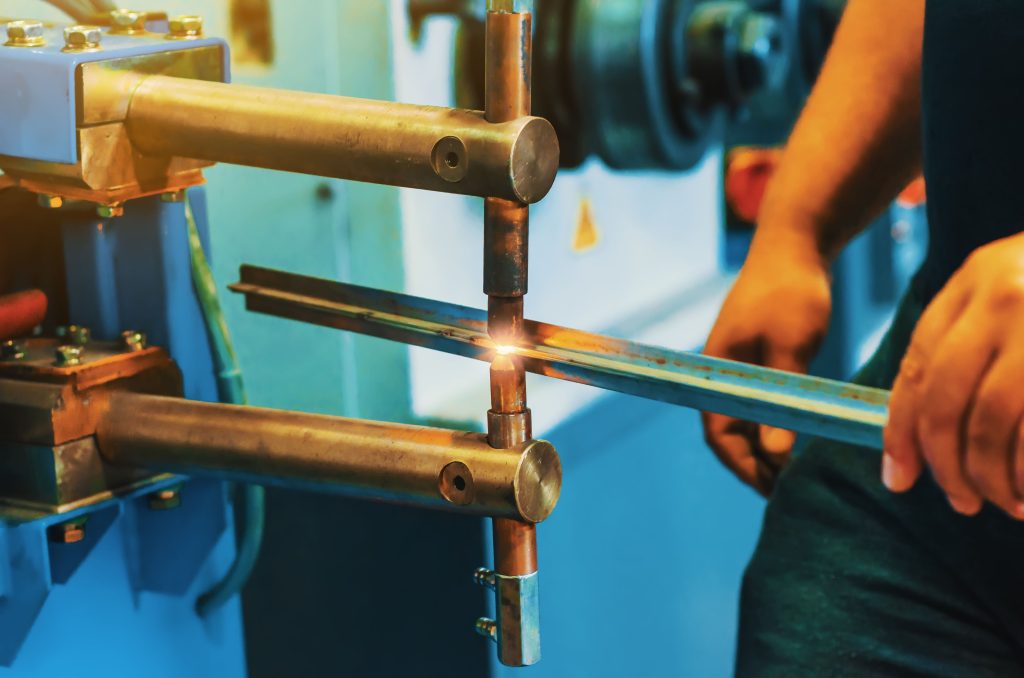
With three vertically integrated plants and a workforce of 400, E&E has the capacity to process a variety of materials from aluminum to stainless steel for domestic, foreign, luxury and military vehicle manufacturers. In the new Decatur shop, the company produces large aluminum skid plates for auto undercarriages that require spot welding, which was a new process for the company.
Vertical integration
Although spot welding is a new endeavor for E&E, the company has long specialized in high-volume stamping, using mechanical and servo presses ranging from 150 tons to 2,500 tons to service its impressive customer base. E&E’s operations include both progressive and transfer die stamping to accommodate a wide range of materials, including carbon and stainless steel, ultra-high-strength alloys and aluminum.

Playing a central role in the company’s ability to maintain tight control over its stamping operations, E&E has its own fully integrated, in-house tool and die shop. Shop workers are responsible for the design, build, maintenance and repair of tooling used across E&E’s stamping and forming operations. This vertical integration supports the company’s goal to bring “every part of the fabrication process under one roof,” while also supporting its ability to launch new programs, such as its foray into spot welding.
E&E’s in-house welding includes manual and robotic MIG welding, but as its automotive customer base continued to grow, company leadership knew it was time to expand. The company, which also has deep experience in press automation, including robotic blank feeding, shear blanking and material transfer, instinctively gravitated to Kuka Robotics, a brand which the company knows quite well.
Reliability required
Facing the new challenge of commissioning a welding cell for aluminum components, E&E partnered with Detroit-based integrator IMG for guidance. The custom automation solutions provider designed and built the complete cell at its facility, incorporating Kuka’s KR Quantec robots to weld and move the skid plates along the line. E&E’s team went to the integrator’s shop for training and to refine the cell prior to it being shipped to Decatur.
Though new to aluminum spot welding, E&E was familiar with Kuka quality and reliability.

“In our Athens plant, all we had were four Kuka robots in a welding cell for the longest time for high-speed projection welding,” says Dillon Givens, E&E’s automation technician. Working with the company’s engineering department to administer new cell implementation, Givens says the durability of Kuka’s robots was a major consideration in determining which robotic technology to use.
“The Kukas in the Athens facility have been there for years and have lasted a long time with minimal wear and tear,” he says. “Some robot manufacturers have run into gear wear and failures with their equipment, but we haven’t experienced that with Kuka.”
Optimized operations
In the Decatur shop, 24 KR Quantec robots operate as material handlers and welding gun carriers. An operator loads a table with the first fixture that has a subassembly welded to it with two spot welds. The assembly is removed from the table and flipped to receive a cover plate, then a material handling robot moves the component down the line where additional welds are performed.
The 6-axis KR Quantec industrial robots have small footprints and optimized energy supply systems, which allows for easier simulation. They are is well-suited for cost-effective cell planning, such as the one commissioned at E&E. The robots also have many software add-ons available that make them particularly adaptable to a variety of applications.

One such add-on is Kuka.RoboSpin, a package that can be added to Kuka.ServoGun software to optimize aluminum spot welding. During each weld, the workpiece is rotated around the tool center point. This rotational action prevents tip sticking and promotes longer tip life. Cycle and downtime are also reduced by not having to dress tips as often, and overall weld quality is improved in the challenging application of aluminum welding. Spin angle and time are defined numerically or via teaching, and the controller calculates the required spin velocity.
The add-on capabilities were essential in refining cell production. “We were new to this process,” Givens says, “but Kuka had the software we needed to accomplish our goals.”

Further expansions
In addition to the speed, precision and durability Kuka brought to E&E, its support played a significant role in getting the welding cell into full production mode. Kuka trained the E&E engineering and production team on the general and specific capabilities of the technology and provided ongoing support as the cell was fine-tuned.
“With any new project, there are issues to overcome,” Givens says. “If we had an issue that we simply couldn’t figure out, we could just make a call and always get someone from Kuka to jump in and help us on any issue. It’s been a real benefit having Kuka on our side, but really, there is no issue that we can’t figure out now.”
With Kuka’s history of durability at E&E’s Athens plant and the success of the new cell in Decatur, plans are in the works for Kuka to drive further automation and robotic expansion for E&E production. Several new Kuka-based robotic cell designs are currently in process across the company, and long-term plans call for additional robotic expansion capabilities over the next five years.
“As it stands right now, Kuka will be involved with every bit of that expansion,” Givens says.
With the success of the new Athens facility’s welding cells and the company’s future expansion plans, Givens says selecting Kuka as E&E’s current robot supplier was an easy choice for one simple reason.
“With the overall craftsmanship Kuka uses to build these robots along with their durability and precision, it makes our automotive manufacturing really easy,” he concludes.